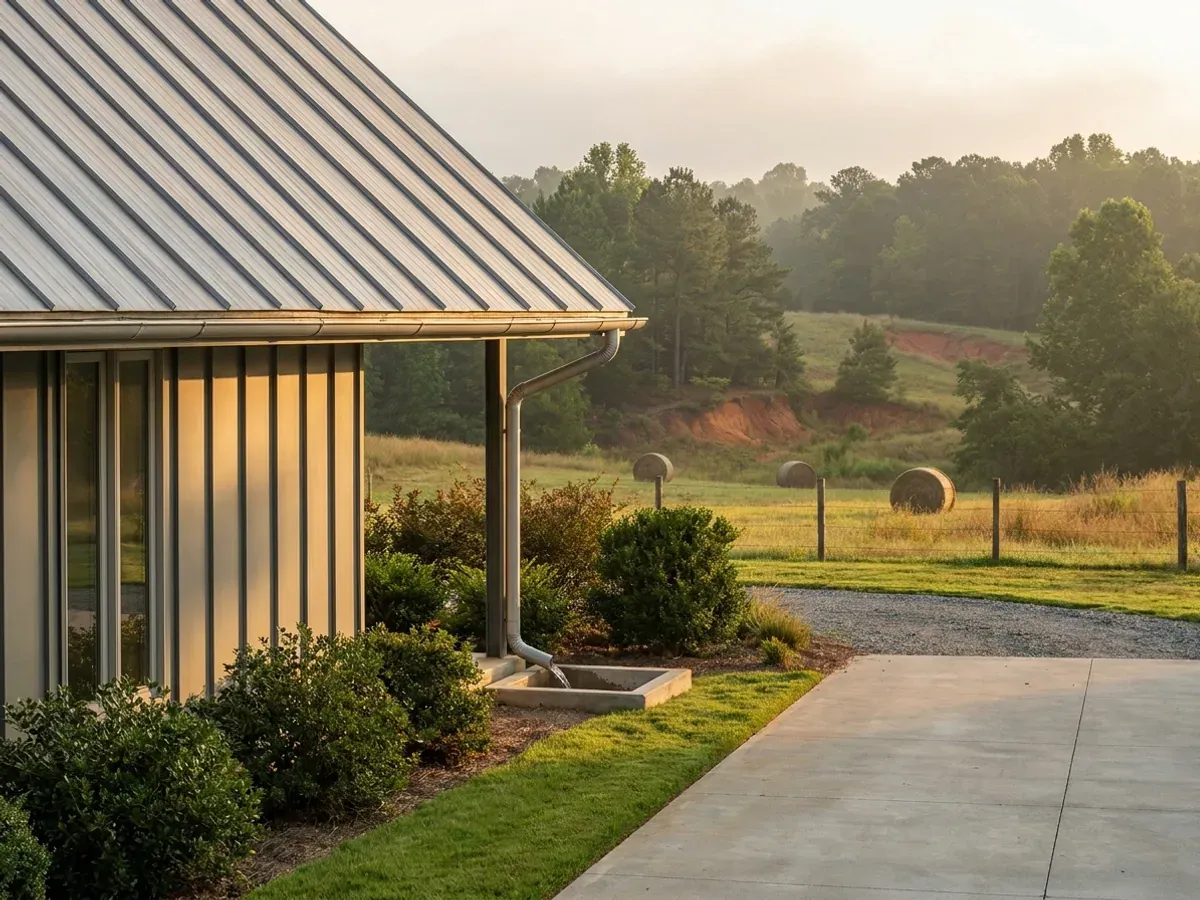
Metal Homes in South Carolina
A metal home wraps an engineered frame in a standing-seam or exposed-fastener envelope: a roof that shrugs off UV and driving rain, and a skin termites will not eat. The hard part in South Carolina is not the steel, it is what happens where the building meets the ground. Modification IRC 2021-24 rewrites Section R318.4 so that where the probability of termite infestation is "very heavy", extruded and expanded polystyrene, polyisocyanurate and other foam plastics may not be installed on the exterior face or under interior or exterior foundation walls or slab foundations located below grade — which is precisely the standard way of insulating a slab-on-grade metal building. Whether it applies is a published local determination, so it is read before the envelope is specified.
How a metal homes project runs
Four stages, in this order. The sequence matters more than it looks: getting engineering and permitting settled before anything is fabricated is what keeps a build from stalling.
Envelope and panel selection
Standing-seam or exposed-fastener, gauge, coating, finish warranty and fastener metallurgy, chosen against the exposure the site actually has rather than against a catalogue default. This is also where the conditioned footprint gets fixed, because the envelope work is priced against conditioned area and a metal building blurs that line more than a conventional house does.
Read the termite band before the insulation is specified
South Carolina does not publish a termite band at state level. The City of Charleston publishes "Very Heavy" on its own design-criteria sheet; York County publishes "Heavy" on its Table R301.2(1); and the table’s footnote leaves it to the jurisdiction, depending on whether there has been a history of local subterranean termite damage. That one entry decides whether R318.4 restricts foam below grade on your parcel, and whether R318.5’s continuous six-inch inspection strip along the sill plate has to be detailed in.
Frame, slab and dry-in
Frame erection, then roof and wall panels sealed at every penetration and transition. Termite pre-treatment lands in this window: S.C. Code Regs. § 27-1085 treats soil surfaces before the slab is poured, treats soil adjacent to exterior foundation walls within ninety days after property transfer or completion of final grade, and requires non-waivable tasks first — cellulose debris removed, wood-to-ground contact broken with treated lumber or concrete bases, shelter tubes removed.
Interior build-out and the energy documentation
Interior framing, systems and finish, with the thermal envelope detailed before drywall closes it. One thing to know about South Carolina’s energy requirement before anyone quotes an R-value at you: it is not in the residential code book. The General Assembly adopted the 2009 International Energy Conservation Code as the state energy standard by statute, effective 1 January 2013, and future updates must also come by statutory amendment. Every one of the forty-six counties sits in IECC climate zone 3A.
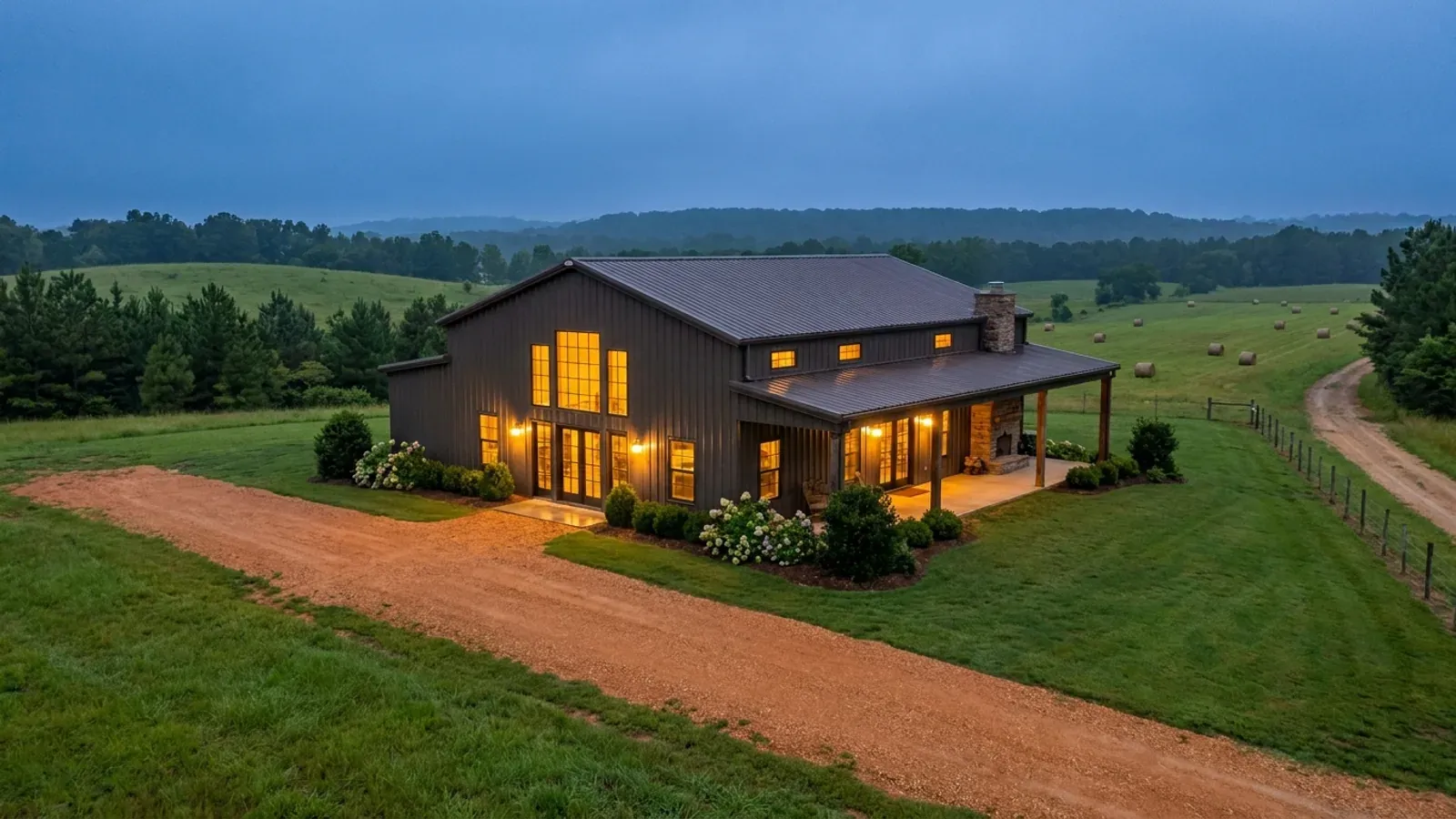
In a very heavy termite area South Carolina will not let foam plastic go below grade — and that is the standard way to insulate a slab edge
The ordinary way to insulate a slab-on-grade metal building is rigid foam at the slab edge and down the perimeter. South Carolina modified the residential code so that in some places you cannot do that. Modification IRC 2021-24, as corrected on 9 September 2022, rewrites Section R318.4: where the probability of termite infestation is "very heavy", extruded and expanded polystyrene, polyisocyanurate and other foam plastics shall not be installed on the exterior face or under interior or exterior foundation walls or slab foundations located below grade. Above grade the foam has to keep a clearance of not less than six inches to exposed earth, and in a crawl space it must leave a six-inch termite inspection gap along the top of the foundation wall and the sill plate. Modification IRC 2021-25 adds Section R318.5: where foam plastic is applied under R318.4, a continuous six-inch strip centred along the sill plate has to be left open so termite activity can be inspected. There are three exceptions — structural members that are entirely noncombustible or pressure-preservative-treated, an approved additional method of protecting the foam and the structure, and the interior side of a basement wall. Whether any of it applies to your build is a local answer, because Table R301.2's own footnote makes the termite band something the jurisdiction fills in depending on whether there has been a history of local subterranean termite damage. So this gets read before the insulation is specified, not after the concrete is ordered.
Where we deliver metal homes
In South Carolina the code is not what changes when you cross a city limit. § 6-9-10(A) makes enforcement mandatory for every municipality and every county, and § 6-9-30(A) puts the unincorporated area of each county under a building official too, so acreage outside town is covered rather than exempt. What changes is who reviews the drawings and what they ask for: § 6-9-50(A) leaves the adopted codes’ administrative chapter — permits, plan review, inspection sequencing, the board of appeals — out of the statewide adoption unless the local governing body adopts it by ordinance. And the wind and seismic criteria change on the Building Codes Council’s maps, whose boundaries § 6-9-105(C) requires to follow physical features rather than county lines. Two parcels twenty miles apart can carry completely different engineering.
Serving clients across the entire region.
Every locality we build in has its own reviewer, its own fee schedule and its own filled-in design criteria. The service area pages set out what each one publishes.
What actually decides the price
Square footage is the number everyone leads with, and it is rarely the one that moves a barndominium budget. These four do.
-
Where the metal package stops and the house starts
South Carolina draws that line inside a licence classification, which makes it unusually explicit. § 40-11-410(4)(f) defines the Contractor's Licensing Board subclassification "Pre-engineered Metal Buildings" as covering the construction of pre-engineered metal buildings "consisting of no more than a concrete floor slab, metal frame, metal roof, metal sidewalls, foundations, and building insulation; but does not include mechanical work as described in Section 40-11-410(5)." Read the words "consisting of no more than". A finished dwelling is more than slab, frame, roof, sidewalls, foundation and insulation. That subclassification describes a shell, and the difference between it and a house — interior framing, systems, finish, the whole envelope detail — is the part of the budget people leave out.
-
The termite band your own jurisdiction publishes
This one number decides whether the paragraph above bites at all, and South Carolina does not publish it at state level. The City of Charleston publishes "Very Heavy" in the termite column of its own design-criteria sheet. York County publishes "Heavy" on its Table R301.2(1). The footnote to that table says the jurisdiction shall fill in this part of the table to indicate the need for protection depending on whether there has been a history of local subterranean termite damage. So it is not uniform even on the published charts, and it is a question to put to your building department by name before the envelope is specified.
-
How the slab edge and the perimeter actually get detailed
If foam cannot go below grade on your parcel, the thermal break at the slab edge has to be solved another way, and that is a design decision rather than a material substitution. The same regulation that governs the treatment says so from the other side: S.C. Code Regs. § 27-1085 requires the operator on single-family residential construction to provide a one-year transferable warranty covering repair of damage due to subterranean termites and retreatment, and expressly does not extend that warranty to structures with rigid foam insulation below grade, untreated wood below grade, or inadequate ground clearance. The code prohibition and the warranty exclusion are pointing at the same failure mode from two directions.
-
Which energy document actually governs, and how old it is
Not the residential code. South Carolina's residential energy requirement was pulled out of the Building Codes Council's ordinary adoption process and put into statute: the General Assembly adopted the 2006 IECC as the State Energy Standard and updated it to the 2009 edition in the 2012 session by Act 143, effective 1 January 2013, and future updates must also be made by statutory amendment. The Council's own 2024 Modification Index states it plainly — pursuant to the Energy Standard Act, S.C. Code Ann. § 6-10-10 et seq., the 2009 edition of the International Energy Conservation Code has been statutorily adopted as the energy standard and is mandatory for use in all jurisdictions within the State. Modification 8-1230 reconciles the residential code's own energy chapter with it. In September 2026 that is still the standard, and only the General Assembly can move it.
Metal Homes in South Carolina: common questions
7 questions we get asked most often about building in South Carolina. If yours is not on the list, ask it directly.
Can I insulate the slab edge with rigid foam?
Who does the termite treatment, and what does South Carolina require of it?
Are Formosan termites something I need to think about?
What insulation does the code require for a metal home in South Carolina?
Does the metal envelope change the wind and seismic design?
Eleven counties do not have a Council map. What happens there?
Can a county refuse a metal house, or require something extra?
Sources
Every figure and legal reference on this page traces to a published document. These are those documents, with the date each was read.
- 1.South Carolina Building Codes Council, 2021 Modification Index, https://llr.sc.gov/bcc/PDFfiles/2021-Modification-index.pdf (application/pdf, downloaded and text layer extracted 5 September 2026) — modification IRC 2021-23, which adds a seventh permitted method to Section R318.1 naming Section 27-1085 of the Rules and Regulations for the Enforcement of the South Carolina Pesticide Control Act “and enforced by the Clemson University Department of Pesticide Regulation”; IRC 2021-24, which rewrites Section R318.4 on foam plastic protection where the termite infestation probability is “very heavy”, as corrected 9 September 2022; IRC 2021-25, which adds Section R318.5, the termite inspection strip; and IRC 2021-04 and IRC 2021-05, which substitute the Council’s county maps for the residential code’s national wind and seismic sources.
- 2.City of Charleston, “Climatic and Geographic Design Criteria” for the 2021 South Carolina Building Codes, https://charleston-sc.gov/DocumentCenter/View/18835/City-Climatic--Geographic-Design-Criteria (application/pdf, read as extracted text 5 September 2026) — ground snow 5 lb/ft², wind 150 mph, special wind region No, wind-borne debris zone 2, seismic design category D2, frost-line depth 0 inches, termite Very Heavy.
- 3.York County, “Table R301.2(1) — Climatic and Geographic Design Criteria”, http://www.yorkcountysc.gov/DocumentCenter/View/6147/Table-R30121-03_2024 (document dated 28 March 2024, read as extracted text in both layout and reading-order modes 5 September 2026) — ground snow 10 psf, wind 115 mph, special wind region No, wind-borne debris No, seismic design category B, frost line 12 in., termite Heavy, and the Table R301.2 footnotes that leave those cells to the jurisdiction to fill in.
- 4.S.C. Code of Regulations § 27-1085, Standards for Prevention or Control of Wood-destroying Organisms, https://www.law.cornell.edu/regulations/south-carolina/R-27-1085 (read 5 September 2026) — pre-construction soil treatment and the ninety-day limb, the non-waivable pre-treatment tasks and the ventilation and clearance figures, the Record of Termiticide Use retention period, the one-year transferable warranty and its exclusion of structures with rigid foam insulation below grade, and subsection (K) on the CL-100 wood infestation report and its Category 7A licence.
- 5.Clemson University Home and Garden Information Center, “Formosan Termites Increase Distribution in SC”, Eric P. Benson, PhD, article dated 6 December 2022, https://hgic.clemson.edu/formosan-termites-increase-distribution-in-sc/ (read 5 September 2026) — the sixteen counties recorded as having established Formosan subterranean termite populations as of June 2022, Clemson’s caveat that the discovery does not mean they are found uniformly throughout a county, and the note that the York and Pickens findings appear to have been isolated introductions on infested railroad ties.
- 6.S.C. Code of Laws Title 40, Chapter 11, Contractors, https://www.scstatehouse.gov/code/t40c011.php (served text retrieved and read 5 September 2026) — § 40-11-410(4)(f), the “Pre-engineered Metal Buildings” subclassification and its “consisting of no more than” scope.
- 7.S.C. Code § 6-10-30, the Energy Standard Act, which adopts the 2009 edition of the International Energy Conservation Code as the State’s Energy Standard, https://www.scstatehouse.gov/code/t06c010.php (served text read 5 September 2026).
- 8.South Carolina Building Codes Council, “2024 Final Modification Index”, https://llr.sc.gov/bcc/PDFfiles/2024%20Final%20Modification%20Index%20with%20Hyperlinks.pdf (application/pdf, 4,418,838 bytes, text layer extracted and read 5 September 2026) — the 2024-cycle modifications, the 26 August 2025 adoption and the 1 January 2027 implementation date — the Council’s statement that, pursuant to the Energy Standard Act, S.C. Code Ann. § 6-10-10 et seq., the 2009 edition of the International Energy Conservation Code has been statutorily adopted as the energy standard and is mandatory for use in all jurisdictions within the State, having been updated to that edition by Act 143 in the 2012 legislative session with an effective date of 1 January 2013 and with future updates requiring statutory amendment; and modifications IRC 2024 04 and IRC 2024 06, which move the wind and seismic sources to a national hazard tool from the 1 January 2027 implementation date.
- 9.South Carolina Building Codes Council, “2024 Combined Continued Modifications with Index”, https://llr.sc.gov/bcc/Forms/2024%20Combined%20Continued%20Modifications%20with%20Index.pdf (application/pdf, 2,084,628 bytes, text layer extracted and read 5 September 2026) — the Council staff comment on the R301.2.2.1 item recording that the hazard-by-location site the adopted code text names ceased operation on 31 December 2024.
- 10.South Carolina Building Codes Council, “Wind/Seismic Maps”, https://llr.sc.gov/bcc/maps.aspx (served HTML read 5 September 2026, 26,165 bytes) — the thirty-five counties with an approved sheet, the eleven without one, the referral to a hazard tool where no map has been approved, and the Council’s statement that the sheets are approved for the 2021 cycle based on the 2015 International Residential Code. The Beaufort County sheet, https://llr.sc.gov/bcc/PDFfiles/WSMaps/Beaufort%2015(Mays).pdf, carries the sheets’ own provenance note: the map is based on the 2015 South Carolina Residential Code and on a report to the Council by Dr Timothy Mays dated 30 June 2016. The Charleston County sheet, https://llr.sc.gov/bcc/PDFfiles/WSMaps/Charleston%2015(Mays).pdf (application/pdf, 41,242,594 bytes), carries 140 mph and 150 mph contours and seismic labels C, D0, D1 and D2.
- 11.S.C. Code of Regulations Chapter 8, the South Carolina Building Codes Council’s regulations, https://www.scstatehouse.gov/coderegs/Chapter%208.pdf (application/pdf, 324,526 bytes, text layer extracted and read 5 September 2026) — the document the Council itself links from its Statutes and Regulations page, https://llr.sc.gov/bcc/statutes.aspx — Regulation 8-236(C); Regulations 8-1202 and 8-1203, which replace the residential code’s wind and seismic sources with the Council’s previously published maps and let the local building official delineate more finely within the jurisdiction provided the result does not surpass the Applied Technology Council value; and 8-1230 on the energy chapter.
- 12.S.C. Code of Laws Title 6, Chapter 9, the Building Codes Act, https://www.scstatehouse.gov/code/t06c009.php (served text retrieved and read 5 September 2026) — § 6-9-10(A) (“enforce only”), § 6-9-100 (the chapter is cumulative to other local ordinances and does not limit the authority of counties or municipalities) and § 6-9-105 (a locality petitioning the Council for a variation on grounds of local physical or climatological conditions).
- 13.South Carolina Building Codes Council, “2021 South Carolina Code Adoptions”, https://www.llr.sc.gov/bcc/pdffiles/SC-Code-Adoption-Notice.pdf (application/pdf, 166,618 bytes, text layer extracted and read 5 September 2026) — “Only the modifications approved and listed on the Council’s website are valid for use in the State. Building code modifications that have not been approved by the Council are invalid and cannot be adopted, employed or enforced by municipalities and counties.” The one granted local residential modification under the 2021 codes — Greenville County’s radon control appendix — is listed at https://llr.sc.gov/bcc/BCAdoption.aspx.
Keep reading
The pages that answer the next question this one raises.
Ready to put metal homes against a real plan? Start there and the rest follows.
Tell us about the land
Send the parcel ID or an address and we will come back with what can be built on it, the wind load it has to meet, and a realistic budget range. That conversation costs nothing.