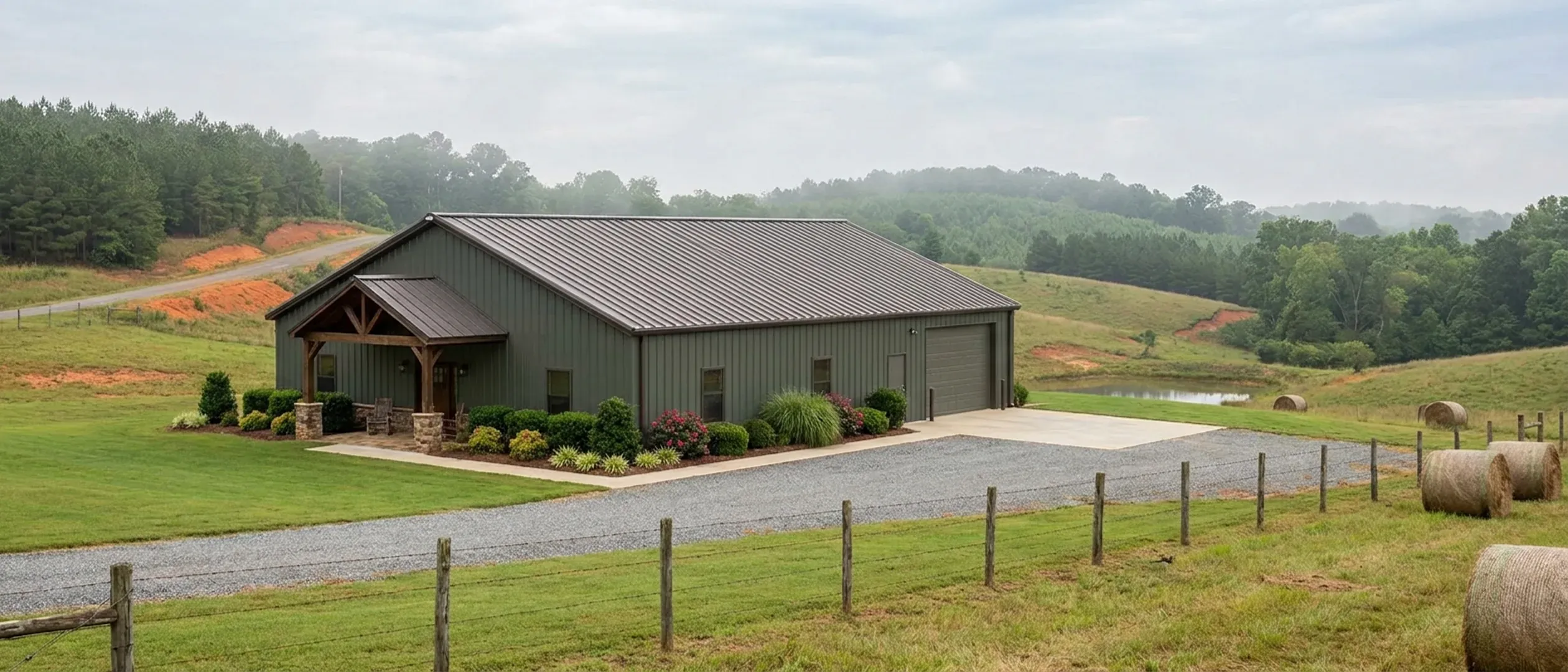
Barndominium Financing in South Carolina: Loans, Appraisal and Insurance
Most of the difficulty in financing this building type is a classification problem wearing a lending problem's clothes. A lender's first question is what the thing is, and 'metal building' is not an answer any loan product recognises. South Carolina answers it precisely, in three separate statutes and one regulation, and the answer is good: a conventional barndominium kit is open construction, which means it is not a modular building unit, and it has no permanent chassis, which means it is not a manufactured home. It is a site-built dwelling erected from a materials package, permitted and inspected locally under the South Carolina Residential Code and certified for occupancy by a registered building official - real property, on the same footing as any other house. This page sets out the classification, the paperwork a lender and an appraiser will want, the bonds and licence caps a South Carolina builder actually carries, and the insurance position, which is not what most contractor marketing implies.
Figures on this page are cited third-party or government data, not a quote from South Carolina Barndominium Builders.
Bottom Line Up Front
- Regulation 8-602(19) defines open construction as an assembly whose parts 'can be readily inspected at the installation site without disassembly.' A kit of frames, purlins, panels and fasteners is open construction, so the Modular Buildings Construction Act does not reach it - and a barndominium has no permanent chassis, so the manufactured-housing statute does not either. It is a site-built house.
- S.C. Code Section 40-59-30(B) strips an unlicensed builder of the mechanics' lien and of any action at law or in equity to enforce the contract, with no good-faith exception - and Section 40-11-200(B) makes it a violation for the OWNER to sign a contract with an unlicensed contractor. Verifying the licence is a lending-risk step, not a courtesy.
- Neither South Carolina contractor licence requires liability insurance and neither requires workers' compensation. The word 'insurance' does not appear anywhere in Title 40 Chapter 11. Workers' comp becomes mandatory only at four or more regularly employed employees under Section 42-1-360(2). A surety bond is not insurance.
- Two named counties have earned flood-insurance discounts through FEMA's Community Rating System: Colleton County publishes a Class 7 rating worth a 15 percent premium reduction, and Richland County's standing gives residents an automatic 10 percent discount.
Verifying the builder, which South Carolina makes a financial question rather than a courtesy
In most states this is diligence. Here the statute puts real money on it, in both directions.
An unlicensed builder cannot enforce the contract, and cannot lien
S.C. Code Section 40-59-30(B) provides that a person or firm required to be licensed and not licensed 'may not file a mechanics' lien or bring an action at law or in equity to enforce the provisions of a contract for residential building or residential specialty contracting which the person or firm entered into in violation of this chapter.' It overrides Section 29-5-10 by name to do it. Section 40-11-370(C) does the same on the general-contractor side, and goes one step further: a firm that contracts 'in a name other than the name that appears on its license' may not bring an action either. There is no good-faith exception written into either provision.
And the owner is in the frame too
Section 40-11-200(B) makes it 'a violation of this chapter for an awarding authority, owner, contractor, or an agent... to consider a bid, sign a contract, or allow a contractor to begin work unless the bidder or contractor has first obtained the licenses required by this chapter', and adds that bids or contracts 'may not be reconsidered or resubmitted' if the contractor was not properly licensed when the initial bid or contract was submitted. Section 40-11-300(B) requires an entity working without the required licence to 'immediately withdraw from the construction project' and bars it from acting as a subcontractor on that project. That is a commercial reason to ask for the number, not merely a prudent one.
The building official is required to check, and to report
Section 40-59-280 provides that the building official 'shall refuse to issue a permit for an undertaking which requires licensure or registration under this chapter unless the applicant has furnished evidence that he is either licensed or registered in accordance with this chapter or exempt', and 'also shall report to the commission the name and address of any person who, in his opinion, has violated this chapter.' Section 40-11-350 is the equivalent for the general-contractor chapter. So the permit counter is a licence checkpoint as well as a plans checkpoint.
How to check it yourself, and the vocabulary to use
South Carolina runs two boards, both inside the Department of Labor, Licensing and Regulation. The Residential Builders Commission licenses residential builders under Title 40 Chapter 59; the Contractor's Licensing Board licenses general and mechanical contractors under Chapter 11. Each has its own licensee lookup on LLR's verification site, reached from that board's page, and each is a form a person completes in a browser rather than something that can be checked in bulk. Note two vocabulary traps. A residential builder's licence is held by an INDIVIDUAL - Section 40-59-410(B)(3) says a licence 'may not be held by a firm' - and a firm holds a separate residential business certificate of authorization instead, which is its own searchable record. And the South Carolina terms are 'residential builder', 'residential specialty contractor', 'General Contractor - Building' and 'License Group One' to 'Five'; the class-letter vocabulary used in some other states does not exist here.
The licence group is a bid cap, and it bites on offering
On the Chapter 11 side the licence carries a per-job financial ceiling. Section 40-11-260 sets General Contractor Group One at bids and jobs not to exceed $100,000, Group Two $400,000, Group Three $1,000,000, Group Four $3,000,000 and Group Five unlimited, each against a net-worth or working-capital test - $20,000 or $10,000 for Group One rising to $350,000 or $250,000 for Group Five. Section 40-11-280 lets the board penalise a licensee who 'undertakes or offers to undertake' work exceeding its group, and Section 40-11-300(A) makes it unlawful 'to divide work into portions so as to avoid the financial or other requirements of this chapter', adding that 'The total cost of construction must be used to determine the appropriate license group for a project.' If a Chapter 11 contractor is bidding your job, the group is the number to ask for.
A residential builder's licence has no upper dollar limit at all
This is the correction most worth making against what circulates online. There is no dollar figure at which the Contractor's Licensing Board 'takes over' for a house. Section 40-59-270 makes the Residential Builders Commission 'the exclusive licensing and registration entity for persons who engage solely in residential building and in residential specialty contracting', and the residential builder's limits are structural rather than financial - a residential building 'not over three floors in height' with 'not more than sixteen units in any single apartment building'. The only dollar numbers in Chapter 59 are floors: $5,000 below which the chapter does not bite, and $500 for residential specialty work. A large single-family barndominium is still residential building.
Bonds, and what they are not
South Carolina requires bonds of its licensed builders. It does not require insurance of them, and the two are routinely confused in contractor marketing.
The residential builder's bond: not less than $15,000
Section 40-59-220(C) requires an applicant for a residential builder's licence to file a surety bond of not less than $15,000, or 'proof of financial responsibility acceptable to the commission'. Section 40-59-410(B)(2) requires a firm holding a residential business certificate of authorization to post 'an executed surety bond approved by the commission in the sum of fifteen thousand dollars initially and as subsequently provided by regulation.' Section 40-59-230(A) makes the licence renewable annually with proof of financial responsibility or bond. So an individual builder and the firm they trade through may each carry a bond, and they are separate records.
The specialty contractor's bond, and when it engages
Regulation 106-2 requires a residential specialty contractor, once an undertaking for an individual owner exceeds $5,000, to post 'an executed surety bond in an amount approved by the Commission not less than ten thousand dollars.' The statute at Sections 40-59-220(D) and 40-59-240(D) says only 'an amount approved by the commission', so the ten-thousand figure comes from the regulation. Note the scope limit that goes with it: Section 40-59-20 prohibits a residential specialty contractor from 'undertaking work outside the scope of his license or registration, including employing, hiring, and contracting or subcontracting with others to perform such work on his behalf.' A specialty registration is not a general-contractor workaround.
The general contractor's bond changed in 2023, and stale sources still print the old figure
Section 40-11-262(A) allows a Chapter 11 applicant to provide a surety bond in lieu of a financial statement, 'in the same amount as the net worth for the applicant's license group'. The section's own effect-of-amendment note records that 2023 Act No. 69 substituted 'in the same amount as the net worth' for 'in an amount of two times the required net worth.' Any source telling you the bond is twice the net worth is describing the pre-May-2023 rule. The same Act moved the Chapter 11 threshold from $5,000 to $10,000, so a source printing $5,000 for the general-contracting threshold is at least three years out of date as well.
A bond is not insurance, and it does not work the way people assume
A surety bond protects the customer, and the principal has to reimburse the surety. It is a credit instrument with a claims process, not a policy that absorbs a loss. The bond Section 40-11-262 describes must 'list the State of South Carolina as obligee' and be 'for the benefit of any person who is damaged by an act or omission of the applicant constituting a breach of construction contract... or by any unlawful act or omission of the applicant in performing construction', and it is 'in addition to, and not in lieu of, any other surety bond required of the applicant by law or regulation.'
And South Carolina has no state recovery fund of the kind some states run
Neither Title 40 Chapter 11 nor Title 40 Chapter 59 establishes a consumer recovery fund financed by licensees. What the boards do have are administrative citation powers that reach unlicensed people expressly: Section 40-59-105 lets LLR issue citations and cease-and-desist orders and assess penalties 'including unlicensed persons', capped at $500 for a first offence and $2,500 per day in aggregate, with second offences referred to the commission; Section 40-11-100 is the equivalent on the contractor board's side, with a $1,000 second-violation ceiling and the same $2,500 daily cap. Those are enforcement tools, not a source of compensation.
Insurance, which belongs on a financing page and is not what marketing implies
The single most repeated phrase in contractor advertising describes two unrelated things, and in South Carolina only one of them is a licensing fact.
Neither South Carolina licence requires liability insurance
The word 'insurance' does not appear anywhere in Title 40 Chapter 11. Section 40-11-240, which lists the complete set of submissions required for licensure, contains no insurance item, and the Contractor's Licensing Board's own licensure page frames financial responsibility entirely as 'Financial Statement or Surety Bond'. On the residential side insurance appears once and only permissively: Section 40-59-220(B) lists what the commission 'may consider' in examining an applicant, and item (6) is 'workers' compensation insurance'. 'May consider' is not 'must hold'. The Residential Builders Commission's regulations at Chapter 106 impose no general liability requirement and no workers' compensation requirement.
Workers' compensation starts at four employees, not at one
Workers' comp is a separate statute, Title 42, and not a licensing condition. Section 42-1-360(2) exempts from the title 'any person who has regularly employed in service less than four employees in the same business within the State or who had a total annual payroll during the previous calendar year of less than three thousand dollars regardless of the number of persons employed during that period.' So a small South Carolina builder with three employees and subcontracted trades may lawfully carry no workers' compensation at all and still hold a perfectly valid residential builder's licence. Section 42-1-380 lets any exempt employer opt in voluntarily. Ask, in writing, and ask for the certificate rather than the assurance.
Why the two words in that stock contractor phrase should be read separately
The two halves come from unrelated bodies of law administered by unrelated bodies. Licensure is a checkable state record held by a named board. Insurance is a private contract that no South Carolina licensing body requires, verifies or records. A firm can be entirely truthful about the first and carry nothing behind the second, and the compound phrase invites a reader to treat one as evidence of the other. Ask for the licence number and check it, and ask separately for a certificate of insurance naming you, with the policy period on it.
Flood insurance, where two named counties have earned real discounts
The National Flood Insurance Program in South Carolina is administered by the South Carolina Department of Natural Resources Flood Mitigation Program. Two counties on this site publish their standing under FEMA's Community Rating System. Colleton County states that it 'is currently rated as a Class 7 community; therefore, residents receive a 15% premium reduction.' Richland County has taken part in the NFIP since 1979 and its Community Rating System standing gives residents an automatic 10 percent discount. Both are real numbers on a thirty-year cost of ownership in counties where flood zones are common, and both are the county's own published figure rather than an estimate.
The elevation certificate is the document the premium runs on
Colleton County identifies the Elevation Certificate, completed by a South Carolina registered surveyor, engineer or architect, as the key document and keeps them on file. Anderson County Section 24-663 and Berkeley County Section 26-63(b) both require the lowest-floor certification as soon as the lowest floor is complete and before further vertical construction - Berkeley adds that work done before it is submitted is at the permit holder's risk. The City of Charleston requires both an Under Construction and a Finished Construction certificate, prohibits dry floodproofing in residential buildings outright, and requires everything mechanical, electrical, plumbing and gas, ductwork included, at or above the design flood elevation. Get the certificate as the ordinance requires it rather than at closing, because retrofitting an elevation is not a paperwork exercise.
Substantial damage, which is a fifty-percent rule and not a flood-only rule
Colleton County publishes the rule most people are surprised by: a structure damaged to 50 percent or more of its pre-damage market value 'must be repaired to meet the same construction requirements as a new building, including elevation requirements' - and that includes damage of any origin, fire and wind as well as flood. On a building sitting below current freeboard requirements, that is a repair-versus-rebuild question decided by an ordinance rather than by an adjuster, and it belongs in the same conversation as the premium.
Cash timing, and the lines a draw schedule has to anticipate
Construction lending is a sequence of releases against milestones, and South Carolina puts several fixed obligations at points a generic schedule does not expect.
Fees that fall at permit issue rather than at completion
Inside the Fort Mill School District, York County collects a $29,640 school impact fee on a new single-family dwelling when the residential building permit issues; inside the Clover School District it is $8,000; elsewhere in the county there is none. Kershaw County Section 6-258 fixes its development impact fee 'at the time of application for a building permit' and requires it remitted 'prior to the issuance of a certificate of occupancy'. York County also charges $350 per disturbed acre for a Land Disturbance Permit and plan review. These land before any construction draw and they are not part of any published per-square-foot rate.
The professional fees that come before the permit
The sealed drawings, the site and soil evaluation, and the survey all precede the permit and therefore precede the first draw on most construction facilities. SCDES's site evaluation fee is $150.00 per site under Regulation 61-56 Section 102, and where a privately hired Professional Soil Classifier is used, SCDES caps a classifier contracting with the Department at three times the Department's permitting fee per site while stating that a privately negotiated fee is a private contract. The engineer's fee is a professional fee and nobody publishes a figure for it. Plan a pre-construction cash requirement rather than assuming the facility covers it.
Milestones a lender can actually inspect against
Because the building is site-built, the inspection record is the natural draw trigger. Richland County Code Section 6-53 is the only published turnaround commitment on this site - first and second inspections within three working days of a properly noticed request, final within five - which makes a Richland County build unusually easy to schedule draws against. The City of Charleston's own accessory-structure guidance lists foundation, sheathing, strapping, framing and tie down, and final as separate hold points. Berkeley County Section 11-61 blocks the certificate of occupancy until water and sewer tap receipts or final septic approval, all elevation certificates and all fees are in, so the final release has four independent predecessors there.
The owner-builder route, and the two-year clock it starts
Section 40-59-260 exempts an owner who builds for their own or their family's sole occupancy, not for sale or rent, with no public access - but the conditions are procedural and they matter to a title file. Section 40-59-260(C) requires the owner to 'personally appear and sign the building permit application'. Section 40-59-260(E) requires the owner to 'promptly file as a matter of public record a notice with the register of deeds, indexed under the owner's name in the grantor's index, stating that the residential building or structure was constructed by the owner as an unlicensed builder', and states that 'Failure to do so revokes the statutory exemption.' Section 40-59-260(B) makes proof of sale, rent or 'the offering for sale or rent' within two years of completion or certificate of occupancy prima facie evidence the project was undertaken for sale. Kershaw County writes the two-year restriction into ZLDR Section 4:1.5 directly. And Section 40-59-260(F) is the limit: the exemption covers the owner and does not permit the owner to hire anyone unlicensed.
One county can decide when you start
Kershaw County has run a Building Permit Allocation System since 13 May 2026, publishing a tracker of permits issued each Monday. A facility with a drawdown commencement date is exposed to that in a way it is not exposed to an ordinary review queue, because the constraint is an allotment rather than a workload. Ask the Planning and Zoning department where the tracker stood before a closing date is agreed.
Reading this because you are weighing a build? The next step is a plan drawn for your program.
What's different about South Carolina
The classification, in the state's own words - and it is three regimes, not one
South Carolina runs three legally distinct regimes for a building, and confusing them is the most common lending mistake on this type. Site-built dwellings sit under Title 6 Chapter 9, the Building Codes Act, permitted and inspected by a registered local building official. Modular buildings sit under Title 23 Chapter 43, the Modular Buildings Construction Act of 1984, inspected at the factory by a Council-approved agency and carrying a Council certification label. Manufactured homes sit under the federal HUD code and Title 40 Chapter 29, regulated by a separate Manufactured Housing Board. Different statutes, different agencies, different evidence of compliance - and different loan products.
Why a kit lands in the first regime and not the second
The whole question turns on one defined term, and South Carolina defines both sides of it. Regulation 8-602(5) defines closed construction as the condition 'when any building, component, assembly, subassembly, or system is manufactured in such a manner that all portions cannot be readily inspected at the erection site without disassembly.' Regulation 8-602(19) defines open construction as manufacture 'in such a manner that all parts or processes of manufacture can be readily inspected at the installation site without disassembly.' A barndominium kit is columns or rigid frames, trusses, purlins, girts, bracing, sheet panels, fasteners and trim, shipped loose and erected on site. Every part of it can be walked up to and looked at by the inspector without taking anything apart. That is open construction, so it is not a 'modular building unit', it carries no Council certification label, and the supplier needs no modular licence for it. The line is factual rather than nominal: a pre-finished wall panel with concealed wiring, or a factory-built bathroom pod, would cross it whatever the seller calls the package.
And why it is not a manufactured home either
Section 40-29-20(9) defines a manufactured home as a structure 'transportable in one or more sections which, in the traveling mode, is eight body feet or more in width or forty body feet or more in length or when erected on site is three hundred twenty or more square feet and which is built on a permanent chassis.' The permanent chassis is the tell, and a barndominium has none. Regulation 8-601(3) makes the exclusion explicit from the other direction, and Section 6-9-10(C) keeps the two regimes from colliding. The practical consequence is the one that matters to a loan file: there is no chattel question here, no HUD label, no installer licence and no de-titling exercise. The building is realty from the first pour.
The evidence a lender's file actually wants, and where each piece comes from
Because the building is site-built, the compliance evidence is ordinary: a local building permit, the inspection record, and a certificate of occupancy from a registered local building official. Add to that the sealed construction documents, which in South Carolina are not optional for this building type - modification IRC 2021-01 sends any design varying from the code's prescriptive methods to 'a South Carolina licensed Architect or Engineer', and Section 40-22-270(8) makes the building official refuse the permit without evidence of the seal. Where the parcel is in a special flood hazard area, add the elevation certificates: Anderson County Section 24-663 and Berkeley County Section 26-63(b) both require a lowest-floor elevation certification prepared by or under the direct supervision of a registered land surveyor or professional engineer, and the City of Charleston requires both an Under Construction and a Finished Construction certificate.
Mixed use is the appraisal crux, and in South Carolina it is a zoning answer
A dwelling with a large workshop attached raises a use question before it raises a valuation one, and the answer differs by jurisdiction rather than by state. Chester County's home-occupation conditions are specific enough to design around: the occupation must be conducted inside the dwelling by resident family members and may use 'not more than 25% of total dwelling floor area, or 50% of an accessory building', with no change in exterior appearance, no outside display and no sale of products except those made on the premises. Kershaw County ZLDR Section 3:2.5-2(B) bars using an accessory building in a residential district for storage in connection with a trade without an approved home occupation permit. Greenville County's Section 5:16.6 permits workshops for the repair and maintenance of agricultural equipment as an accessory use in AG while excluding a commercial repair shop. If the shop is for your own use, say so and design to those limits; if it is a business, the zoning answer comes before the loan application.
The paperwork the money is actually contingent on: the septic answer
On rural acreage the most common reason a purchase or a draw stalls is not the building. SCDES permits onsite wastewater under Regulation 61-56, judges suitability on soil morphology rather than a percolation test, and Section 104.1(7) lets the Department refuse a permit where site conditions are unsuitable for the system requested. Section 200.2 makes soils with massive or platy structure, or substantial expansible layer clay minerals or smectites, unsuitable outright. SCDES's own land-buying page says it plainly: 'not all property is suitable for a septic system.' It also warns that an onsite wastewater permit cannot issue where public sewer is accessible, which catches edge-of-town acreage that feels rural. A financing contingency written around the septic evaluation is the single most useful clause on a South Carolina land contract.
Pros and cons, honestly
Pros
- The classification is clean. Regulation 8-602(19) makes a kit open construction, so it is not a modular building unit, and with no permanent chassis it is not a manufactured home. It is a site-built house and it is real property.
- The compliance evidence is ordinary: a local building permit, an inspection record and a certificate of occupancy from a registered local building official - the same file any conventional house produces.
- Sealed engineering is required for this building type in South Carolina anyway, so a lender's file usually contains a stamped structural design that a conventional stick-built file does not.
- A residential builder's licence carries no upper dollar limit, so there is no threshold at which the project has to be re-tendered to a different class of contractor.
- The licence itself is a checkable state record, and Section 40-11-370(B)'s exact-name rule means a Chapter 11 contractor's advertised name should match the name on the licence - a mismatch is itself a finding.
- Colleton County publishes a Community Rating System Class 7 standing worth a 15 percent flood-insurance premium reduction, and Richland County's standing gives an automatic 10 percent discount.
Cons
- Neither South Carolina contractor licence requires liability insurance, and neither requires workers' compensation - which becomes mandatory only at four or more regularly employed employees under Section 42-1-360(2).
- There is no South Carolina consumer recovery fund financed by licensees. The boards have citation and cease-and-desist powers, not a compensation pot.
- An unlicensed builder's contract is unenforceable and carries no mechanics' lien under Section 40-59-30(B), with no good-faith exception - and Section 40-11-200(B) puts the owner in violation for signing it.
- A large part of the cost falls before the permit issues: sealed drawings, the site and soil evaluation, the survey and, in two York County school districts, an impact fee at permit issue rather than at completion.
- The septic evaluation can end a purchase rather than delay it. Regulation 61-56 Section 200.2 makes smectitic and massive or platy soils unsuitable for onsite wastewater outright.
- If the shop is a business rather than a hobby, the home-occupation limits engage - 25 percent of the dwelling's floor area or 50 percent of an accessory building in Chester County, and an approved permit in Kershaw County.
- An owner-builder who does not file the Section 40-59-260(E) deed notice loses the statutory exemption retroactively, and cannot sell, rent or even offer the house within two years without triggering the statutory presumption.
Is a barndominium harder to finance than a conventional house in South Carolina?
Is a barndominium a manufactured home?
Is a barndominium kit a modular building?
What will an appraiser want to see?
How do I check that a South Carolina builder is licensed?
Does South Carolina require my builder to carry insurance?
What happens if my builder turns out not to be licensed?
Do I need flood insurance, and can I reduce the premium?
Can I run a business out of the shop?
Can I act as my own builder and finance it?
Are there any state grants or programmes worth knowing about?
Does the 2027 code change affect a loan already in progress?
Questions answered? Tell us what you want to build and we will put real numbers against it.
Sources
Every figure and legal reference on this page traces to a published document. These are those documents, with the date each was read.
- 1.S.C. Code of Regulations Chapter 8 (Building Codes Council), Regulations 8-601(3), 8-602(5) and 8-602(19), https://www.scstatehouse.gov/coderegs/Chapter%208.pdf (read in full 5 September 2026) — 8-602(19) defines open construction as manufacture “in such a manner that all parts or processes of manufacture can be readily inspected at the installation site without disassembly”, and 8-602(5) defines closed construction as its opposite. That pair is the whole of the classification argument on this page.
- 2.S.C. Code § 23-43-20(2), Modular Buildings Construction Act of 1984, https://www.scstatehouse.gov/code/t23c043.php, and § 40-29-20(9), Manufactured Housing Board, https://www.scstatehouse.gov/code/t40c029.php (both read 5 September 2026) — the closed-construction definition of a modular building unit, and the permanent-chassis definition of a manufactured home. A kit-built barndominium fails both tests, which is why it is site-built real property.
- 3.S.C. Code Title 40 Chapter 59, Residential Builders — §§ 40-59-20, 40-59-30(A) and (B), 40-59-105, 40-59-220(B), (C) and (D), 40-59-230(A), 40-59-240, 40-59-260(B) to (F), 40-59-270, 40-59-280 and 40-59-410(B), https://www.scstatehouse.gov/code/t40c059.php (served chapter text fetched and read 5 September 2026) — § 40-59-30(B) provides that an unlicensed person or firm “may not file a mechanics' lien or bring an action at law or in equity to enforce the provisions of a contract”, overriding § 29-5-10 by name, and the chapter contains no good-faith exception to it. § 40-59-220(B) lists workers' compensation insurance only among the items the commission “may consider”.
- 4.S.C. Code Title 40 Chapter 11, Contractors — §§ 40-11-20, 40-11-100, 40-11-200(A) and (B), 40-11-240, 40-11-260, 40-11-262, 40-11-280, 40-11-300, 40-11-350 and 40-11-370, https://www.scstatehouse.gov/code/t40c011.php (the whole served chapter text fetched and searched 5 September 2026: the word “insurance” occurs nowhere in it, and § 40-11-240, which lists the complete set of submissions required for licensure, contains no insurance item). § 40-11-200(B) makes it a violation for an awarding authority, owner, contractor or agent to consider a bid, sign a contract or allow a contractor to begin work without the required licence, and § 40-11-262(A)'s effect-of-amendment note records that 2023 Act No. 69 substituted “in the same amount as the net worth” for the previous two-times-net-worth bond rule.
- 5.S.C. Code of Regulations Chapter 106, Residential Builders Commission, https://www.scstatehouse.gov/coderegs/Chapter%20106.pdf (read in full 5 September 2026) — R.106-2's not-less-than-ten-thousand-dollar specialty bond once an undertaking for an individual owner exceeds $5,000. The chapter runs 106-1 to 106-5 and imposes no general liability insurance requirement and no workers' compensation requirement.
- 6.South Carolina Department of Labor, Licensing and Regulation, Contractor's Licensing Board licensure requirements, https://llr.sc.gov/clb/clb_licensure.aspx (read 5 September 2026) — the board's own financial-responsibility headings are “Financial Statement or Surety Bond” and “Surety Bond Requirement”, and the page does not use the word “insurance” at all. Note that this host answers a missing path with HTTP 200 and a short splash page, so a reading here rests on the served content rather than on the status code.
- 7.S.C. Code §§ 42-1-360 and 42-1-380, South Carolina Workers' Compensation Law, https://www.scstatehouse.gov/code/t42c001.php (read 5 September 2026) — § 42-1-360(2) exempts from the title any person who “has regularly employed in service less than four employees in the same business within the State or who had a total annual payroll during the previous calendar year of less than three thousand dollars”, and § 42-1-380 lets an exempt employer opt in voluntarily. Workers' compensation is a Title 42 question, not a licensing condition.
- 8.Licensee verification: Residential Builders Commission licensee lookup, https://verify.llronline.com/LicLookup/Resbu/Resbu.aspx?div=46, and Contractor's Licensing Board licensee lookup, https://verify.llronline.com/LicLookup/Contractors/Contractor.aspx?div=69 (both live browser search forms, checked 5 September 2026); board landing pages at https://llr.sc.gov/res/ and https://llr.sc.gov/clb/. Each lookup is a form a person completes; neither is a bulk-checkable list.
- 9.S.C. Code §§ 40-22-270(8) and 40-22-280, https://www.scstatehouse.gov/code/t40c022.php (served text read 5 September 2026), with South Carolina Building Codes Council, 2021 Modification Index, https://llr.sc.gov/bcc/PDFfiles/2021-Modification-index.pdf for modification IRC 2021-01's definition of accepted engineering practice — the sealed structural design a South Carolina permit requires for this building type, which is why a compliant file usually carries one.
- 10.S.C. Code of Regulations R.61-56, Onsite Wastewater Systems, https://des.sc.gov/sites/des/files/Library/Regulations/R.61-56.pdf (application/pdf, 4,282,530 bytes, downloaded and read as text extracted with pdftotext -layout, 5 September 2026) — § 102 the $150.00 site evaluation fee, § 104.1(7) the Department's power to refuse a permit where site conditions are unsuitable for the system requested, and § 200.2 the outright unsuitability of soils with massive or platy structure or substantial expansible layer clay minerals or smectites. S.C. Department of Environmental Services, “Before You Buy Land”, https://des.sc.gov/permits-regulations/septic-tanks/homeowner-resources/you-buy-land carries SCDES's own “not all property is suitable for a septic system” and the warning that a permit cannot issue where public sewer is accessible. SCDES Professional Soil Classifiers, https://des.sc.gov/permits-regulations/septic-tanks/professional-soil-classifiers.
- 11.Colleton County Planning & Development, Floodplain Management, https://www.colletoncounty.org/planning-development/floodplain-management (read 5 September 2026) — the county “is currently rated as a Class 7 community; therefore, residents receive a 15% premium reduction” under FEMA's Community Rating System, the Elevation Certificate completed by a South Carolina registered surveyor, engineer or architect as the key document, and the 50-percent substantial-damage rule that applies to damage of any origin.
- 12.Richland County Flood Zone Verification form, https://www.richlandcountysc.gov/files/assets/county/v/1/planning-development/documents/fzv_request.pdf (application/pdf, 146.7 KB, read 5 September 2026), and Richland County Flooding, https://www.richlandcountysc.gov/Property-Business/Comprehensive-Planning/Flooding — participation in the National Flood Insurance Program since 1979, the Community Rating System standing that gives residents an automatic 10 percent discount, and the two-foot finished-floor requirement.
- 13.South Carolina Department of Natural Resources Flood Mitigation Program, https://www.dnr.sc.gov/water/flood/ (read 5 September 2026) — the state agency that administers the National Flood Insurance Program in South Carolina; flood insurance maps at https://www.dnr.sc.gov/water/flood/floodinsurancemaps.html.
- 14.Anderson County Code § 24-663 (Flood Damage Prevention), https://www.andersoncountysc.org/wp-content/uploads/2022/03/FLOOD_DAMAGE_PREVENTION_Standards_AndersonSC.pdf (application/pdf, 246,215 bytes, read 5 September 2026); Berkeley County Code §§ 11-61, 26-63 and 26-71, https://library.municode.com/sc/berkeley_county/codes/code_of_ordinances (read 5 September 2026) — the lowest-floor elevation certification required as soon as the lowest floor is complete and before further vertical construction, and the four independent predecessors to a Berkeley certificate of occupancy.
- 15.City of Charleston, “Residential (1 & 2 Family Dwellings) Flood Design Review Checklist”, https://charleston-sc.gov/DocumentCenter/View/36275/CoC---Flood-Design-Review-Checklist-2021-SCRC-RESIDENTIAL-FINAL-020824, and “Building Flood Design Compliance Matrix”, March 2023, https://www.charleston-sc.gov/DocumentCenter/View/34312 (both read 5 September 2026) — the Under Construction and Finished Construction certificates, the prohibition on dry floodproofing in residential buildings, and the requirement that mechanical, electrical, plumbing, gas and ductwork sit at or above the design flood elevation.
- 16.York County Planning & Development Services, “Impact Fees”, https://www.yorkcountysc.gov/833/Impact-Fee (read 5 September 2026) — the $29,640 Fort Mill School District and $8,000 Clover School District fees on a new single-family dwelling, which apply by school district rather than county-wide and are collected when the residential building permit issues.
- 17.Kershaw County Code ch. 6, art. XI, §§ 6-250 to 6-258 (Ord. No. 111.2025, enacted 22 July 2025), code library at https://library.municode.com/sc/kershaw_county/codes/code_of_ordinances (read 5 September 2026); the county's Development Impact Fees page read from the Internet Archive capture at https://web.archive.org/web/20260516111028/https://www.kershaw.sc.gov/departments/departments-h-q/planning-zoning/development-impact-fees — the fee fixed at the time of the building permit application and remitted before the certificate of occupancy.
- 18.Kershaw County Planning and Zoning, Building Permit Allocation System, https://www.kershaw.sc.gov/departments/departments-h-q/planning-zoning/building-permit-allocation-system, read 5 September 2026 from the Internet Archive capture at https://web.archive.org/web/20260609232921/https://www.kershaw.sc.gov/departments/departments-h-q/planning-zoning/building-permit-allocation-system; and Kershaw County ZLDR §§ 3:2.5-2(B) and 4:1.5, https://web.archive.org/web/20250328212452if_/https://www.kershaw.sc.gov/home/showpublisheddocument/16498/638772923167730000 — the weekly allotment tracker, the home-occupation permit condition on trade-related storage, and the owner-builder two-year restriction the county writes into its own ordinance.
- 19.Chester County Zoning Ordinance, home-occupation conditions, master copy updated 26 September 2025, https://chestercountysc.gov/forms/Zoning-Ordinance-Master-Updated-9.26.25-PDF.pdf; County of Greenville Zoning Ordinance § 5:16.6, https://www.greenvillecounty.org/Zoning/pdf/OfficialZoningOrdinance.pdf (both read 5 September 2026) — the 25-percent-of-dwelling / 50-percent-of-accessory-building limit, and the agricultural-equipment workshop permitted in AG while a commercial repair shop is excluded.
- 20.Richland County Code of Ordinances § 6-53, read via the American Legal Publishing code library render for richco_sc on 5 September 2026; department page at https://www.richlandcountysc.gov/Government/Organization/Departments/Building-Permitting-and-Inspections — the only published inspection turnaround commitment found on this site, and therefore the only county where a draw schedule can be built against a stated duty rather than an estimate.
- 21.S.C. Code §§ 6-9-10(A) and 6-9-130(A), South Carolina Building Codes Act, https://www.scstatehouse.gov/code/t06c009.php, with the Building Codes Council's Building Code Adoption page, https://llr.sc.gov/bcc/BCAdoption.aspx, and the “2024 Building Codes Modifications Index”, https://llr.sc.gov/bcc/PDFfiles/2024%20Final%20Modification%20Index%20with%20Hyperlinks.pdf (all read 5 September 2026) — a building is inspected under the codes in effect on the date the original building permit issued, and the 2024 editions take effect for local jurisdictions on 1 January 2027.
Keep reading
The pages that answer the next question this one raises.
The Nine Published Cost Ranges
Every per-square-foot figure in circulation, attributed to its publisher, plus the permit fee schedules eight named South Carolina jurisdictions publish.
Read itHow Long Does It Take?
Permit expiry, inspection turnaround and the sequence errors that cost weeks - the milestones a draw schedule has to be built against.
Read itAre They Worth It?
Resale, the shop-to-house ratio, and the South Carolina cases where the honest answer is no.
Read itTurnkey Builds
What a single-contract build covers, and which parts of a South Carolina project sit outside any builder's scope by law.
Read itPermitting and Plan Review
The licence checkpoint at the permit counter, the submittal packets named counties publish, and the order they want them in.
Read itCounty by County
Impact fees, flood-insurance standings and permit fee schedules for each county we cover.
Read itWant a real number instead of a range?
Start your plans and we will come back with a budget for what you actually want to build, not a national average. Send the parcel ID or an address when you have one and we will price it against your land. That conversation costs nothing.