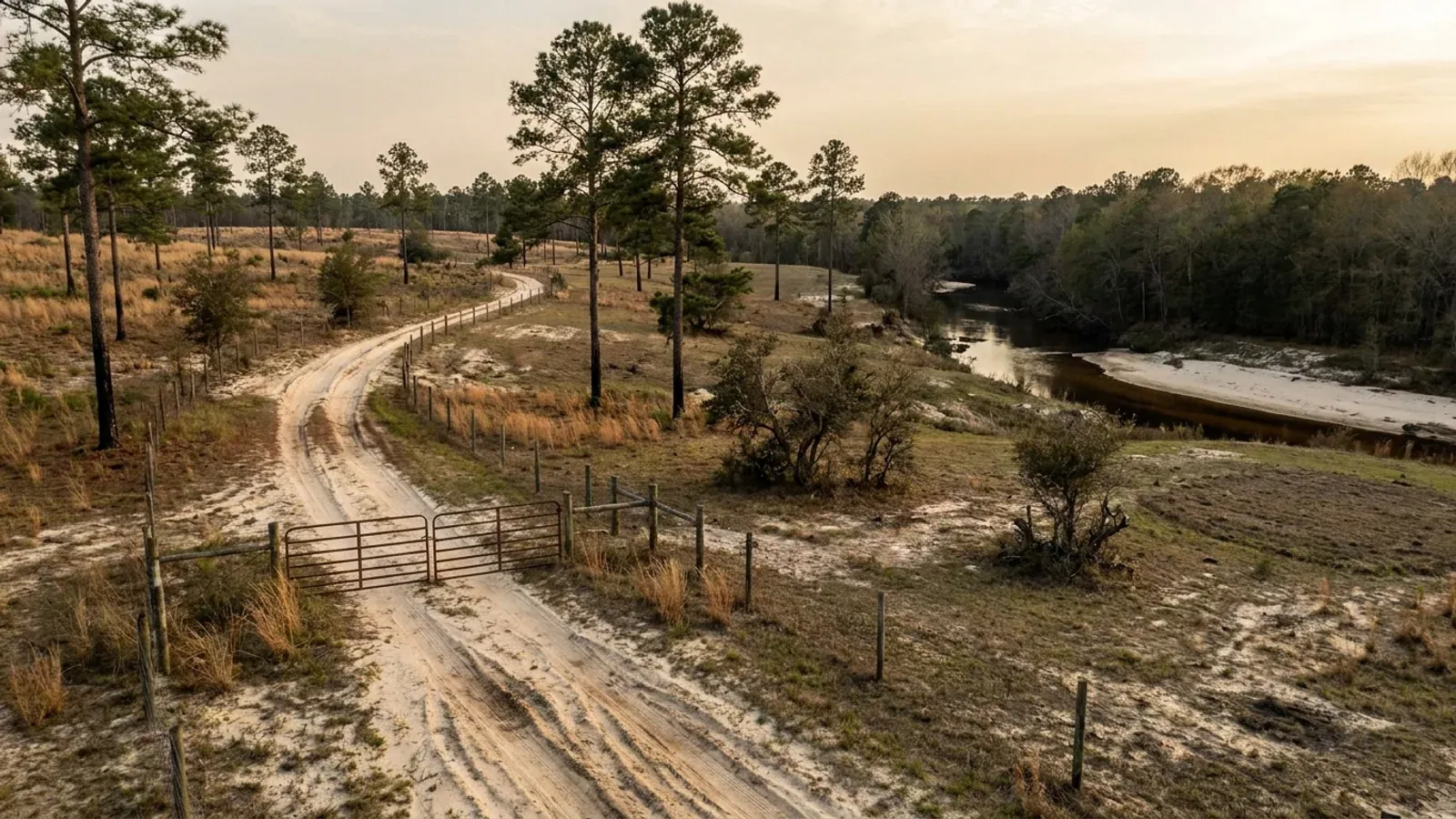
Open longleaf pine woodland on deep white sand, with wiregrass and turkey oak understorey, fire-blackened trunk bases and a sandy two-track road.
Kershaw County One statewide code, county design maps

Barndominium Builders in Kershaw County, SC

Kershaw County is the best combination of growth and land in the Midlands, and for a barndominium it is also the friendliest ordinance within thirty-five minutes of downtown Columbia. Zoning here is countywide - the Unified Code of Zoning and Land Development Regulations, approved by County Council on 23 February 2010 and amended since, establishes its districts "for use in the unincorporated areas of Kershaw County," and 61,951 of the county's 73,166 residents live in that unincorporated balance. The three Rural Resource districts, RD-1, RD-2 and MRD-1, run on a one-acre minimum lot and carry the sentence that decides most of these projects: accessory buildings are capped at half the dwelling's floor area only in R-15, R-10 and R-6, and "no maximum area" is specified for the other districts. The ordinance also lets an accessory structure be erected on a lot of record before the principal building goes up, which the City of Columbia expressly forbids. Two things changed recently and both matter to timing: County Council adopted a Development Impact Fee Ordinance in July 2025, and a Building Permit Allocation System took effect on 13 May 2026. Camden is the county seat and the horse country the county is known for - and the town of Kershaw, confusingly, is not in this county at all.

Kershaw County at a glance

County
Kershaw County
Population
73,166

Building conditions in Kershaw County

The building code is the same in every South Carolina county: S.C. Code § 6-9-10(A) requires each municipality and county to enforce the Building Codes Council's codes and to enforce only those, and SC Regulation 8-236(C) bars a local jurisdiction from writing one of its own. The design numbers are not local either, but they are not one number for the state — Regulations 8-1202 and 8-1203 send wind and seismic to the Council's own map for this county, and those maps are drawn as contours, so the figure is read at your address rather than off a county name. What is genuinely local is who issues the permit and inspects the work, what that office charges, the permit procedure it adopted by ordinance, whether your parcel is zoned at all, and the rest of Table R301.2 — frost depth, termite probability and flood — which the jurisdiction fills in for itself.

Build conditions for Kershaw County , South Carolina : design wind speed The Building Codes Council's approved Kershaw County map carries 115 MPH wind contour lines. BUILD CONDITIONS KERSHAW COUNTY, SCKershaw CountyONE STATEWIDE CODEDESIGN WIND SPEEDThe Building Codes…Regs 8-1202 and 8-1203 replace IRC R301.2.1 and R301.2.2.1 with the Council's own county maps.This is a contour map rather than a single fill: the map's note says the speed "applies at all…ZONING · RD-1, RD-2 AND MRD-1 (RURAL RESOURCE…1 acre (43,560 sq ft) in RD-1, RD-2…Unified Code of Zoning and Land Development Regulations, approved 23Feb 2010, as amended, in the version the county published updated 2…IMPACT AND PERMIT FEESDevelopment impact feeKershaw County does levy one, which is unusual in South Carolina.The Development Impact Fee Ordinance for Kershaw County was adopted…WHO ISSUES THE PERMITKershaw County Planning and Zoning D…Camden, the county seat. The same department administers the ZLDR,issues building permits and collects the development impact fee; th…
Build conditions for Kershaw County, drawn from the sourced facts on this page. Every figure above is cited in the quick-facts panel below, with its source and vintage.
The Council's Kershaw County map carries 115 MPH contours and no seismic label in its text
South Carolina takes the ultimate design wind speed away from the IRC's national figure and gives it to the Building Codes Council's own county maps: Reg 8-1202 replaces IRC R301.2.1 with "the previously published maps by the South Carolina Building Codes Council," and Reg 8-1203 does the same for seismic design category at R301.2.2.1. The Council's approved map for Kershaw County was downloaded and its text layer read: the only wind value on it is 115 MPH, appearing on several contour lines across the county, and it prints the standard note on its face - "Wind speed, shown in miles per hour, applies at all points along the length of its corresponding (blue) line. Interpolation between wind speed lines is determined by the AHJ as permitted by Figure R301.2(4A) of the 2015 International Residential Code." That makes Kershaw one of the low-wind counties in the state, well below the 130 and 140 mph lines that appear on the coastal-plain maps. The map's machine-readable text layer carries no seismic design category label at all, so none is stated here; ask the Kershaw County building official to read the category off the Council map for your parcel and put it in writing before the truss or steel package is ordered.

SC Building Codes Council, Wind/Seismic Maps, https://llr.sc.gov/bcc/maps.aspx , and the Council's Kershaw County map, https://llr.sc.gov/bcc/PDFfiles/WSMaps/Kershaw%2015.pdf (HTTP 200, application/pdf, 7,748,647 bytes, downloaded 5 Sep 2026; text layer extracted with pdftotext -layout and read in full). Regs 8-1202 and 8-1203, 2021 Code Modifications, S.C. State Register Vol. 46 Issue 5, 27 May 2022, https://llr.sc.gov/bcc/PDFfiles/2021-Code-Modifications.pdf

In the rural districts there is no size cap and no limit on the number of accessory buildings
This is the sentence that decides whether a barndominium works as one building or two, and Kershaw County's answer is unusually good. ZLDR Sec. 3:2.5-2(C): "Accessory buildings and structures shall not exceed fifty (50) percent of the gross floor area (GFA) of the principal building or use in the R-15, R-10, or the R-6 districts, or thirty-five (35) percent of the buildable area to the rear of the principal building, whichever is greater. No maximum area specified for other districts." Sec. 3:2.5-2(A) does the same for count: "The number of accessory buildings shall not exceed three (3) on any lot or parcel in the R-15, R-10, or the R-6 districts. No maximum on the number of accessory buildings in other districts." R-15, R-10 and R-6 are the county's three suburban residential districts. The Rural Resource districts - RD-1, RD-2 and MRD-1 - are not among them, and neither is GD. So on rural acreage a detached shop larger than the house is not a variance question. What still binds you is the dimensional table: Table 3-4 sets the RD districts at a 43,560 square foot (one acre) minimum lot, 100 feet of street frontage width, setbacks of 35 feet front, 20 feet side and 30 feet rear, a maximum impervious surface ratio of 0.4 and a maximum density of one dwelling unit per gross acre. And read the height note carefully - the 35-foot cap is measured "from average elevation of finished grade within twenty (20) feet of the structure to the bottom of the eave," not to the ridge. On a clear-span shop the eave height is the number to design to.

Kershaw County Unified Code of Zoning and Land Development Regulations, Secs. 3:2.5-2 and Table 3-4 with note (d), approved by County Council 23 Feb 2010, as amended 25 Oct 2016 with amendments through the version updated 25 February 2025. The county's live server refuses automated requests, so this was read from the Internet Archive's capture of the county's own current ZLDR document, https://web.archive.org/web/20250328212452if_/https://www.kershaw.sc.gov/home/showpublisheddocument/16498/638772923167730000 (application/pdf, 8,172,526 bytes, read 5 Sep 2026), linked from the county's ZLDR page at https://www.kershaw.sc.gov/departments/departments-h-q/planning-zoning/zldr-zoning-land-development-regulations-820

You may put the shop up before the house - the ordinance says so in as many words
Most zoning ordinances make an accessory structure wait for its principal building, and that single clause is what forces a barndominium buyer to build the expensive half first. Kershaw County goes the other way. ZLDR Sec. 3:2.5-4, Accessory Structures without Principal Building: "Accessory structures, where allowed as an accessory to residential and non-residential uses, are allowed to be erected on lots of record without the principal structure. Such accessory structures shall conform to all the requirements of this section. If a principal structure is subsequently erected on the lot, both the accessory and principal structure must comply with all applicable requirements of this Ordinance." There is one warning attached and it is worth taking seriously: "The location, size, or any other factor of the pre-existing accessory structure may not be considered as grounds for a variance from any requirement imposed on the accessory and/or principal structure." In plain terms, put the shop where the house can still meet its setbacks, its septic separation and its one-acre lot standard, because the county will not later bend a rule to accommodate a building you sited first. Compare the City of Columbia thirty-five minutes down the road, where UDO Sec. 17-4.3(c) requires that an accessory structure "Not be constructed or established prior to the time the principal use or structure is constructed or established." Same metro, opposite rule.

Kershaw County ZLDR Sec. 3:2.5-4, read from the Internet Archive's capture of the county's own current ZLDR document, https://web.archive.org/web/20250328212452if_/https://www.kershaw.sc.gov/home/showpublisheddocument/16498/638772923167730000 (read 5 Sep 2026); City of Columbia Unified Development Ordinance Sec. 17-4.3(c) for the contrast, https://planninganddevelopment.columbiasc.gov/wp-content/uploads/2025/09/AccessoryStructure_25.pdf

A building permit allocation system took effect on 13 May 2026, and the county posts the tracker weekly
Kershaw County is growing at 11.9 percent and it has responded with something very few South Carolina counties have: a system that rations residential building permits rather than simply issuing them. The county's Planning and Zoning department runs a page headed Building Permit Allocation System, which links "the Building Permit Allocation System Ordinance Effective 5/13/2026" and a second document, "Building Permit Allocation System Permits Issued - Updated each Monday." A weekly-updated allotment tracker is the signature of a cap that can be reached, which means the calendar matters here in a way it does not in a neighbouring county: the question is not only whether your plans comply but whether an allotment is available when you apply. The ordinance document itself is served only from the county's own host, which refuses automated requests, so its terms - what counts against the allotment, whether an owner-occupied single dwelling on existing acreage is treated differently from a subdivision lot, and how the queue works - have to come from the Planning and Zoning department directly. Ask about it in the first phone call, before a site plan is drawn, and ask where the tracker stood that week.

Kershaw County Planning and Zoning, Building Permit Allocation System, https://www.kershaw.sc.gov/departments/departments-h-q/planning-zoning/building-permit-allocation-system , read 5 Sep 2026 from the Internet Archive's capture of that county page, https://web.archive.org/web/20260609232921/https://www.kershaw.sc.gov/departments/departments-h-q/planning-zoning/building-permit-allocation-system (the live host does not serve automated requests). The effective date and the weekly tracker are the county's own words on that page

Kershaw County charges development impact fees, and they are paid before the certificate of occupancy
Most South Carolina counties do not levy an impact fee. Kershaw does. County Council adopted the Development Impact Fee Ordinance for Kershaw County by Ord. No. 111.2025 on 22 July 2025, "pursuant to and in compliance with the authority of the South Carolina Development Impact Fee Act," after a 2022 Council resolution directed the Planning Commission to do the studies. The fees fund parks and recreation facilities and municipal facilities and equipment, and Sec. 6-255 applies them "to all new development or redevelopment located within unincorporated county limits." Sec. 6-258 sets the mechanics: the Planning and Zoning department determines and collects them, the amount is fixed "at the time of application for a building permit," and "in all instances, the development impacts fees must be remitted to the county planning and zoning department prior to the issuance of a certificate of occupancy." Council's own findings record that the maximum allowable parks and recreation fee from the study was cut by ten percent, "setting the fees at 90 percent of the maximum amount." Nine categories are exempt under Sec. 6-256, and two of them are worth knowing on rural land: replacing a residential unit, including a manufactured home, with another residential unit on the same lot, and "construction of an addition to a residential structure that does not increase new demand." The dollar schedule is Exhibit A to the adopting ordinance rather than printed in the code text, so get the current figure from the department with your permit application.

Kershaw County Code of Ordinances ch. 6, art. XI, Secs. 6-250 to 6-258 (Ord. No. 111.2025, 22 July 2025), read 5 Sep 2026 through Municode's code content API for Kershaw County, South Carolina (Municode client 6461, Camden; Code of Ordinances product 12422, job 483882, banner "CODE OF ORDINANCES KERSHAW COUNTY, SOUTH CAROLINA - Codified through Ordinance No. 111.2025, enacted July 22, 2025. (Supp. No. 2)"), library at https://library.municode.com/sc/kershaw_county/codes/code_of_ordinances ; the county lists its impact fee study, capital improvements plan and housing affordability analysis on its Development Impact Fees page, read 5 Sep 2026 from the Internet Archive capture at https://web.archive.org/web/20260516111028/https://www.kershaw.sc.gov/departments/departments-h-q/planning-zoning/development-impact-fees

The state's number one agricultural county, and 85 percent of its people live outside a town
The 2022 Census of Agriculture puts Kershaw County first among South Carolina's 46 counties in the total market value of agricultural products sold - $364,568,000, about 8 percent of the whole state's farm sales - and first in livestock, poultry and products and in poultry and eggs, which alone accounted for $350,387,000 of that total. It also ranks second in the state for horses, ponies, mules, burros and donkeys, which is what Camden's steeplechase country looks like in a federal table. The land numbers are just as useful: 100,593 acres in farms across 575 operations, an average of 175 acres, made up of 46,773 acres of woodland, 27,514 of cropland, 15,613 of other land and 10,693 of pasture. The size distribution is the part a homesite buyer should read - 212 farms of 10 to 49 acres and 210 of 50 to 179 acres, so 422 of the 575 operations - 73 percent - fall in those two bands. And the jurisdictional split is decisive: of the county's 73,166 residents on 1 July 2025, Camden held 9,201, Elgin 1,675, Bethune 339, the Columbia city part zero, and the unincorporated balance 61,951. Eighty-five percent of Kershaw County lives under county zoning and the county building official, not a town's.

USDA National Agricultural Statistics Service, 2022 Census of Agriculture County Profile, Kershaw County, South Carolina, https://www.nass.usda.gov/Publications/AgCensus/2022/Online_Resources/County_Profiles/South_Carolina/cp45055.pdf (application/pdf, 879,281 bytes, downloaded and read 5 Sep 2026; the state ranks are the profile's own "Rank in State" column, cross-checked against the Saluda and Orangeburg county profiles, which report $297,195,000 and $303,730,000 in total sales). Municipal and unincorporated populations from U.S. Census Bureau sub-est2025_45.csv, https://www2.census.gov/programs-surveys/popest/datasets/2020-2025/cities/totals/sub-est2025_45.csv ; county total 73,166 from co-est2025-alldata.csv, https://www2.census.gov/programs-surveys/popest/datasets/2020-2025/counties/totals/co-est2025-alldata.csv

Also worth knowing before you build in Kershaw County

The septic permit comes before the building permit, not after
Kershaw County sequences these in an order that catches people out. ZLDR Sec. 4:1.6 lists what the applicant must produce to open a building permit: "complete an application form; submit a copy of a recorded plat issued in the property owner(s)' name; obtain a 911 address if one has not been assigned; provide a SCDHEC septic tank permit or public sewer tap receipt; and provide additional information as may be required by the Planning Official." So on a rural parcel the state septic permit is a precondition of the county building permit, and the septic permit itself is not quick. Onsite wastewater is permitted by the South Carolina Department of Environmental Services under Regulation 61-56, not by the county. Section 102.2 fixes the site evaluation fee at "one hundred and fifty dollars ($150.00)," payable with the application. Section 104.1(6) makes you prepare the site before anyone comes out: clear and mark the property boundary lines and corners, post an identification marker in the front centre of the lot, stake the corners of the proposed building, mark the proposed stub-out, septic tank and drain field areas, locate the well, and submit a site sketch. Kershaw County lies along the Fall Line, and § 104.1(5) changes the evaluation method at that boundary - "Backhoe pits shall be required above the Fall Line that separates the Piedmont area from the Coastal Plain as defined by the South Carolina Geological Survey" - so which method applies is a question for your parcel rather than for the county. Section 104.1(7) is the one that ends deals: the Department will not issue a permit if it determines site conditions are unsuitable for the system requested.

Kershaw County ZLDR Sec. 4:1.6, https://web.archive.org/web/20250328212452if_/https://www.kershaw.sc.gov/home/showpublisheddocument/16498/638772923167730000 ; S.C. Regulation 61-56, Onsite Wastewater Systems, §§ 102.2, 104.1(5), 104.1(6) and 104.1(7), SCDES copy at https://des.sc.gov/sites/des/files/Library/Regulations/R.61-56.pdf (HTTP 200, application/pdf, 4,282,530 bytes, downloaded 5 Sep 2026 and read as text extracted with pdftotext -layout)

Pull your own permit and you cannot sell, lease or rent the house for two years
Owner-builder projects are common on rural acreage, and Kershaw County allows them with a condition that is recorded against the property. ZLDR Sec. 4:1.5: "A licensed contractor is required to obtain the building permit. For single-family residential units only, the property owner may obtain the building permit. However, if the property owner acquires the permit, the property owner must sign a disclosure statement, filed with the Register of Deeds, stating the property owner's responsibility to hire a licensed contractor for any work not performed by the property owner. The disclosure statement shall also stipulate that a home constructed under a building permit issued to the property owner cannot be sold, leased, or rented for a period of two years after completion of construction and the certificate of occupancy has been issued." For every other kind of project the permit has to be taken out by a contractor, and the Planning and Zoning department verifies a current and valid residential or general contractor's licence before issuing. Two clocks run alongside it under Sec. 4:1.3: a permit expires if work has not begun within six months of issuance - and work is not deemed started until a scheduled inspection verifies it - and a permit expires outright twenty-four months after the date of issuance, after which a new one must be purchased.

Kershaw County ZLDR Secs. 4:1.3 and 4:1.5, read from the county's current ZLDR document via the Internet Archive, https://web.archive.org/web/20250328212452if_/https://www.kershaw.sc.gov/home/showpublisheddocument/16498/638772923167730000 (read 5 Sep 2026)

Within a quarter mile of Lake Wateree a different septic regime applies, and it follows the sale
Kershaw County shares Lake Wateree with Fairfield and Lancaster counties, and the ZLDR draws a special overlay around it. Sec. 3:7.4-2 sets the Lake Wateree Overlay District as "a one quarter mile (1,320 feet) wide zone starting at, and perpendicular to the project boundary as defined under the Federal Energy Regulatory Commission (FERC) regulatory provisions governing Duke Energy," that project boundary being the 225.5 foot contour above mean sea level; and "any parcel transected by the one quarter mile delineation shall be considered to completely lie within the LWOD," so a parcel is either wholly in or wholly out. Two consequences bite on a build. First, under Sec. 3:7.4-8(C) any new or replacement onsite sewage disposal system inside the LWOD must include an access manhole built into the lid over each compartment of the tank and over the outlet end, "with risers and access manholes extending to within six (6) inches of the ground surface," made vandal, tamper and child resistant. Second, Sec. 3:7.4-8(D) requires that before the sale of any ownership interest in a lot containing a system, the seller give the buyer a written inspection report prepared by a licensed inspector, dated no earlier than sixty days before the sale, preceded by a pump-out of the tank, with a copy of the report and the pumping contractor's sewage disposal manifest filed with the Building Official within ten days. Conveyance by gift or inheritance between family members is excluded. All shoreline activity inside the FERC project boundary is separately subject to Duke Energy's Shoreline Management Plan.

Kershaw County ZLDR Secs. 3:7.4-2, 3:7.4-3 and 3:7.4-8, https://web.archive.org/web/20250328212452if_/https://www.kershaw.sc.gov/home/showpublisheddocument/16498/638772923167730000 (read 5 Sep 2026)

The county adopted the codes in 2002 and set its own building-code appeals board
S.C. Code § 6-9-10(A) makes every county in the State enforce the Building Codes Council's codes and "enforce only" them, but the administrative machinery is local, and Kershaw County built its own. County Code Sec. 6-3 sets the reach: "The provisions of this chapter shall apply to all lands within the unincorporated limits of the county and those municipalities which, by written agreement, executed a contract to have these provisions administered within their corporate limits." Sec. 6-25 adopts by reference the International Residential Code with the deletion of section R105.3.1, the International Building Code with the deletion of Sections 101.4.1 and 101.4.5, the International Plumbing, Mechanical, Gas, Energy and Fire Codes, the National Electrical Code, and "all revisions and future revisions by the S.C. Building Code Council" - so the county's adoption tracks the state automatically. Article IV creates a Building Codes Board of Adjustments and Appeals to hear appeals from the building official. And Article VII carries a requirement that catches pier-and-beam and post-frame designs: Sec. 6-160 provides that "every new residential dwelling shall comply with the foundation wall or underskirting requirement," for a new single-family detached dwelling "upon completion of the construction," with residential structures in a flood zone complying instead with the flood damage prevention ordinance on foundation walls.

Kershaw County Code of Ordinances ch. 6, Secs. 6-1, 6-3, 6-25, 6-86 to 6-91 and 6-160 (Ord. of 6-11-2002), read 5 Sep 2026 through Municode's code content API for Kershaw County, South Carolina (client 6461, product 12422, job 483882, codified through Ord. No. 111.2025 enacted 22 July 2025, Supp. No. 2), library at https://library.municode.com/sc/kershaw_county/codes/code_of_ordinances ; S.C. Code § 6-9-10 at https://www.scstatehouse.gov/code/t06c009.php

Five acres or a family gift: the two ways acreage actually gets split here
Two exemptions do most of the work when a Kershaw County tract is divided. Under ZLDR Sec. 5:1.1-1(B), following S.C. Code § 6-29-1110, "the division of land into parcels of five acres or more where no new street is involved" is exempt from the subdivision regulations; the plat still has to be received as information by the Planning and Zoning department, which notes that fact on it. The county then adds its own at Sec. 5:1.1-2(C): a division by gift conveyed by deed with no new street involved, "limited to the conveyance of land from one member to another member of the same immediate family i.e. (husband, wife, mother, father, children, grandchildren, brothers, sisters)." That one carries a lock - land so divided "may not be further transferred by sale or gift to any party other than a member of the same immediate family for a period of eighteen (18) months from the date the plat is approved for recording and shall be so notated on the plat," with the Planning Official able to waive the wait for legitimate and compelling cause and an automatic waiver on judicial foreclosure. Where a family exemption relies on an unimproved private street or drive for access, Sec. 5:1.2-2(A) limits it to no more than ten lots out of the original parcel. Division by will or inheritance under the statute of descent and distribution is exempt too, again provided no new street is involved.

Kershaw County ZLDR Secs. 5:1.1-1, 5:1.1-2 and 5:1.2-2, https://web.archive.org/web/20250328212452if_/https://www.kershaw.sc.gov/home/showpublisheddocument/16498/638772923167730000 (read 5 Sep 2026); S.C. Code § 6-29-1110 at https://www.scstatehouse.gov/code/t06c029.php

A barndominium is never a farm structure, even in the state's top farm county
Kershaw County leads South Carolina in farm sales, so the farm-structure exemption comes up here more than most places - and the statute closes it. S.C. Code § 6-9-65(A) defines a farm structure as a structure built on a farm "other than a residence or a structure attached to it." A barndominium is a residence, so it is outside the exemption in every case, and the shop half of a shouse is outside it too because it is attached to a residence. There is no square-footage test and no percentage-of-use test to argue. Three further points from the same section: § 6-9-65(C) makes the exemption conditional on the owner filing an affidavit with the local building official before construction; the definition excludes any structure "originally qualifying as a farm structure but later converted to another use," so a pole barn put up under the exemption and finished into living space later comes back under the code as the residence it has become; and § 6-9-65(B) leaves the FEMA National Flood Insurance Program standards in force regardless. Kershaw County's own code carries the reference note to § 6-9-65(B) under Chapter 6. Two related ZLDR limits worth knowing: Sec. 3:2.5-2(D) prohibits the use of mobile or manufactured homes "or similar structures as accessory buildings" in any zoning district, and Sec. 3:2.5-2(B) bars using an accessory building in a residential district for storage in connection with a trade without an approved home occupation permit.

S.C. Code § 6-9-65, served in full at https://www.scstatehouse.gov/code/t06c009.php (read 5 Sep 2026); Kershaw County Code ch. 6 state-law reference note, via Municode's code content API (client 6461, product 12422, job 483882), https://library.municode.com/sc/kershaw_county/codes/code_of_ordinances ; Kershaw County ZLDR Sec. 3:2.5-2, https://web.archive.org/web/20250328212452if_/https://www.kershaw.sc.gov/home/showpublisheddocument/16498/638772923167730000

The town of Kershaw is not in Kershaw County
This is the one place-name collision in South Carolina that breaks the usual rule, and it produces wrong answers in listings, in title work and in search results. The town of Kershaw sits in Lancaster County, not Kershaw County: the Census Bureau records it as place 38095 under county FIPS 057, which is Lancaster, with a 2025 population of 2,038. Kershaw County's seat is Camden, place 10855 under county FIPS 055, at 9,201. Every other South Carolina county that shares its name with a municipality contains that municipality; this is the exception. It matters practically because the two are about forty miles apart, sit under different county ordinances and different building officials, and Lancaster County's Unified Development Ordinance - which by agreement extends into the town of Kershaw and into Heath Springs - is not the document that governs anything in Kershaw County. If a listing says "Kershaw, SC," check the county before you check anything else.

U.S. Census Bureau, Vintage 2025 Subcounty Resident Population Estimates, sub-est2025_45.csv, https://www2.census.gov/programs-surveys/popest/datasets/2020-2025/cities/totals/sub-est2025_45.csv (SUMLEV 157 record: place 38095, Kershaw town, county 057; and place 10855, Camden city, county 055; downloaded 5 Sep 2026)
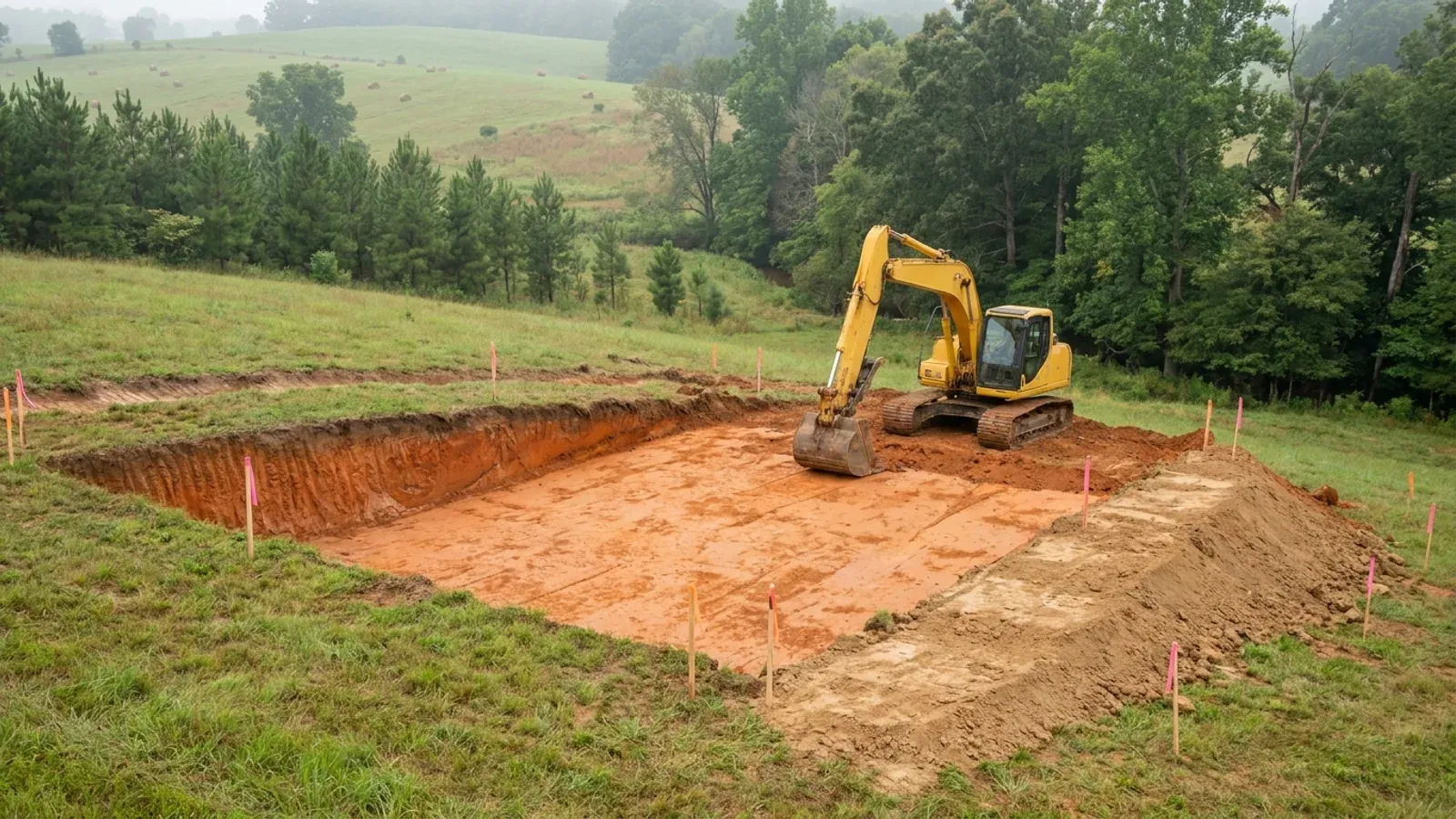
An excavator grading a compacted building pad on a cleared lot, with orange clay in the cut face, survey stakes and a drainage swale.
Below the slab

The expensive surprises are in the ground, not the building

What moves a South Carolina budget is usually below grade, and more often than not it is the drainfield rather than the foundation. R.61-56 § 200.1 settles whether a parcel can take an onsite system from soil morphology — texture, structure, depth to a restrictive horizon and depth to the zone of saturation — and § 200.2 then rules out two conditions outright: soils exhibiting massive or platy structure, and soils with substantial amounts of expansible layer clay minerals or smectites. That second clause is the one that bites on the mafic Piedmont, where the shrink-swell series sit in quantity under York, Fairfield, Chester, Laurens, Union, Newberry, Greenwood, McCormick, Lancaster, Saluda, Abbeville and Edgefield. A foundation problem has a price and an answer; an unbuildable septic parcel has neither, which is why we look at it first. Bedroom count is the number to settle early, because § 61-56.501 drives design flow from bedrooms, design flow drives trench length, and trench length plus a repair area decides how much good soil the parcel has to have — shop square footage adds nothing to it. Above the Fall Line the evaluation is done in backhoe pits rather than borings alone, so the answer comes from a dug hole and not a form. The site work, the foundation and the drainfield therefore get resolved together rather than one at a time. We price the dirt before we price the building.

What a build looks like

Three stages every Kershaw County project passes through, from a raw parcel to a finished home. Site work first, because that is where the budget is decided.
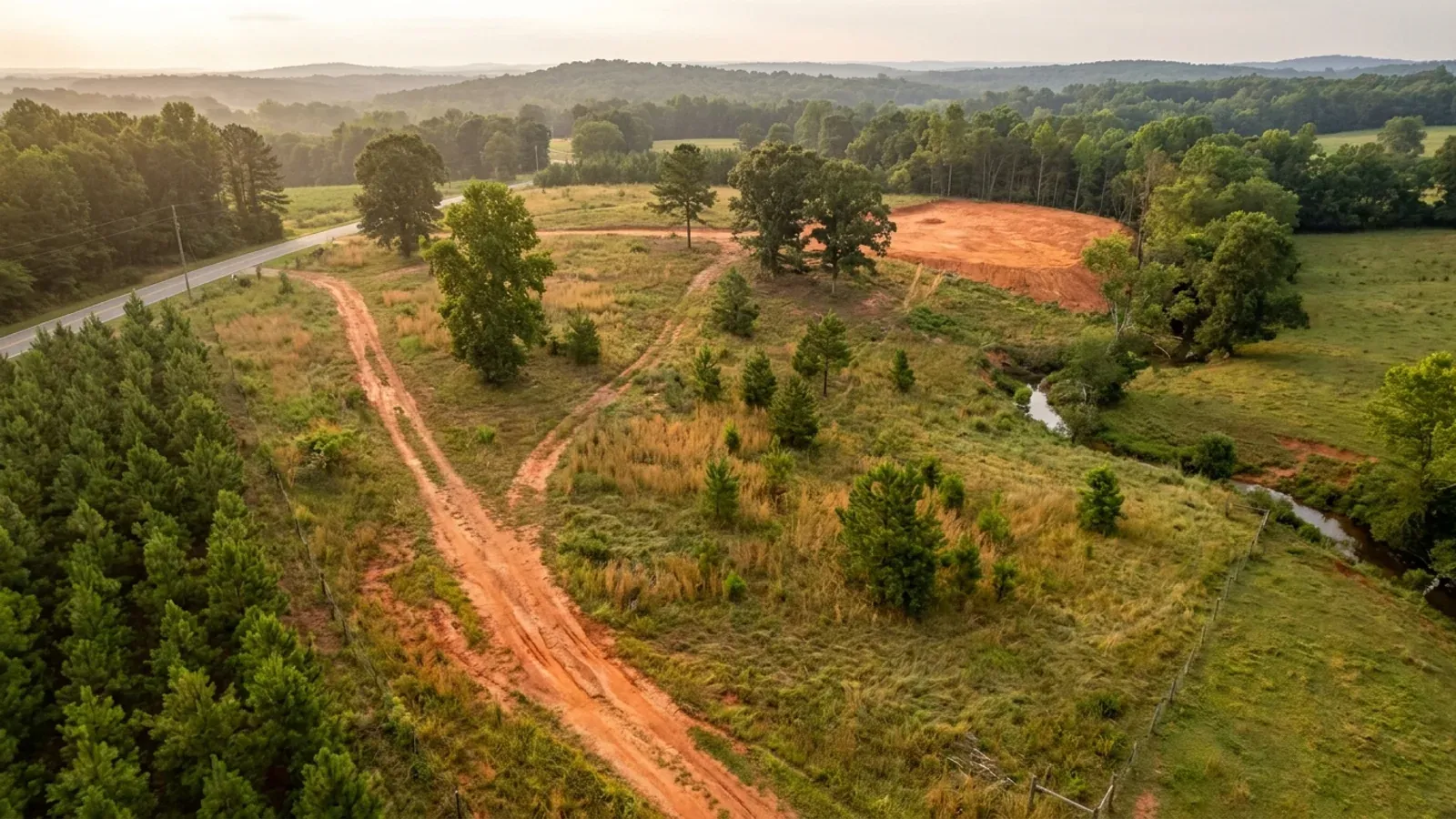
Aerial view of an undeveloped rural lot with cleared rough grass, planted pine along one boundary, and a red dirt access track cut through orange clay.
Stage one

The parcel

Zoning, setbacks, flood zone and utility access get checked before anything is drawn.

An excavator grading a compacted building pad on a cleared lot, with orange clay in the cut face, survey stakes and a drainage swale.
Stage two

Pad and permit

Clearing, grading and a compacted pad, while the submittal works through whichever office issues the permit where you are building.
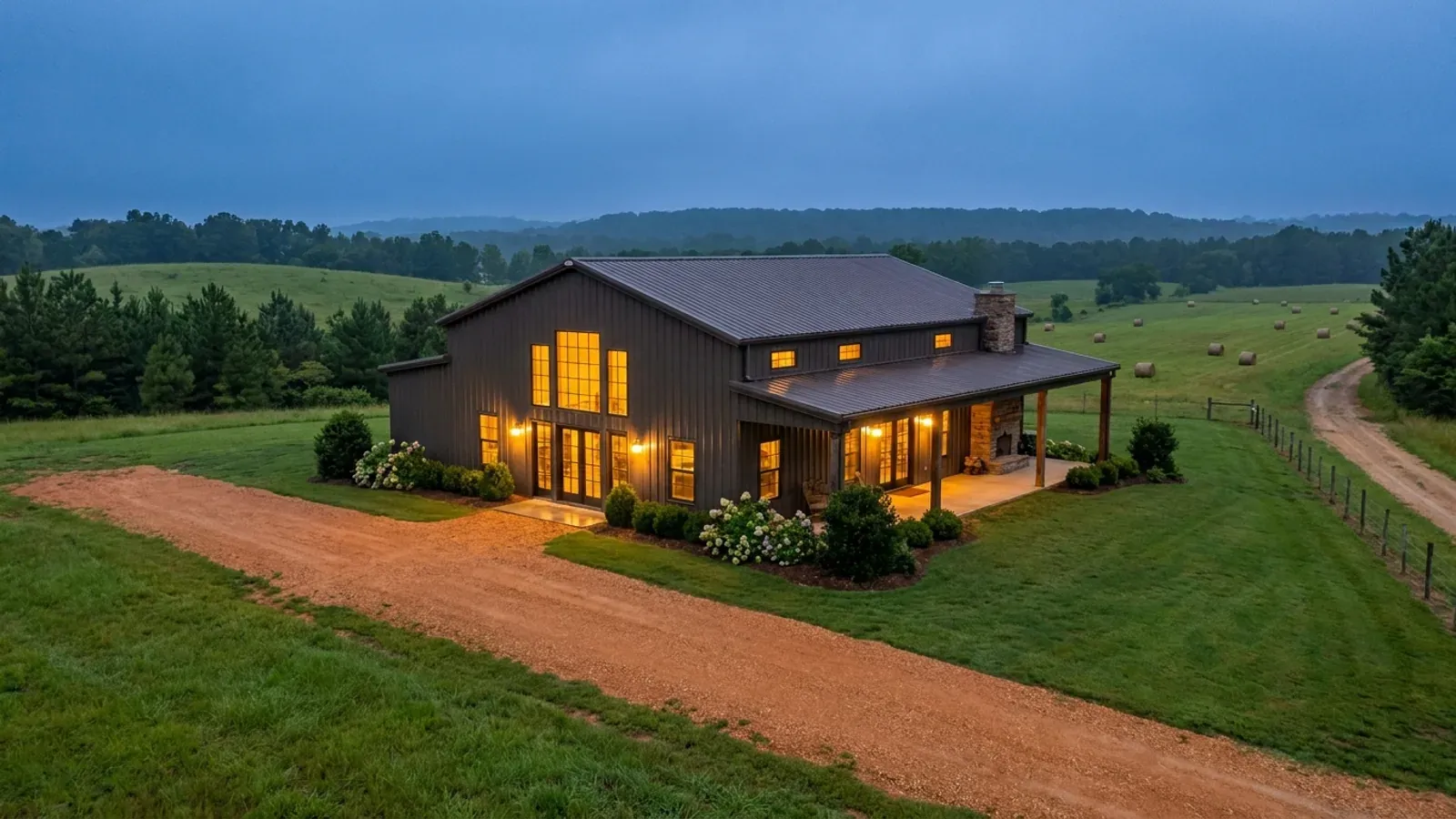
A finished barndominium at dusk with warm interior lighting glowing through its large windows.
Stage three

Frame to finish

Shell erected and dried in, then systems, insulation and interior finish through to CO.

Those are the rules where you are building in Kershaw County. Tell us what you want to build and we will draw it to them.

Nearby areas we build in

Others we cover nearby. One may be a county and another a municipality inside one — and a South Carolina municipality can sit in two counties at once — so the office that issues the permit, the fees it charges, whether the land is zoned at all, and which design map covers it can all differ from one card to the next.

Building in Kershaw County: common questions

10 questions we get asked most often about building in Kershaw County. If yours is not on the list, ask it directly.

How big can the shop be relative to the house in Kershaw County?
On rural land, as big as the site will carry. The cap that exists in most zoning ordinances exists here too, but it is confined to three districts. ZLDR Sec. 3:2.5-2(C) reads: "Accessory buildings and structures shall not exceed fifty (50) percent of the gross floor area (GFA) of the principal building or use in the R-15, R-10, or the R-6 districts, or thirty-five (35) percent of the buildable area to the rear of the principal building, whichever is greater. No maximum area specified for other districts." Sec. 3:2.5-2(A) says the same about count - no more than three accessory buildings in R-15, R-10 or R-6, "no maximum on the number of accessory buildings in other districts." The three Rural Resource districts, RD-1, RD-2 and MRD-1, are not on that list, and neither is GD. So a detached shop bigger than the house is not a variance question on RD-zoned acreage. What does bind you is the dimensional table. Table 3-4 gives the RD districts a one-acre minimum lot, 100 feet of street frontage width, setbacks of 35 feet front, 20 feet side and 30 feet rear, and a maximum impervious surface ratio of 0.4 - and that last number is the one people forget, because a shop pad, a turning apron and a drive all count as impervious surface against the whole lot area. Height is capped at 35 feet, but note (d) measures it "from average elevation of finished grade within twenty (20) feet of the structure to the bottom of the eave." Measuring to the eave rather than the ridge is generous to a gabled building and unforgiving to a tall-eave clear-span shop, so size the door opening against that number early.
Can I build the shop first and the house later?
Yes, and Kershaw County says so explicitly rather than leaving it to the counter. ZLDR Sec. 3:2.5-4 provides that accessory structures "are allowed to be erected on lots of record without the principal structure," subject to conforming to all the requirements of that section, and adds that if a principal structure is later erected, both buildings must comply with everything the ordinance requires. That is genuinely useful on acreage: you can get equipment, materials and a workspace under a roof in year one and build the dwelling in year two. Two cautions come with it. The first is in the ordinance itself: "The location, size, or any other factor of the pre-existing accessory structure may not be considered as grounds for a variance from any requirement imposed on the accessory and/or principal structure." Site the shop as though the house already existed - front, side and rear setbacks, the drainfield and its replacement area, the well separation, the driveway. The second is practical and current: a Building Permit Allocation System took effect on 13 May 2026, and if permits are being allotted then a two-permit plan is two trips through whatever queue the county is running. Ask the Planning and Zoning department how the allocation treats an accessory building on a lot with no dwelling before you commit to the sequence. And note the contrast with the City of Columbia, where the UDO expressly forbids erecting an accessory structure before the principal one - if a staged build is the plan, the county line is doing real work for you.
What is the Building Permit Allocation System, and does it affect a single house on my own land?
It is new and it is the first thing to ask about. Kershaw County's Planning and Zoning department runs a page headed Building Permit Allocation System which links "the Building Permit Allocation System Ordinance Effective 5/13/2026" and a companion document, "Building Permit Allocation System Permits Issued - Updated each Monday." A county that publishes a weekly allotment tracker is a county where the supply of permits can run out, which changes the shape of a build schedule: your plans can be perfectly compliant and still be waiting on an allotment. Why it exists is not hard to see in the numbers - the county grew 11.9 percent between the 2020 census base of 65,407 and the 2025 estimate of 73,166, and effectively all of that was in-migration; in the year to July 2025 net migration added 1,333 people while natural change was minus 66. The ordinance document itself is served only from the county's own host, which does not answer automated requests, so the terms that matter to you - whether an owner-occupied dwelling on existing acreage is treated differently from a subdivision lot, what counts against an allotment, how the queue is ordered, and whether accessory structures are counted - have to come from the department. Call them before you draw a site plan, ask where the tracker stood that week, and ask what the allotment position looks like for the quarter you intend to apply in.
What design wind speed and seismic category apply in Kershaw County?
The wind speed comes off a state map. Reg 8-1202 replaced IRC section R301.2.1 with "the previously published maps by the South Carolina Building Codes Council," and Reg 8-1203 did the same for seismic design category at R301.2.2.1. The Council's approved map for Kershaw County was downloaded and read in full, and the only wind value it carries is 115 MPH, appearing on several contour lines. That is the low end of the state's range - the Council's coastal-plain maps run to 130, 140 and in two counties 150 - and it is worth knowing, because a barndominium is a large, tall, mostly open building whose engineering cost is driven by exactly that number. Note the word contour: the map says on its face that a wind speed "applies at all points along the length of its corresponding (blue) line" and that interpolation between lines "is determined by the AHJ." On seismic the honest answer is that the Kershaw map carries no design category label in its machine-readable text layer, so no category is stated on this page. Get the county building official to read it off the Council map for your tax map number and put it in writing. For context on why it matters: the IRC's seismic provisions do not reach a detached one- or two-family dwelling at all until category D0, and South Carolina's D2 band sits in the Charleston, Berkeley and Dorchester triangle, a long way south-east of here.
How does septic work here, and when in the process does it happen?
Earlier than most people expect, because Kershaw County makes it a precondition of the building permit rather than a parallel task. ZLDR Sec. 4:1.6 requires the applicant to "provide a SCDHEC septic tank permit or public sewer tap receipt" as part of opening a building permit, alongside a recorded plat in the owner's name and a 911 address. The septic permit itself comes from the South Carolina Department of Environmental Services under Regulation 61-56, not from the county. Section 102.2 fixes the site evaluation fee at "one hundred and fifty dollars ($150.00)," payable with the application. Before the evaluator comes out, § 104.1(6) requires you to clear and mark the property boundary lines and corners, post an identification marker in the front centre of the lot, stake the corners of the proposed building, mark the proposed stub-out, tank and drain field areas, locate the well, and submit a site sketch - an unmarked, uncleared tract will not be evaluated. Kershaw County lies along the Fall Line, and § 104.1(5) provides that "backhoe pits shall be required above the Fall Line that separates the Piedmont area from the Coastal Plain as defined by the South Carolina Geological Survey," so the method used on your parcel is a parcel question, not a county one. Two things to plan the building around: § 104.1(7) lets the Department refuse a permit outright where site conditions are unsuitable for the system requested, and a wide slab with a turning apron eats the room a drainfield and its replacement area need. Site the drainfield first and the pad second. If your parcel is within a quarter mile of Lake Wateree, the overlay adds its own requirements on top.
Can I be my own contractor?
On a single-family dwelling, yes, with a condition that gets recorded. ZLDR Sec. 4:1.5 says a licensed contractor is required to obtain the building permit, then carves out single-family residential units: the property owner may take the permit out, but must sign a disclosure statement, "filed with the Register of Deeds," stating the owner's responsibility to hire a licensed contractor for any work not performed by the owner. The same disclosure "shall also stipulate that a home constructed under a building permit issued to the property owner cannot be sold, leased, or rented for a period of two years after completion of construction and the certificate of occupancy has been issued." That two-year restriction is the part to think about before signing, because it is a restriction on the property, not a handshake. Anything that is not a single-family dwelling has to be permitted by a contractor, and the Planning and Zoning department verifies a current and valid residential or general contractor's licence before issuing and may ask for a copy at any time. Watch the clocks either way: under Sec. 4:1.3 a permit expires if work has not begun within six months of issuance - and work is not deemed started until a scheduled inspection verifies it - and every permit expires twenty-four months after the date of issuance, after which a new one must be purchased.
I am looking at land near Lake Wateree. Is anything different there?
Yes, and the boundary is all-or-nothing. ZLDR Sec. 3:7.4-2 draws the Lake Wateree Overlay District as "a one quarter mile (1,320 feet) wide zone starting at, and perpendicular to the project boundary as defined under the Federal Energy Regulatory Commission (FERC) regulatory provisions governing Duke Energy," the project boundary being the 225.5 foot contour above mean sea level, and it provides that "any parcel transected by the one quarter mile delineation shall be considered to completely lie within the LWOD." So a parcel clipped by that line is entirely inside the district, not partly. What changes: under Sec. 3:7.4-8(C) any new or replacement onsite sewage disposal system inside the district must have an access manhole built into the lid over each compartment of the tank and over the outlet end, "with risers and access manholes extending to within six (6) inches of the ground surface," made vandal, tamper and child resistant. And under Sec. 3:7.4-8(D), before the sale of any ownership interest in a lot with a system on it, the seller must give the buyer a written inspection report by a licensed inspector, dated no earlier than sixty days before the sale, preceded by a pump-out of the tank, with a copy of the report and the pumping contractor's sewage disposal manifest going to the Building Official within ten days. Gifts and inheritances between family members are excluded. Shoreline work inside the FERC project boundary is also subject to Duke Energy's Shoreline Management Plan, and the overlay carries shoreline buffer and residential-lot erosion provisions on top of the county-wide water quality buffers. None of this makes lake land a bad buy; it means the septic design and the closing paperwork both have extra steps.
Can I build it as a farm building and skip the code?
No - and this is the county where the question comes up most, because Kershaw ranks first in South Carolina for the total market value of agricultural products sold. The statute closes it cleanly. S.C. Code § 6-9-65(A) defines a farm structure as one built on a farm "other than a residence or a structure attached to it." A barndominium is a residence, so it falls outside the exemption from day one, and the shop half of a shouse falls outside it too because the definition excludes a structure attached to the residence. There is no square-footage threshold and no percentage-of-use argument. Three further points from the same section: § 6-9-65(C) says the exemption does not apply unless the owner files an affidavit with the local building official before construction; the definition excludes any structure "originally qualifying as a farm structure but later converted to another use," so a pole barn erected under the exemption and finished into living space later comes back under the code as the residence it has become; and § 6-9-65(B) preserves the FEMA National Flood Insurance Program standards regardless. A genuinely detached barn or equipment shed on the same land can qualify - and in Kershaw's rural districts you do not need the exemption to build one large, because the ordinance sets no maximum area for accessory buildings there anyway. The building anyone sleeps in is permitted as a dwelling.
I want to split off a piece of family land. What does the county allow?
Two routes carry most of it. The first is the five-acre rule: ZLDR Sec. 5:1.1-1(B), following S.C. Code § 6-29-1110, exempts "the division of land into parcels of five acres or more where no new street is involved" from the subdivision regulations, with the plat received as information by the Planning and Zoning department and noted as such. The second is the county's own family exemption at Sec. 5:1.1-2(C): a division by gift conveyed by deed, no new street involved, "limited to the conveyance of land from one member to another member of the same immediate family i.e. (husband, wife, mother, father, children, grandchildren, brothers, sisters)." That one carries an eighteen-month lock - land so divided may not be transferred by sale or gift to anyone outside the immediate family for eighteen months from the date the plat is approved for recording, and the restriction is written onto the plat. The Planning Official may waive the wait for legitimate and compelling cause, and it is waived automatically on judicial foreclosure. Where the access to a family-exempt lot is an unimproved private street or drive, Sec. 5:1.2-2(A) limits the exemption to no more than ten lots out of the original parcel. Division by will or inheritance under the statute of descent and distribution is exempt as well, again where no new street is involved. Exempt from subdivision review does not mean exempt from zoning: every resulting lot still has to meet the one-acre minimum, the 100-foot frontage width and the setbacks in Table 3-4 before a dwelling goes on it.
Is the town of Kershaw in Kershaw County?
No, and this trips up more people than any other place-name question in the State. The town of Kershaw is in Lancaster County. The Census Bureau records it as place 38095 under county FIPS 057 - Lancaster - with a 2025 population of 2,038. Kershaw County's seat is Camden, about forty miles away, with 9,201 residents. Every other South Carolina county that shares a name with a municipality actually contains that municipality; this is the single exception, and it means an automatic rule that reads a county off a town name produces a wrong answer here. The practical consequence is jurisdictional. A parcel in the town of Kershaw answers to Lancaster County and the town, under Lancaster County's Unified Development Ordinance, which by agreement extends into the town of Kershaw and Heath Springs. A parcel in Kershaw County answers to the Kershaw County ZLDR, the Kershaw County building official, Kershaw County's development impact fee and Kershaw County's building permit allocation system - none of which apply in the town. If a listing, a plat or a search result says "Kershaw, SC," confirm the county from the tax map number before anything else.

Building in Kershaw County?

Start with the plan. Tell us what you want to build and we will draw it, then confirm which office issues the permit for your parcel, what it will let you put there, and what wind load it has to meet. That conversation costs nothing.