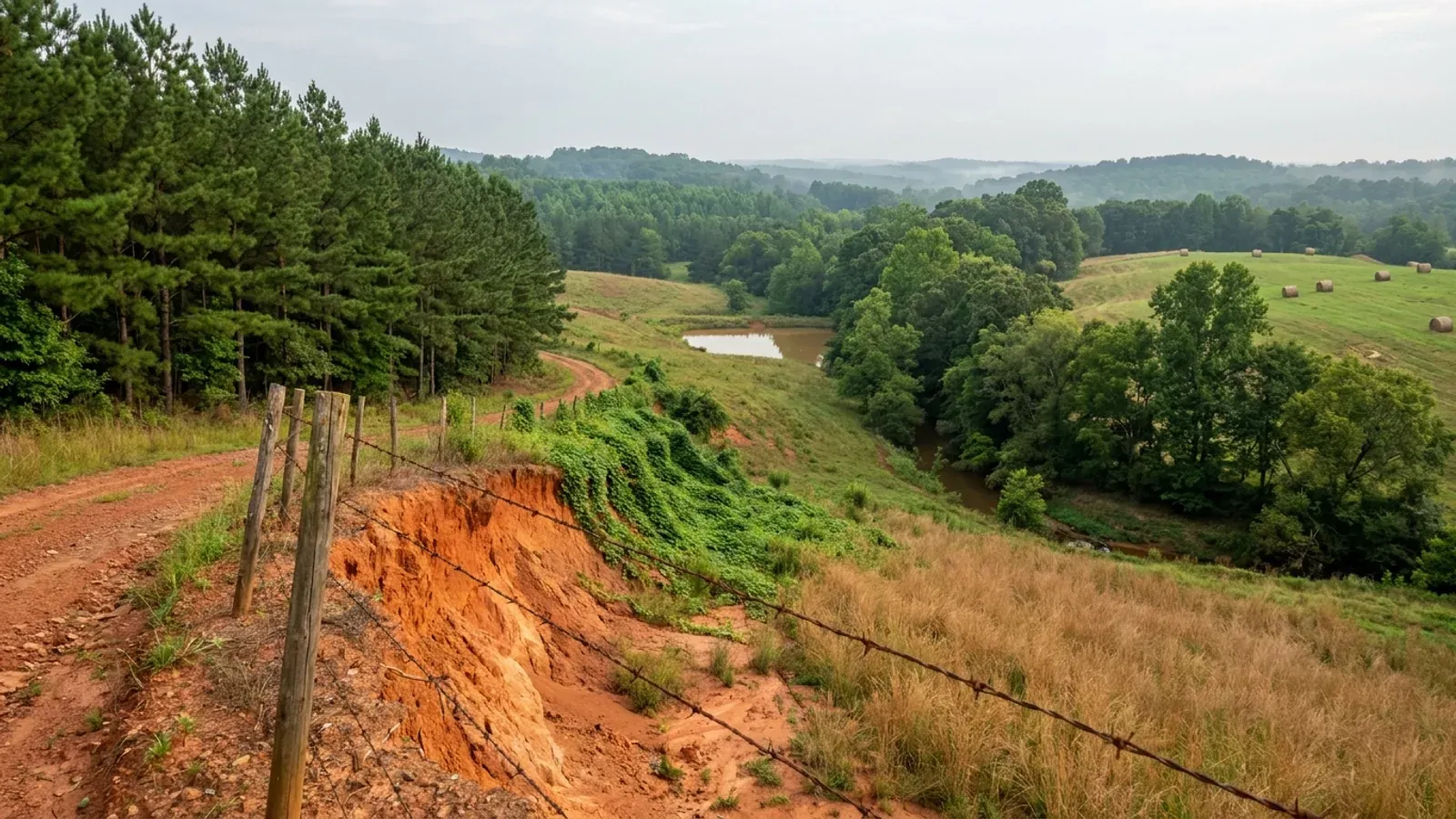
Barndominium Builders in Newberry County, SC
Newberry County sits on I-26 almost exactly midway between Columbia and Greenville, and it is the rare South Carolina county where the farm economy is bigger than the population suggests. The 2022 Census of Agriculture ranks it sixth in the state for the market value of agricultural products sold at $217.2 million, fourth for livestock, poultry and products, fourth for poultry and eggs and second for cattle and calves, off an inventory of 3,020,641 broilers and 20,360 cattle. Ninety-five percent of those sales are livestock rather than crops. That matters to anyone building here for two reasons. It means the ground is genuinely good — Cecil, the well-drained red Piedmont clay that builds without drama, is the single largest mapped soil component at 137,241 acres, and only 11.8 percent of the county's mapped major components carry a representative slope of 15 percent or steeper, against 30.9 percent in Fairfield County next door. And it means the county's zoning ordinance is written around working land: the R2 Rural district has no maximum building height and puts no floor-area cap on an accessory building at all, so the shop can be as big and as tall as you like. The line that does exist is a different one. The moment a structure in R2 houses a non-residential, non-agricultural use and passes 3,000 square feet of gross floor area, it needs a special exception from the Board of Zoning Appeals — and a 100-foot buffer from every neighbouring house.
Building conditions in Newberry County
The building code is the same in every South Carolina county: S.C. Code § 6-9-10(A) requires each municipality and county to enforce the Building Codes Council's codes and to enforce only those, and SC Regulation 8-236(C) bars a local jurisdiction from writing one of its own. The design numbers are not local either, but they are not one number for the state — Regulations 8-1202 and 8-1203 send wind and seismic to the Council's own map for this county, and those maps are drawn as contours, so the figure is read at your address rather than off a county name. What is genuinely local is who issues the permit and inspects the work, what that office charges, the permit procedure it adopted by ordinance, whether your parcel is zoned at all, and the rest of Table R301.2 — frost depth, termite probability and flood — which the jurisdiction fills in for itself.
S.C. Building Codes Council, "Newberry 15.pdf", linked from "Wind/Seismic Maps" at https://llr.sc.gov/bcc/maps.aspx — map at https://llr.sc.gov/bcc/PDFfiles/WSMaps/Newberry%2015.pdf (HTTP 200, application/pdf, 4,337,139 bytes; text layer extracted with pdftotext in -layout and -raw modes and reconciled, 8 Sep 2026). Mechanism at modifications IRC 2021-04 and IRC 2021-05, https://llr.sc.gov/bcc/PDFfiles/2021-Modification-index.pdf
Newberry County Code of Ordinances, Chapter 153 (Zoning Code), §§ 153.067, 153.068 and 153.172, and § 153.075(E) (Airport Height and Land Use Protection Overlay District), county-hosted copy at https://www.newberrycounty.gov/sites/default/files/uploads/departments/Planning%20and%20Zoning/zoning.pdf (HTTP 200, application/pdf, 1,136,463 bytes; extracted with pdftotext in -layout, -table and -raw modes and searched in full, 8 Sep 2026); the county publishes its live code at https://codelibrary.amlegal.com/codes/newberrycounty/latest/newberryco_sc/0-0-0-2459 , linked from https://www.newberrycounty.gov/planning-zoning
Newberry County Code of Ordinances § 153.089 (Rural District Conditional Uses), subsections (A) through (D), with the special-exception route at § 153.137 (R2 Rural District Special Exceptions), county-hosted copy at https://www.newberrycounty.gov/sites/default/files/uploads/departments/Planning%20and%20Zoning/zoning.pdf (extracted and read 8 Sep 2026); enabling authority cited in the ordinance at S.C. Code §§ 6-29-710 et seq., https://www.scstatehouse.gov/code/t06c029.php
Newberry County Planning-Zoning, "Structure Information Sheet", https://www.newberrycounty.gov/planning-zoning/additional-information/structure-information-sheet and "Frequently Asked Questions", https://www.newberrycounty.gov/planning-zoning/frequently-asked-questions (both HTTP 200, served HTML retrieved and read 8 Sep 2026); Planning and Zoning fee schedule, https://www.newberrycounty.gov/sites/default/files/uploads/departments/planning-zoning_fees.pdf (HTTP 200, application/pdf, 94,247 bytes; extracted in pdftotext -raw, -table and -layout modes on 8 Sep 2026 — the -layout render offsets the fee column one row against its labels and was discarded, and the two renders that agree are quoted); Building & Inspection FAQ, https://www.newberrycounty.gov/building-inspection/frequently-asked-questions
Newberry County Building & Inspection, "Contractor License Limits", building official Ron Powell, CBO-MCP, (803) 321-2662, https://www.newberrycounty.gov/building-inspection/contractor-license-limits (HTTP 200, served HTML retrieved and read 8 Sep 2026); the page directs readers to the S.C. Department of Labor, Licensing and Regulation for licence limitations, and the county links LLR at https://www.newberrycounty.gov/building-inspection
USDA NASS, 2022 Census of Agriculture County Profile — Newberry County, South Carolina (cp45071), https://www.nass.usda.gov/Publications/AgCensus/2022/Online_Resources/County_Profiles/South_Carolina/cp45071.pdf (HTTP 200, application/pdf, 879,932 bytes; downloaded 8 Sep 2026 and read in BOTH pdftotext -raw and -layout modes — the -layout render shifts the percent-change column one row against its labels, so every figure here comes from the -raw render, in which label, value and rank print on one line); statute at S.C. Code § 6-9-65, https://www.scstatehouse.gov/code/t06c009.php ; zoning scope at § 153.089, https://www.newberrycounty.gov/sites/default/files/uploads/departments/Planning%20and%20Zoning/zoning.pdf
Also worth knowing before you build in Newberry County
- Cecil country — the gentlest large county in this part of the Piedmont
- One soil series dominates Newberry County to a degree that is unusual anywhere: Cecil, at 137,241 acres, is roughly forty percent of all mapped major-component acreage in the survey area, ahead of Hard Labor at 34,025, Pacolet at 23,450, Rion at 21,127, Wynott at 14,419 and Winnsboro at 13,500. Cecil is the classic well-drained red Piedmont clay, and the survey returns it here with an average representative slope of eight percent and no recorded restrictive layer. The county-level picture follows: 11.8 percent of mapped major-component acreage carries a representative slope of 15 percent or steeper and 21.3 percent carries 10 percent or steeper. The same measure in Fairfield County, immediately east, is 30.9 percent and 43.3 percent. That is the whole explanation for why Newberry farms 27.5 percent of its land area and Fairfield farms 13.9 percent of its, and it is a real advantage for a slab-on-grade building with a long clear-span bay: less cut and fill, less retaining, fewer stepped footings. The steep ground here is real but it is concentrated — Pacolet at an average 22.1 percent and Rion at 20.1 percent are the two components to check for on a specific tract.
- Here the septic constraint is water, not rock
- Newberry is above the Fall Line, so Regulation 61-56 § 104.1(5) requires the soil evaluation to be dug with backhoe pits rather than borings alone, and § 104.1(6) requires the site to be ready first: boundary lines cleared and marked, an identification marker at the front centre of the lot, stakes at the corners of the proposed building, the stub-out, tank and drainfield areas marked, the well location identified, and a site sketch with the application. What differs from the counties either side is which clause bites. Fairfield's problem is § 200.5, depth to rock. Newberry's is § 200.3, which requires the vertical separation between the deepest point of effluent application and the zone of saturation to be at least six inches where peak sewage flow will not exceed 1,500 gallons per day. Several of the county's common ridge soils are moderately well drained rather than well drained and carry a seasonal wet zone within about two feet of the surface: the survey returns Prosperity with a wet zone as shallow as 53 centimetres, Helena at 58, and Santuc and Callison at 66. Prosperity is worth knowing by name because it was described here — the USDA gives its type location as Newberry County, southeast of Whitmire off McCullough Road — and it is classified an Aquic Hapludult, the "Aquic" being the wetness itself written into the taxonomy. A tract that looks flat, red and perfect can still be the one where the drainfield has to move.
- The county's adopted-code list names the 2021 editions and the 2018 modifications
- Newberry County publishes its adopted codes on its own Building & Inspection pages, and the list is worth reading in full because of its last line. It records ICC A117.1 (latest edition), the 2021 International Residential Code, the 2021 International Building Code, the 2021 International Mechanical, the 2021 International Fuel & Gas Code, the 2009 International Energy Conservation Code, the 2021 Fire Code, the 2021 Plumbing Code, the 2020 National Electric Code — and then "2018 SC Modifications (see LLR for listing of modifications)." The Building Codes Council, for its part, publishes a 2021 Modification Index for the 2021 code cycle and an adoption notice recording that it adopted the latest editions with modifications on 6 October 2021 with a 1 January 2023 local implementation date. The county's list points readers at LLR for the modifications; the Council's current published set for these code editions is the 2021 index. Both are real published documents and the reconciliation belongs to the Newberry County building official at plan review, not to a builder or a website. Get it settled in writing before drawings are commissioned. The county also publishes one local requirement worth carrying to your mechanical contractor: "Underground gas piping is not to be used as a grounding electrode. All underground gas piping will require a dielectric coupler to be installed in the system as it exits the earth and prior to entering the structure."
- What the building permit costs, band by band
- Newberry's Building Department publishes a straight valuation ladder rather than a square-foot table: $50.00 on a total valuation of $1,000 or less; $50.00 for the first $1,000 plus $10.00 for each additional $1,000 or fraction thereof from $1,001 to $5,000; $50.00 for the first $5,000 plus $10.00 for each additional $1,000 from $5,001 to $50,000; $270.00 for the first $50,000 plus $5.00 for each additional $1,000 from $50,001 to $100,000; $470.00 for the first $100,000 plus $5.00 for each additional $1,000 from $100,001 to $500,000; and $1,670.00 for the first $500,000 plus $5.00 for each additional $1,000 above that. Plan review is a quarter of the permit fee on residential work and half on commercial. The first re-inspection is $75.00 and it doubles each time thereafter. Manufactured home fees are $100.00 single wide, $200.00 double wide, $5.00 for a decal and $100.00 to move one. Separately, the Planning and Zoning schedule prices the land-use side: a flood permit at $75.00, a variance request at $150.00, a notice of appeal at $200.00 and a special exception request at $200.00 — which is the fee that attaches if your business use in R2 passes the 3,000 square foot line. Starting work without a permit doubles the applicable permit fee and may draw a stop work order.
- 555 farms, 110,964 acres, and the average holding is getting bigger, not smaller
- The 2022 Census of Agriculture counts 555 farms in Newberry County holding 110,964 acres — 27.5 percent of the county's land area — at an average of 200 acres each. Against 2017 the number of farms is down 9 percent, the land in farms is up 17 percent and the average size is up 28 percent. That is the opposite of what is happening in most of the Midlands: ground is being consolidated into larger operations rather than split into smaller ones. Inside the acreage, 44,673 acres are woodland, 37,774 cropland, 23,143 pastureland and 5,374 other — four figures that sum exactly to the 110,964 total, which is why they are quoted rather than any of the ambiguous ones. The size distribution shows where the market sits: 45 farms of 1 to 9 acres, 130 of 10 to 49, 228 of 50 to 179, 95 of 180 to 499, 41 of 500 to 999 and 16 above 1,000 acres. Forty-one percent of every farm in the county is in the 50-to-179-acre band. The practical consequence for a buyer is that ten- and twenty-acre building parcels are not what this county is producing on its own; they generally come out of a larger tract, which makes the subdivision route and the road-frontage question part of the purchase rather than an afterthought.
- 39,561 people, and the growth is entirely people arriving
- The Census Bureau's Vintage 2025 estimates put Newberry County at 39,561 residents on 1 July 2025, against a 2020 estimates base of 37,716 — a gain of 1,845 people, or 4.9 percent, in five years. The components for the year to July 2025 show where it comes from: 411 births against 500 deaths, a natural change of −89, international migration of +97 and net domestic migration of +231, for net migration of +328. Every bit of the county's growth is migration, and both kinds of migration are running positive, which is not true of every rural South Carolina county. At 5.9 net domestic migrants per thousand residents Newberry is growing more slowly than Chester County's 15.7 but faster than Fairfield County's 1.0. The reading for a land buyer is that this is a county with a real employment base rather than a commuter shell — which is consistent with an agricultural economy ranked sixth in the state — and that competition for parcels here is more likely to come from people already working in the county than from an out-of-town commuter wave.
- The corridor overlay bans things regardless of what the underlying district allows
- Newberry runs a Corridor Protection Overlay District along its important roadway corridors, and it works subtractively: "All regulations and requirements in the underlying zoning districts still apply within the overlay district except that the following uses shall be prohibited: junkyards, landfills, salvage and scrap operations, outdoor storage of any number of junked vehicles, CAFOs, manufactured home parks, commercial campgrounds and RV parks, communications towers, and sexually-oriented businesses." The stated purpose is to "preserve and enhance the overall visual appearance and quality of important roadway corridors within the county in order to preserve property values, promote economic development, and protect the image of Newberry County." Two of those prohibitions matter to a rural build: outdoor storage of junked vehicles of any number, which catches the project-car habit that a big shop encourages, and concentrated animal feeding operations, which is a real constraint in the state's fourth-ranked poultry county. Landscaped road buffers are also required in the overlay for new and expanded industrial and commercial uses and large subdivisions. Because the overlay is drawn on the official zoning map rather than described in words, whether a specific frontage is inside it is a question for the Zoning Department with your tax map number in hand.
- Working out of the shop: 25 percent of the house, or 50 percent of the building
- If the business is small enough to stay a home occupation, § 153.097 sets out what that permits and it is more generous to a shop than to a house. The occupation must be "carried on wholly within the principal residence or accessory structure", and "the floor area dedicated to such use shall not exceed 25% of the floor area of the principal residence or 50% of an accessory building." On top of that: no activity out of doors and no outdoor storage, display or refuse area in the yard; no merchandise displayed so as to be visible from outside the residence; no person not residing in the principal residence employed on the premises; no traffic above what a residential neighbourhood normally sees; no alteration whatsoever of the residential character of the buildings or premises; no health, safety or traffic hazard and no noise, glare, heat, vibration, smoke, dust or odour perceptible to adjacent uses; no display, rental or sale of goods other than those prepared on the premises; and no use of the occupation for paid receptions or parties. The half-of-an-accessory-building figure is the number to design around if part of the reason for the shop is a business — and the moment the operation outgrows the home-occupation conditions, § 153.089's conditional-use route and its 3,000 square foot special-exception threshold are what it falls into instead.
- Countywide in the unincorporated area, with a joint commission over part of it
- Newberry County's zoning reaches every acre outside a municipality. Section 153.017 states it without qualification: "The provisions of this chapter shall apply to all land and improvements within the unincorporated area of Newberry County, South Carolina." There is no unzoned remainder here, and § 153.018 then bars any building, structure, sign or land from being used, graded, excavated, occupied, altered, erected, moved, enlarged or structurally altered except in conformity with the general provisions and with the specific provisions for the district it is in. Section 153.028 adds that a new structure may be erected "only on a lot of record." The bodies that hear exceptions are both citizen boards meeting in the Newberry Courthouse Annex: the Board of Zoning Appeals hears administrative appeals, variances and special exceptions at 5:30 p.m. on the first Tuesday of each month, and the Joint Planning Commission — which the county describes as representing "the county and some municipalities" — makes recommendations to County Council on rezonings and text changes and reviews developers' plans under the Land Use Ordinance at 6:00 p.m. on the third Tuesday. The department says it will handle the forms needed to get you onto either agenda.
Acreages, drainage class, representative slope and restriction kind and depth from USDA-NRCS Soil Data Access, survey areas SC071 (Newberry County) and SC039 (Fairfield County), tabular queries posted to https://SDMDataAccess.sc.egov.usda.gov/Tabular/post.rest on 8 Sep 2026; Cecil series description at https://soilseries.sc.egov.usda.gov/OSD_Docs/C/CECIL.html (HTTP 200, read 8 Sep 2026); farmland shares computed against county land areas of 630.339 and 686.306 square miles in the U.S. Census Bureau 2025 Gazetteer county file and the 2022 Census of Agriculture county profiles
S.C. Regulation 61-56, Onsite Wastewater Systems, §§ 104.1(5), 104.1(6), 200.1, 200.3 and 200.6, https://des.sc.gov/sites/des/files/Library/Regulations/R.61-56.pdf (HTTP 200, application/pdf; extracted with pdftotext and read 8 Sep 2026); Prosperity series taxonomic class and type location from USDA-NRCS Official Series Descriptions, https://soilseries.sc.egov.usda.gov/OSD_Docs/P/PROSPERITY.html (HTTP 200, read 8 Sep 2026); drainage class and shallowest monthly wet-zone depth from USDA-NRCS Soil Data Access, survey area SC071, queries posted to https://SDMDataAccess.sc.egov.usda.gov/Tabular/post.rest on 8 Sep 2026
Newberry County Building & Inspection, "Currently Adopted Codes", https://www.newberrycounty.gov/building-inspection/currently-adopted-codes (HTTP 200, served HTML retrieved and read 8 Sep 2026); S.C. Building Codes Council 2021 Modification Index, https://llr.sc.gov/bcc/PDFfiles/2021-Modification-index.pdf and "2021 South Carolina Code Adoptions" notice, https://www.llr.sc.gov/bcc/pdffiles/SC-Code-Adoption-Notice.pdf ; statewide enforcement duty at S.C. Code § 6-9-10(A), https://www.scstatehouse.gov/code/t06c009.php
Newberry County Building & Inspection, "Forms and Fees", https://www.newberrycounty.gov/building-inspection/forms-and-fees and department page, https://www.newberrycounty.gov/building-inspection (both HTTP 200, served HTML retrieved and read 8 Sep 2026); land-use fees from the Planning and Zoning fee schedule, https://www.newberrycounty.gov/sites/default/files/uploads/departments/planning-zoning_fees.pdf (extracted in pdftotext -raw, -table and -layout modes on 8 Sep 2026; the -layout render offsets the fee column one row against its labels and was discarded, and only figures on which the -raw and -table renders agree are quoted)
USDA NASS, 2022 Census of Agriculture County Profile — Newberry County, South Carolina (cp45071), https://www.nass.usda.gov/Publications/AgCensus/2022/Online_Resources/County_Profiles/South_Carolina/cp45071.pdf (read in pdftotext -raw mode 8 Sep 2026 and cross-checked against the -layout render, which offsets the percent-change column by one row); farmland share computed against the county land area of 630.339 square miles in the U.S. Census Bureau 2025 Gazetteer county file
U.S. Census Bureau, Vintage 2025 County Population Totals and Components of Change, co-est2025-alldata.csv, SUMLEV 050, STATE 45, COUNTY 071 (with COUNTY 023 and COUNTY 039 for the Chester and Fairfield comparisons), https://www2.census.gov/programs-surveys/popest/datasets/2020-2025/counties/totals/co-est2025-alldata.csv (HTTP 200, text/csv, 2,071,735 bytes; fetched and parsed 8 Sep 2026)
Newberry County Code of Ordinances § 153.075, subsections (C) and (D) (Overlay Districts; Corridor Protection Overlay District), with landscaping at § 153.184(H) and buffers at § 153.182, county-hosted copy at https://www.newberrycounty.gov/sites/default/files/uploads/departments/Planning%20and%20Zoning/zoning.pdf (extracted and read 8 Sep 2026)
Newberry County Code of Ordinances § 153.097 (Home Occupations), subsections (A) through (J), county-hosted copy at https://www.newberrycounty.gov/sites/default/files/uploads/departments/Planning%20and%20Zoning/zoning.pdf (extracted and read 8 Sep 2026)
Newberry County Code of Ordinances §§ 153.017, 153.018 and 153.028, county-hosted copy at https://www.newberrycounty.gov/sites/default/files/uploads/departments/Planning%20and%20Zoning/zoning.pdf (extracted and read 8 Sep 2026); board composition and meeting times from the Newberry County Planning-Zoning FAQ, https://www.newberrycounty.gov/planning-zoning/frequently-asked-questions (HTTP 200, read 8 Sep 2026)
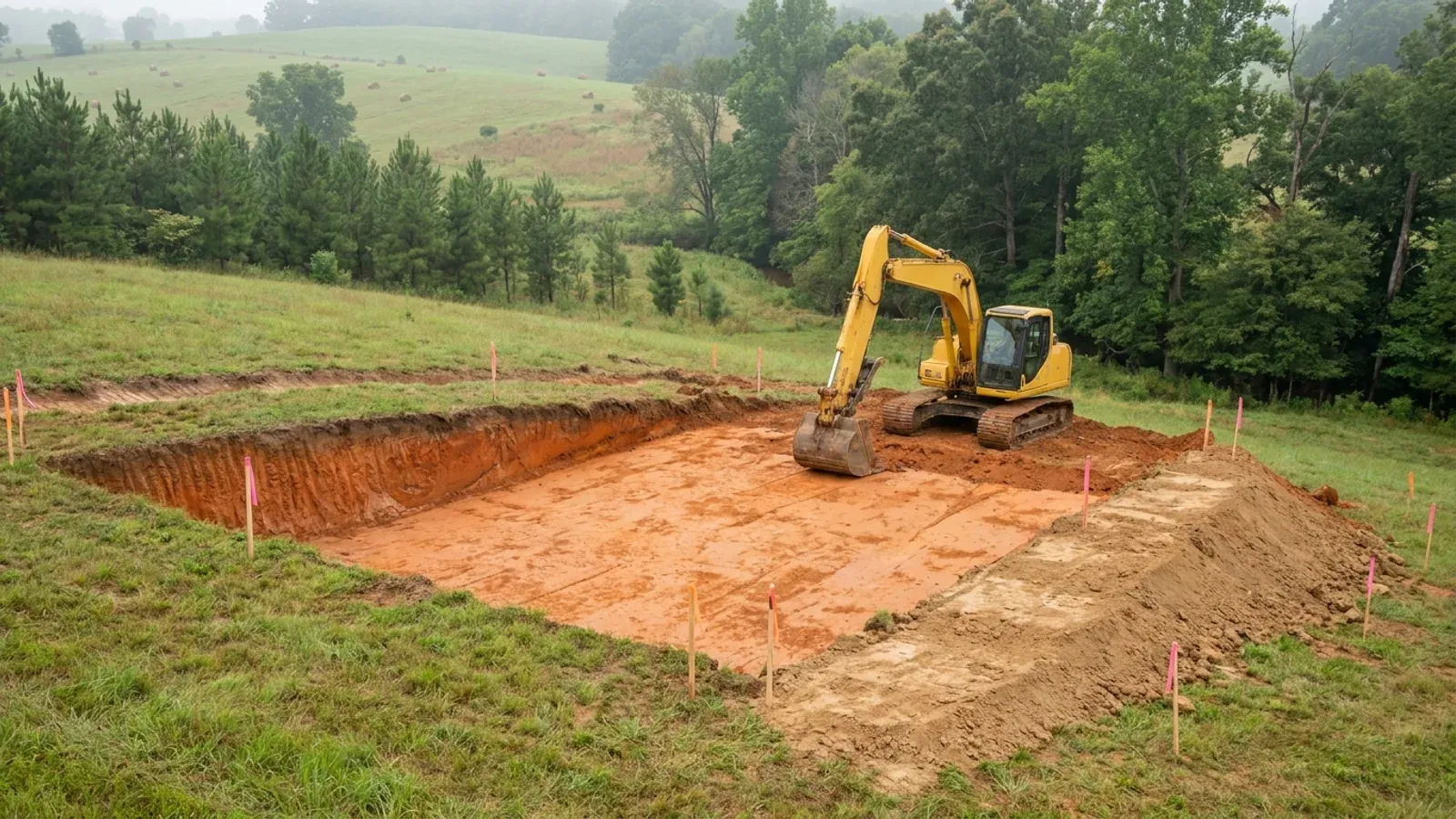
The expensive surprises are in the ground, not the building
What moves a South Carolina budget is usually below grade, and more often than not it is the drainfield rather than the foundation. R.61-56 § 200.1 settles whether a parcel can take an onsite system from soil morphology — texture, structure, depth to a restrictive horizon and depth to the zone of saturation — and § 200.2 then rules out two conditions outright: soils exhibiting massive or platy structure, and soils with substantial amounts of expansible layer clay minerals or smectites. That second clause is the one that bites on the mafic Piedmont, where the shrink-swell series sit in quantity under York, Fairfield, Chester, Laurens, Union, Newberry, Greenwood, McCormick, Lancaster, Saluda, Abbeville and Edgefield. A foundation problem has a price and an answer; an unbuildable septic parcel has neither, which is why we look at it first. Bedroom count is the number to settle early, because § 61-56.501 drives design flow from bedrooms, design flow drives trench length, and trench length plus a repair area decides how much good soil the parcel has to have — shop square footage adds nothing to it. Above the Fall Line the evaluation is done in backhoe pits rather than borings alone, so the answer comes from a dug hole and not a form. The site work, the foundation and the drainfield therefore get resolved together rather than one at a time. We price the dirt before we price the building.
What we build in Newberry County
All nine services are available in Newberry County. What a build costs depends far more on the parcel than on square footage, so we price against your land rather than publishing a rate card.
Custom Plans
Barndominium plans drawn for your parcel and sealed at the point where South Carolina’s engineering exemption stops applying.
Barndominium Kits
Engineered shell packages for South Carolina land — open construction under the state’s own definition, and therefore not a modular building.
Turnkey Builds
Barndominium construction from raw land through to occupancy: one contract, one schedule, one party answering the building official.
What a build looks like
Three stages every Newberry County project passes through, from a raw parcel to a finished home. Site work first, because that is where the budget is decided.
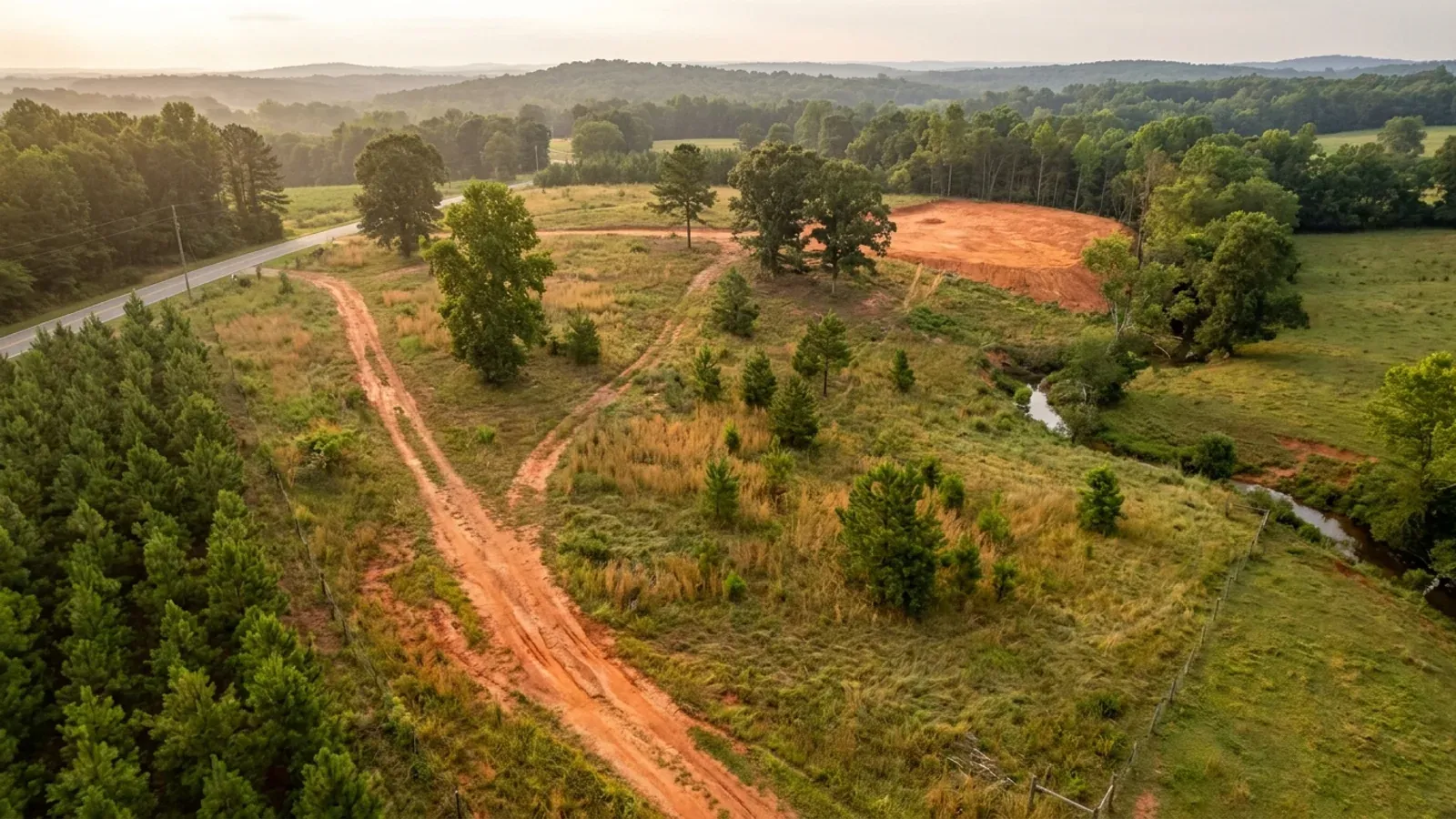
The parcel
Zoning, setbacks, flood zone and utility access get checked before anything is drawn.
Pad and permit
Clearing, grading and a compacted pad, while the submittal works through whichever office issues the permit where you are building.
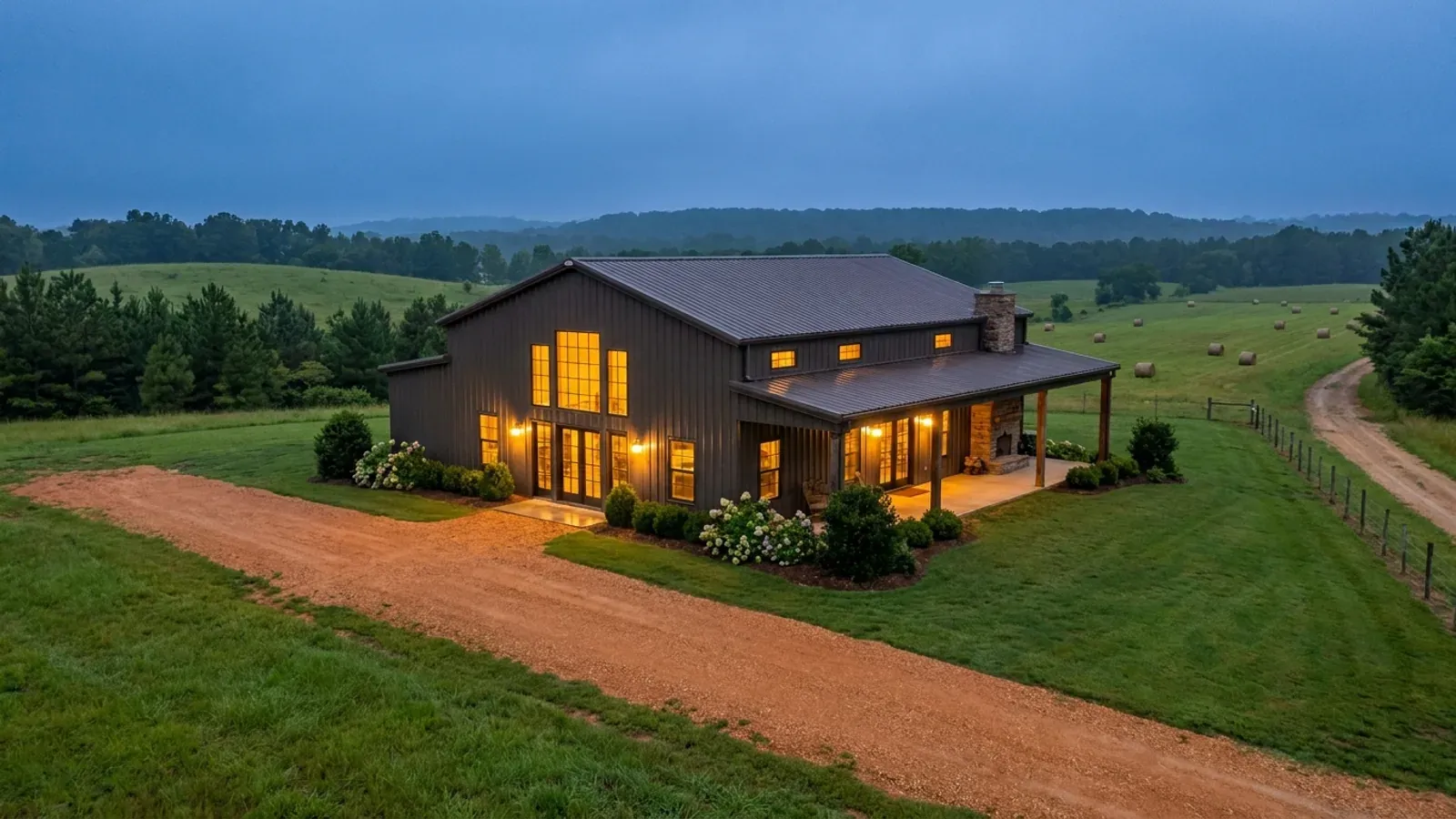
Frame to finish
Shell erected and dried in, then systems, insulation and interior finish through to CO.
Those are the rules where you are building in Newberry County. Tell us what you want to build and we will draw it to them.
Keep reading
The questions that usually come next once you know what Newberry County allows.
Nearby areas we build in
Others we cover nearby. One may be a county and another a municipality inside one — and a South Carolina municipality can sit in two counties at once — so the office that issues the permit, the fees it charges, whether the land is zoned at all, and which design map covers it can all differ from one card to the next.
Building in Newberry County: common questions
8 questions we get asked most often about building in Newberry County. If yours is not on the list, ask it directly.
Can the shop be bigger than the house in Newberry County?
What if I want to run a business out of the shop?
What design wind speed and seismic category apply in Newberry County?
Which permits do I need, in what order, and what do they cost?
Which code edition does Newberry County enforce?
This is one of the biggest farm counties in the state. Can I build it as a farm building?
What should I check about the ground before I buy in Newberry County?
How do I know my contractor is licensed for a job this size?
Building in Newberry County?
Start with the plan. Tell us what you want to build and we will draw it, then confirm which office issues the permit for your parcel, what it will let you put there, and what wind load it has to meet. That conversation costs nothing.