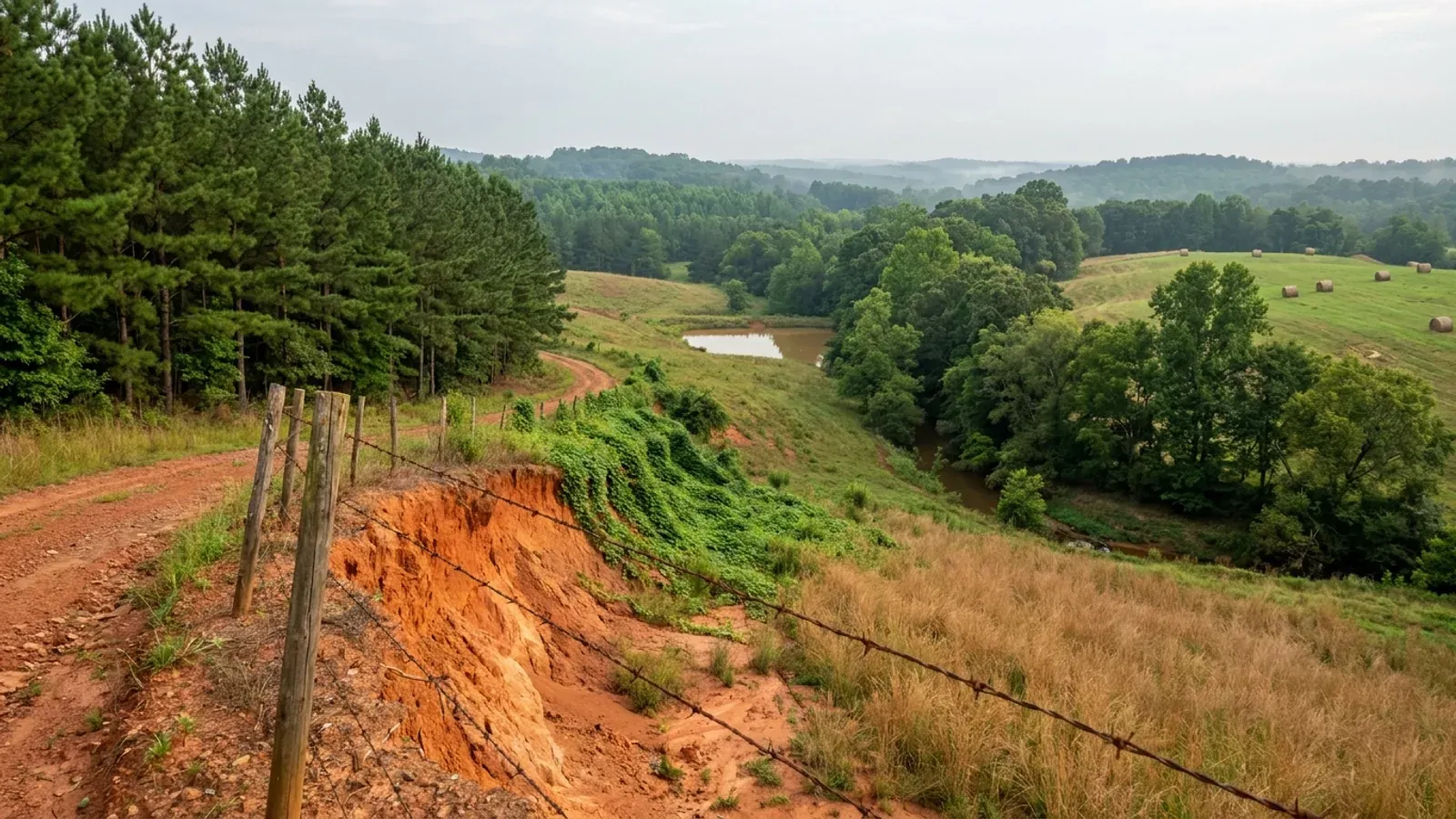
Rolling South Carolina Upstate pasture with a red dirt track cut through orange clay, planted pine rows on one edge, hardwood along a creek bottom, and round hay bales in the field.
Spartanburg County One statewide code, county design maps

Barndominium Builders in Spartanburg County, SC

Spartanburg County took in 9,230 net domestic migrants in the year to July 2025 — second only to Horry in the whole state — and added 52,860 people since the 2020 census. It is also one of the more unusual regulatory places to build in South Carolina, in three separate ways that all matter to a barndominium. It is one of eleven counties for which the Building Codes Council has approved no wind or seismic map at all, so the design figures nobody publishes have to be settled with the building official in writing. Its land-use regulation runs on two ordinances between them covering the whole unincorporated county — a Performance Zoning Ordinance in the Southwest Planning Area and a Unified Land Management Ordinance everywhere else — and the county states plainly that neither assigns zoning classifications at the parcel level the way a conventional district map does. And its Building Codes Department publishes a page addressed, by name, to barndominium customers, which sets out a rule that has been in force since October 2017 and that catches more people here than anything else in the code: a storage building may not be converted into a single-family home unless a South Carolina registered architect designed it. On the ground the county is 97,644 acres of farmland across 1,230 operations at a 79-acre average, on some of the best foundation soil in the state — 329,072 acres of Cecil, more than any other survey area in South Carolina.

Spartanburg County at a glance

County
Spartanburg County
Population
380,857

Building conditions in Spartanburg County

The building code is the same in every South Carolina county: S.C. Code § 6-9-10(A) requires each municipality and county to enforce the Building Codes Council's codes and to enforce only those, and SC Regulation 8-236(C) bars a local jurisdiction from writing one of its own. The design numbers are not local either, but they are not one number for the state — Regulations 8-1202 and 8-1203 send wind and seismic to the Council's own map for this county, and those maps are drawn as contours, so the figure is read at your address rather than off a county name. What is genuinely local is who issues the permit and inspects the work, what that office charges, the permit procedure it adopted by ordinance, whether your parcel is zoned at all, and the rest of Table R301.2 — frost depth, termite probability and flood — which the jurisdiction fills in for itself.

Build conditions for Spartanburg County , South Carolina . BUILD CONDITIONS SPARTANBURG COUNT…Spartanburg CountyONE STATEWIDE CODEADOPTED RESIDENTIAL CODEONE STATEWIDE CODENo design wind speed is carried on this page. It is read off the Building Codes Council mapcovering the county and settled in writing with the authority over your parcel before the frame i…ZONING · NO PARCEL-LEVEL ZONING CLASSIFICATIO…The county's own zoning page states that Spartanburg County operatesunder two ordinances covering the whole unincorporated area — the…IMPACT AND PERMIT FEESBuilding permit feeNo impact fee appears on Spartanburg County's published residentialfee schedule. The residential building permit is $4.75 per thousand…WHO ISSUES THE PERMITSpartanburg County Building Codes De…366 N Church Street, Main Level Suite 500, Spartanburg SC 29303;864-596-2727. Office hours 8:00 am to 4:30 pm, permitting to 4:00…
Build conditions for Spartanburg County, drawn from the sourced facts on this page. Every figure above is cited in the quick-facts panel below, with its source and vintage.
No Building Codes Council wind or seismic map exists for this county — and the absence is the local fact
South Carolina does not use the residential code's national wind and seismic maps for houses. Regulation 8-1202 replaces IRC Section R301.2.1 and Regulation 8-1203 replaces R301.2.2.1 with "the previously published maps by the South Carolina Building Codes Council," and those maps live on the Council's own Wind/Seismic Maps page. The page as served on 6 September 2026 carries 33 county map PDFs plus two whole-county text lines — Abbeville and York — for 35 of South Carolina's 46 counties. The string "Spartanburg" does not occur anywhere on it. The eleven counties with no approved map are Anderson, Cherokee, Greenville, Greenwood, Laurens, McCormick, Oconee, Pickens, Spartanburg, Sumter and Union: essentially the whole Upstate, plus Sumter. The page's own governing paragraph says the maps "are intended to be the primary source for defining the appropriate boundaries for wind and seismic design in South Carolina for single- and two-family dwellings," and that a hazard website may be consulted "to determine the wind and seismic zones if a map has not been approved for that particular county." So no South Carolina authority publishes an ultimate design wind speed or a seismic design category for Spartanburg County, and any figure quoted for this county without a named publisher behind it should be treated as somebody's assumption. The delineation power sits with the local building official under those same two regulations. Get the numbers into the plan-review correspondence in writing before a frame is ordered or a foundation is priced.

SC Building Codes Council, "Wind/Seismic Maps", https://llr.sc.gov/bcc/maps.aspx (served HTML retrieved and enumerated 6 Sep 2026: 33 county map PDFs plus whole-county text lines for Abbeville and York, and zero occurrences of "Spartanburg"); mechanism at SC Regs 8-1202 and 8-1203, 2021 Code Modifications, https://llr.sc.gov/bcc/PDFfiles/2021-Code-Modifications.pdf

Two ordinances cover the county and neither one assigns a zoning classification to your parcel
This is the single most misunderstood thing about building in Spartanburg County, and the county says it in one sentence on its own zoning page: "Spartanburg County is currently operating under two zoning ordinances--the Performance Zoning Ordinance (PZO) in the Southwest Planning Area and the Unified Land Management Ordinance (ULMO) in the remainder of the County... Neither ordinance assigns zoning classifications (such as residential, commercial, etc.) at the parcel level as do most traditional (or Euclidean) zoning ordinances." That is not the same thing as being unzoned, and it is not the same thing as conventional zoning either. There is a mapped district structure: the PZO establishes a Restrictive Development (RD) District, a General Development (GD) District and a Partial Restriction (PR) District, and in the PR District "the regulations contained in the Unified Land Management Ordinance (ULMO) shall apply" — that is how the two documents join up across the whole unincorporated county. But the districts are intensity and performance categories, not use categories. The RD District "is intended to be primarily used and preserved for agricultural and residential activities," and the ordinance's own explanation is that non-residential activity is not forbidden there but must meet "the more restrictive development standards," so that "Spartanburg County promotes good development, without unreasonably taking away a property owner's land use options." What follows for a barndominium is practical: there is no district label to look up that will tell you whether a dwelling with a large attached shop is allowed. The questions that actually decide it are setbacks, bufferyards, road classification, height, and — in the Southwest Planning Area — the PZO's activity-group tables. Ask Planning and Development which ordinance and which district your tax map number falls in first, then ask the standards question second.

Spartanburg County Planning and Development, "Zoning in Spartanburg County", https://www.spartanburgcounty.gov/760/Zoning-ULMO-and-PZO (served HTML read 6 Sep 2026); district definitions and the PR deferral at Performance Zoning Ordinance §§ 1.1.20 and 1.1.40, Ordinance # O-19-29 adopted 16 September 2019, effective 1 January 2020, amended through 15 June 2026 with an effective date of 15 July 2026, https://www.spartanburgcounty.gov/DocumentCenter/View/107061/PZO-Adopted-by-County-Council-61526-and-enacted-71526 (application/pdf, 2,269,838 bytes, downloaded 6 Sep 2026 and read as text extracted with pdftotext -layout)

The county publishes a page for barndominium customers — and it closes the shop-first-house-later route
Spartanburg County's Building Codes Department maintains a page under Residential Construction/Permitting headed "Tiny House/Barndominium (Steel/Metal Construction) Customers." Very few county building departments in South Carolina address this building type by name at all, and the substance of the page is a rule that decides how the project has to be sequenced. It reads: "Beginning October 1, 2017 Spartanburg County Building Codes Department will no longer allow a storage building to be converted to single family home. (EXCEPTION) Unless Designed by a S.C Registered Architect." It continues: "Tiny/Small Homes must be constructed on site meeting the requirements of the current edition of the adopted International Residential Code, or constructed by a licensed S.C. Modular Home Builder and moved to site," and "Wood storage buildings utilized as single family dwellings must be designed by a licensed Architect registered with the State of South Carolina. This includes the foundation. Stamped drawings must be submitted and approved." Read that carefully, because it kills the most common plan people arrive with. Putting up a metal shell as a storage building and finishing the living end later is not a permitting shortcut in this county — it is a conversion, and since October 2017 a conversion only goes through with an architect's stamped design behind it, foundation included. The cheaper and more predictable route is the one the department names: design and permit the building as a dwelling from the start, to the residential code, with the shop bay in the drawings.

Spartanburg County Building Codes, "Tiny House/Barndominium (Steel/Metal Construction) Customers", https://www.spartanburgcounty.gov/733/7584/Tiny-HouseSmall-House-Customers (served HTML read 6 Sep 2026); the department's habitability checklist at "Tiny Home Requirements", https://www.spartanburgcounty.gov/838/Tiny-Home-Requirements (read 6 Sep 2026)

Height is not capped — extra height is bought foot-for-foot in setback, and no rule sizes the shop against the house
This is the answer to the question a barndominium buyer actually asks, and in this county it is unusually generous in both ordinances. In the ULMO area, Table 3a's "Maximum Height (feet)" column for a single-family dwelling contains no number at all — only footnote (Y), which reads: "Each additional foot above 35' add 1' to each side and rear yard setback." Height above 35 feet is therefore not prohibited; it is priced in setback. The Performance Zoning Ordinance does the same thing in words at Section 2.3.10: "maximum building/structure height is 35 feet or 50 feet depending on the Activity Group. Maximum heights may be increased as follows: for buildings/structures exceeding the maximum height, setback values shall be increased by one (1) foot for each foot over 35 or 50 feet." A separate rule at 2.3.11 doubles that trade to two feet per foot on the river-facing facade for property near the Enoree, North Tyger, Middle Tyger and South Tyger Rivers. On floor area there is no ratio rule at all for a workshop. ULMO Section 3.20(2)(a) states flatly: "There is no limit to the number of accessory buildings." Table 3a gives an Accessory Use a 5-foot rear setback, 5 or 10 feet at the side, the road setback for its street class, and "NONE" for spacing between buildings on the same lot. The one place a percentage appears is Section 3.05, and it applies only to a second dwelling: "A single detached accessory dwelling unit no greater than 1/3 the floor area of the principal dwelling." A workshop is not a dwelling unit, and a shouse whose shop and living space share one continuous roof is not an accessory building at all — it is simply the principal dwelling, subject to the single-family row of Table 3a.

Spartanburg County Unified Land Management Ordinance, Ordinance No. O-99-015 adopted 31 December 1999 and amended through 7 March 2022 — Exhibit A Table 3a (Residential Setbacks and Other Requirements) with footnote (Y), Section 2.02-1, Section 3.05 and Section 3.20, https://www.spartanburgcounty.gov/DocumentCenter/View/107071/ULMO-amended-3722 (application/pdf, 1,791,803 bytes, downloaded 6 Sep 2026 and read as text extracted with pdftotext -layout); Performance Zoning Ordinance §§ 2.3.10 and 2.3.11, https://www.spartanburgcounty.gov/DocumentCenter/View/107061/PZO-Adopted-by-County-Council-61526-and-enacted-71526 (read 6 Sep 2026)

329,072 acres of Cecil — the largest body of good foundation soil of any survey area in the state
The ordinary red Piedmont clay that people arrive worried about is, in Spartanburg County, mostly the thing they should be pleased to find. A Soil Data Access query of the SSURGO database returns 329,072 acres of Cecil as a mapped component in the Spartanburg survey area — more than Anderson (207,080), more than Greenville (165,580), more than any other survey area in South Carolina — plus 36,578 acres of Pacolet. Both are kaolinitic: kaolinite is a low-activity 1:1 clay with none of smectite's interlayer swelling, so this is firm, well-drained, low-shrink-swell ground that ordinarily satisfies the residential code's presumptive bearing value for clay and often exceeds it, and it is about the friendliest soil in the state for an embedded-post frame. The genuinely expansive soils exist here but are a small minority of the county: the same query returns 4,777 acres of Wynott and 1,959 acres of Brewback, both weathered off mafic rock — diabase, gabbro, diorite — and both rated high or very high for shrink-swell. Against 329,072 acres of Cecil that is a patchwork to be located, not a countywide condition to be feared. What actually varies on an Upstate parcel is depth: residual saprolite of inconsistent thickness over rock, weathered-rock refusal at different elevations across one pad. On a wide slab-on-grade building with a long clear span that is worth a boring before the foundation is priced, rather than a surprise after the excavator finds rock under one corner.

NRCS Soil Data Access SSURGO component-acreage queries by survey area, recorded in research/statewide/soils-and-geology.md; series properties from the USDA-NRCS Official Series Descriptions, https://soilseries.sc.egov.usda.gov/OSD_Docs/C/CECIL.html , https://soilseries.sc.egov.usda.gov/OSD_Docs/P/PACOLET.html , https://soilseries.sc.egov.usda.gov/OSD_Docs/W/WYNOTT.html and https://soilseries.sc.egov.usda.gov/OSD_Docs/B/BREWBACK.html

9,230 net domestic migrants in one year, into a county of 1,230 farms averaging 79 acres
The Census Bureau's Vintage 2025 estimates put Spartanburg County at 380,857 people as of 1 July 2025, against 327,997 at the 2020 census — up 52,860, or 16.1 percent, the sixth-fastest rate in South Carolina and the third-largest absolute gain. The single-year migration number is the one that describes the market: net domestic migration of +9,230 in the year to July 2025, second in the state behind Horry, plus 1,161 net international and 621 natural increase. The land those people are arriving into is small-tract country. The 2022 Census of Agriculture counts 1,230 farms working 97,644 acres — 18.9 percent of the county's 517,383 land acres — at an average of 79 acres. The distribution is the useful part: 144 farms of 1 to 9 acres and 678 of 10 to 49, so 822 of the 1,230 operations are under 50 acres, 275 sit between 50 and 179, and only 41 in the whole county exceed 500 acres. Farmland use splits into 34,327 acres of cropland, 24,149 of pasture and 32,213 of woodland. Between 2017 and 2022 the number of farms fell 14 percent while land in farms rose 2 percent and the average holding grew 19 percent, so the acreage base is not shrinking here the way it is in Greenville next door — but the tracts that come to market in the five-to-forty-acre range are what a barndominium buyer is competing for, and they are competing against a lot of new arrivals.

U.S. Census Bureau, Vintage 2025 County Population Estimates, co-est2025-alldata.csv, SUMLEV 050, STATE 45 / COUNTY 083, https://www2.census.gov/programs-surveys/popest/datasets/2020-2025/counties/totals/co-est2025-alldata.csv ; USDA National Agricultural Statistics Service, 2022 Census of Agriculture County Profile — Spartanburg County, South Carolina, https://www.nass.usda.gov/Publications/AgCensus/2022/Online_Resources/County_Profiles/South_Carolina/cp45083.pdf (HTTP 200, application/pdf, 879,562 bytes, downloaded 6 Sep 2026 and read as text extracted in both layout and reading-order modes); land area from https://www2.census.gov/geo/docs/maps-data/data/gazetteer/2025_Gazetteer/2025_gaz_counties_45.txt

Also worth knowing before you build in Spartanburg County

The fallback the adopted code text names stopped operating at the end of 2024
The gap left by the missing county map has a second half worth knowing before an engineer bills for it. The 2021 modification in force today tells the local building official that a hazard website may be consulted where no Council map exists. That site is gone. The Council's own staff comment on the 2024 residential seismic item records: "The Committee should consider that the ATC Hazards by Location site ceased operation on December 31, 2024. Users are being encouraged to use the ASCE Hazard Tool in its place." The 2024 modifications rewrite R301.2.1 and R301.2.2.1 to point at the ASCE Hazard Tool directly, with an implementation date of 1 January 2027. So for the whole of 2026 the position in Spartanburg County is that there is no state-published map and the site the in-force code text names no longer exists. That is not a reason for alarm; it is a reason to settle the criteria with Building Codes in writing at plan review and to have the engineer state on the drawings which source and which values were used. It also has a bearing on how much engineering the project needs. The residential code applies its seismic chapter to a detached one- or two-family dwelling only in seismic design categories D0, D1 and D2, and those categories are confined, on the Council's own maps, to the Lowcountry — but with no published category for this county, the honest answer is that the building official determines it, and a barndominium's big open shop bay beside a two-storey living end is exactly the plan shape that R301.2.2.6's irregularity conditions catch if it lands in a category that switches the chapter on.

SC Building Codes Council, "2024 Combined Continued Modifications with Index", staff comment on the 2024 IRC R301.2.2.1 item, https://llr.sc.gov/bcc/Forms/2024%20Combined%20Continued%20Modifications%20with%20Index.pdf ; adoption and implementation dates at https://llr.sc.gov/bcc/BCAdoption.aspx ; seismic trigger at 2021 South Carolina Residential Code §§ R301.2.2 and R301.2.2.6 as modified by Regs 8-1202 and 8-1203, https://llr.sc.gov/bcc/PDFfiles/2021-Code-Modifications.pdf

A storage building on a vacant parcel is not an accessory building — it is the principal activity
Inside the Southwest Planning Area the Performance Zoning Ordinance has a provision that decides the order of operations for anyone planning to put a shop up first. Section 2.1.20 lists Accessory Activities, and item (n) reads: "Personal Use Storage Buildings that meet the accessory use requirements may be placed on a residential property with an existing residence. Personal Use Storage Buildings shall not be used for commercial, institutional, or other nonresidential purposes. If the Parcel is vacant, the proposed building shall be considered a Principal Activity and must obtain a Zoning and/or Building Permit for a Principal Activity listed in Section 2.1.10." That is the land-use half of the same point the Building Codes Department makes on the code side: on bare ground there is no such thing as an accessory shop, because there is nothing yet for it to be accessory to. The building is the principal activity on the parcel and is permitted as one. Pair that with the department's October 2017 conversion rule and the sequencing question answers itself — on a vacant tract, the cheapest path to a lawful dwelling is to permit the dwelling.

Spartanburg County Performance Zoning Ordinance § 2.1.20 (Accessory Activities), item (n), https://www.spartanburgcounty.gov/DocumentCenter/View/107061/PZO-Adopted-by-County-Council-61526-and-enacted-71526 (read 6 Sep 2026)

The permit fee is one line: $4.75 per thousand of construction cost, $32.00 minimum
Spartanburg County publishes a single, unusually simple residential fee schedule, effective 1 July 2017. A residential building permit is "$4.75 per Thousand, $32.00 Minimum" of construction cost. Residential mechanical, electrical, plumbing, swimming pool and fire sprinkler permits run on the same table — $32.00 up to $2,000.99, then $32.00 plus $4.75 per thousand over $2,000. Sheds, garages and other improvements use the same figures, and so do agricultural buildings, which additionally require the completed agricultural disclosure statement. A demolition permit is $105.00 and a moving permit is $105.00. The printable schedule also carries a septic tanks line at $150.00 — note that the onsite wastewater system itself is permitted by the state under Regulation 61-56, not by the county. Reinspection is $53.00 for the third and subsequent inspections. Renewal is $53.00 each, and this is the line that catches long self-managed builds: permits expire six months after issuance or after the last inspection, for building, plumbing, mechanical and electrical alike. The department's own page says it will estimate the fee once you give it the building use, type of construction, square footage and total cost. There is no valuation table converting square feet into a deemed cost, and no impact fee appears on the county's published residential schedule.

Spartanburg County Building Codes, "Residential Fee Schedule" (effective 1 July 2017), https://www.spartanburgcounty.gov/732/7569/Residential-Fee-Schedule (served HTML read 6 Sep 2026), with the printable version at https://www.spartanburgcounty.gov/DocumentCenter/View/13516/RESIDENTIAL-FEE-SCHEDULE ; fee-estimate practice from Building Codes, https://www.spartanburgcounty.gov/173/Building-Codes (read 6 Sep 2026)

The agricultural exemption here comes with a notarised affidavit, and a barndominium cannot use it
Spartanburg County publishes the form, which makes the limits of the exemption unusually easy to see. Its "Agricultural Building Statement" reproduces S.C. Code § 6-9-65 in full and then asks the owner to swear to it before a notary. The statute defines a farm structure as one built on a farm "other than a residence or a structure attached to it," and expressly excludes any structure "originally qualifying as a 'farm structure' but later converted to another use." A barndominium is a residence, so it is outside the exemption in every case; the shop half of a shouse is attached to a residence, so it is outside too. There is no square-footage test and no percentage-of-use test to argue over. The county's acknowledgement paragraph puts it in plain words for the owner to sign: "As an agricultural building this building may not be used for any purpose, including residential or commercial, other than agriculture. I further understand that if the use of the structure changes, The Spartanburg County Building Codes Department will be notified and any required permits will be obtained." The form is signed, dated and sworn before a Notary Public of South Carolina. Section 6-9-65(C) makes the exemption conditional on exactly that filing before construction; § 6-9-65(B) preserves the National Flood Insurance Program standards regardless; and § 6-9-65(D) leaves the county free to require a building permit anyway — which it does, at the same $4.75 per thousand as everything else. Combined with the department's rule against converting a storage building into a dwelling, the exemption route to a barndominium is closed at both ends here.

Spartanburg County Building Codes, "Agricultural Building Statement", https://www.spartanburgcounty.gov/DocumentCenter/View/13430/Agricultural-Building-statement (HTTP 200, application/pdf, 71,949 bytes, downloaded 6 Sep 2026 and read as extracted text); S.C. Code § 6-9-65, https://www.scstatehouse.gov/code/t06c009.php ; fee treatment at https://www.spartanburgcounty.gov/732/7569/Residential-Fee-Schedule

The Performance Zoning Ordinance was amended this July, and some of it now applies countywide
County Council approved a substantial set of amendments to the Performance Zoning Ordinance on 15 June 2026, with an effective date of 15 July 2026 — recent enough that older advice about this county is out of date. The county's own FAQ describes the PZO as governing the Southwest Planning Area, "which includes unincorporated areas within the vicinity of Duncan, Lyman, Reidville, Greer, and Woodruff," and explains the design philosophy: "Unlike traditional zoning, which focuses primarily on land-use categories for specific parcels, a focal point of the PZO is how development actually performs on the ground." Two of the amendments reach outside that area. New residential subdivisions of four or more lots must now provide landscaping and trees along existing roads bordering the development, countywide; and where neighbourhood entry signage is provided it must use upgraded materials and landscaping. The FAQ is explicit that this is not an extension of parcel-level zoning: "the Unified Land Management Ordinance (ULMO) remains in place outside the Southwest Planning Area," though "Council's longer-term goal is to have one consistent set of land management rules across the county." Projects already approved are not affected retroactively. For a single self-built barndominium on an existing tract none of this bites directly — the subdivision landscaping rules attach to divisions of four or more lots — but anyone buying into a new rural subdivision here is buying under standards that changed two months ago.

Spartanburg County, "Performance Zoning Ordinance Amendments — Frequently Asked Questions" (approved by County Council 15 June 2026, effective 15 July 2026), https://www.spartanburgcounty.gov/DocumentCenter/View/107063/PZO-FAQ (HTTP 200, application/pdf, 66,292 bytes, downloaded 6 Sep 2026 and read as extracted text); ordinance itself at https://www.spartanburgcounty.gov/DocumentCenter/View/107061/PZO-Adopted-by-County-Council-61526-and-enacted-71526

Above the Fall Line the septic evaluation is dug with a backhoe, not augered
Septic is a state permit, not a county one: the South Carolina Department of Environmental Services permits onsite wastewater under Regulation 61-56. The Upstate difference is method. Section 104.1(5) provides that backhoe pits are required above the Fall Line separating the Piedmont from the Coastal Plain as defined by the South Carolina Geological Survey, and the whole of Spartanburg County is above that line — so the evaluation is a machine on site, not a hand auger, and the site has to be ready for it. Section 104.1(6) requires the boundary lines and corners cleared and marked, an identification marker at the front centre of the lot, the corners of the proposed building staked, the stub-out, tank and drainfield area marked and the well located before the evaluator arrives. Space is the other constraint on a wide building: § 200.6 keeps no part of the system within five feet of a building or a property line, 75 feet of a private well or 25 feet of a drainage ditch, and § 200.7(1) requires a usable repair area equivalent to at least fifty percent of the size of the original system. The evaluation may be done by certified Department staff or by a licensed Professional Soil Classifier, and the Permit to Construct is valid five years provided site conditions do not change. Site the drainfield and its replacement area first and the building pad second — on a barndominium footprint that is a wider building than the county's septic staff usually see, and the layout is easier to solve on paper than on the ground.

S.C. Regulation 61-56, Onsite Wastewater Systems, §§ 102, 104.1(5), 104.1(6), 200.6 and 200.7(1), SCDES copy at https://des.sc.gov/sites/des/files/Library/Regulations/R.61-56.pdf ; Fall Line placement of the county from research/statewide/land-water-and-septic.md and the SCDNR Geological Survey physiographic mapping at https://www.dnr.sc.gov/geology/geologic-hazards.html

There is no karst under a Spartanburg parcel — that warning belongs somewhere else
Buyers arriving from limestone country ask about sinkholes, because in the Appalachian valleys a parcel genuinely can sit on soluble carbonate rock. South Carolina is not built that way, and the Upstate least of all. SCDNR's own geologic-hazards mapping of karst, GGMS-5, covers the Coastal Plain only — its title says so — and the areas it draws are a broad potentially-karstic zone in the middle Coastal Plain plus a handful of discrete known-sinkhole areas around Beaufort, east of Lake Moultrie along the Santee River, north of Myrtle Beach and at Georgetown. The Piedmont, which is all of Spartanburg County, is crystalline rock, and crystalline rock does not dissolve. What does bite on an Upstate parcel is more mundane: saprolite depth that changes across one building pad, weathered-rock refusal at inconsistent elevations, and slope. Note also that neither the county nor the state publishes a numeric slope threshold that applies here — the only South Carolina figure found is a 10 percent slope-stability modelling threshold inside GGMS-5, and that map's own disclaimer says the information "should not be used for land-use zoning, building-code requirements, or defining insurance rate zones" and is not a substitute for a site-specific geotechnical evaluation. Those are boring questions, not map questions.

SCDNR Geological Survey, Geologic Hazards of the South Carolina Coastal Plain, GGMS-5 (2012, 1:600,000), map discussion, legend and disclaimer, https://www.dnr.sc.gov/geology/pdfs/GGMS5.pdf ; SCDNR Geologic Hazards landing page, https://www.dnr.sc.gov/geology/geologic-hazards.html

Two dwellings on one tract are allowed here, and the rules for the second one are written down
Rural buyers frequently want a second dwelling on the same acreage — for a parent, for a build-while-you-live-there arrangement, or as the eventual main house once the shop end is finished. The ULMO answers it directly. Section 2.02-6 provides that except for single-family detached dwellings there is no limit on the number of principal buildings on a lot; and then: "Two single-family, detached residential dwellings, including manufactured/mobile homes, or any combination of two such dwellings may be established on a single lot or parcel; provided the dimensional requirements on Table 3 shall be met for both dwellings as if they were established on separate lots," arranged to ensure public street access and lot conformance in case the property is later subdivided. The section requires fifty feet of public street frontage for each dwelling, disallows 25-foot flag lots for this purpose, and prohibits multiple dwelling units on lots served by roads built to the private-street standard or lesser. It also confirms that "Single family dwellings may be located on non-residential parcels provided all applicable requirements of this ordinance are met." There is a separate and smaller route at Section 3.05 for an accessory dwelling unit no greater than one third of the principal dwelling's floor area. Note the timing point: a recreational vehicle "may be set up for a period of up to 90 days within a twelve-month period for the purposes of living on site while building a residence," which is a shorter window than most owner-builders assume.

Spartanburg County Unified Land Management Ordinance §§ 2.02-6, 3.03-2 and 3.05, https://www.spartanburgcounty.gov/DocumentCenter/View/107071/ULMO-amended-3722 (read 6 Sep 2026)
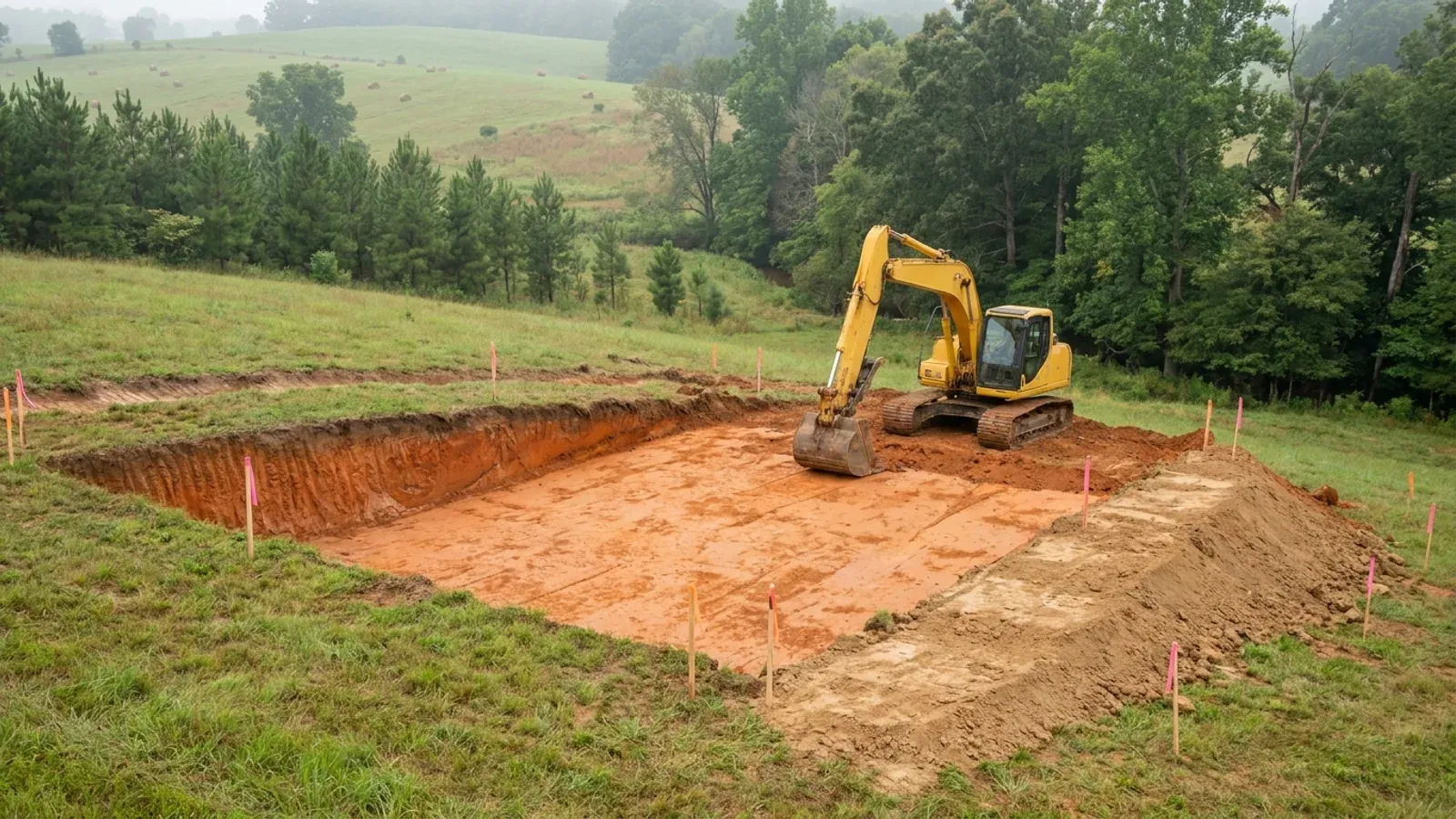
An excavator grading a compacted building pad on a cleared lot, with orange clay in the cut face, survey stakes and a drainage swale.
Below the slab

The expensive surprises are in the ground, not the building

What moves a South Carolina budget is usually below grade, and more often than not it is the drainfield rather than the foundation. R.61-56 § 200.1 settles whether a parcel can take an onsite system from soil morphology — texture, structure, depth to a restrictive horizon and depth to the zone of saturation — and § 200.2 then rules out two conditions outright: soils exhibiting massive or platy structure, and soils with substantial amounts of expansible layer clay minerals or smectites. That second clause is the one that bites on the mafic Piedmont, where the shrink-swell series sit in quantity under York, Fairfield, Chester, Laurens, Union, Newberry, Greenwood, McCormick, Lancaster, Saluda, Abbeville and Edgefield. A foundation problem has a price and an answer; an unbuildable septic parcel has neither, which is why we look at it first. Bedroom count is the number to settle early, because § 61-56.501 drives design flow from bedrooms, design flow drives trench length, and trench length plus a repair area decides how much good soil the parcel has to have — shop square footage adds nothing to it. Above the Fall Line the evaluation is done in backhoe pits rather than borings alone, so the answer comes from a dug hole and not a form. The site work, the foundation and the drainfield therefore get resolved together rather than one at a time. We price the dirt before we price the building.

What a build looks like

Three stages every Spartanburg County project passes through, from a raw parcel to a finished home. Site work first, because that is where the budget is decided.
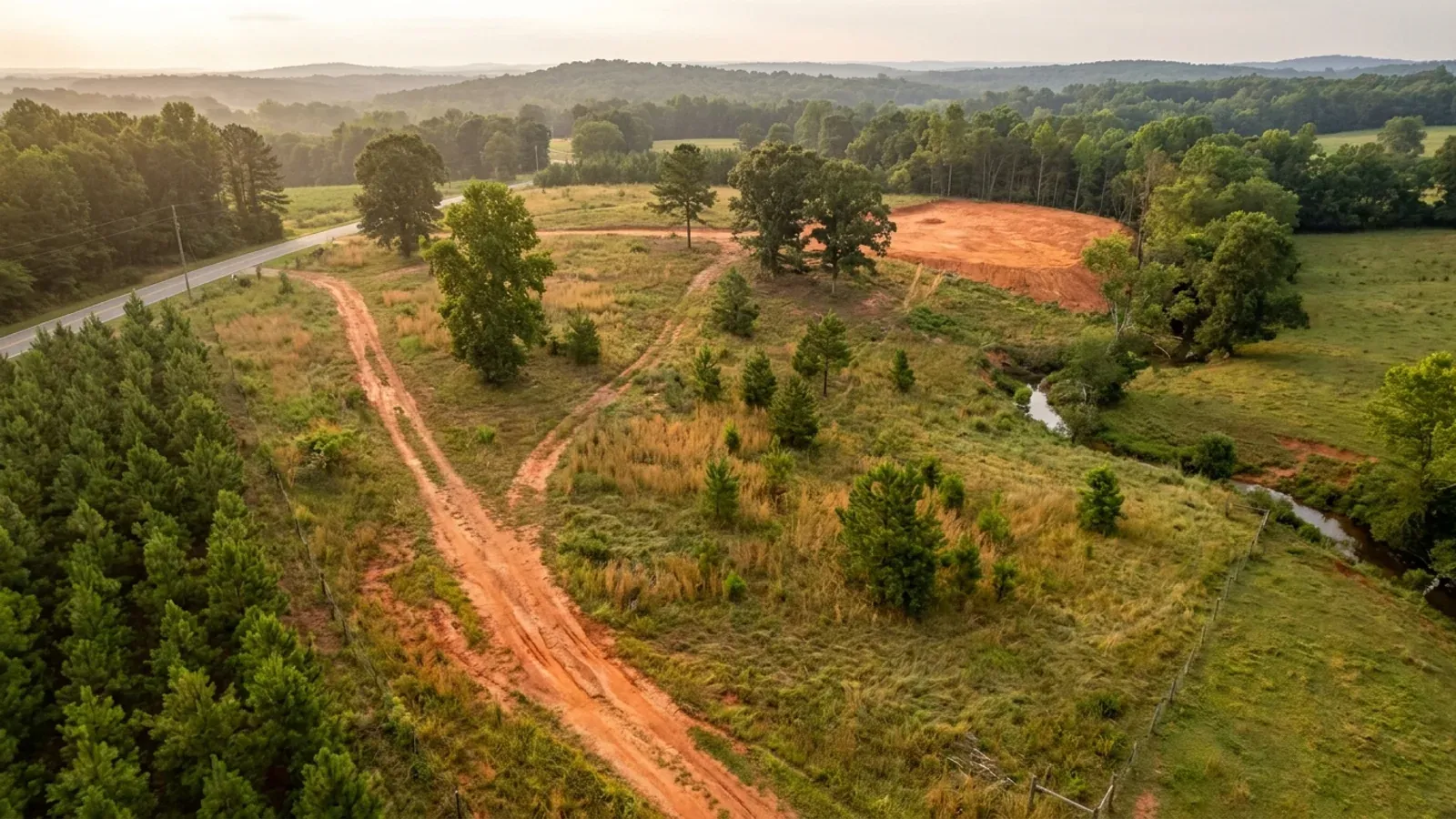
Aerial view of an undeveloped rural lot with cleared rough grass, planted pine along one boundary, and a red dirt access track cut through orange clay.
Stage one

The parcel

Zoning, setbacks, flood zone and utility access get checked before anything is drawn.

An excavator grading a compacted building pad on a cleared lot, with orange clay in the cut face, survey stakes and a drainage swale.
Stage two

Pad and permit

Clearing, grading and a compacted pad, while the submittal works through whichever office issues the permit where you are building.
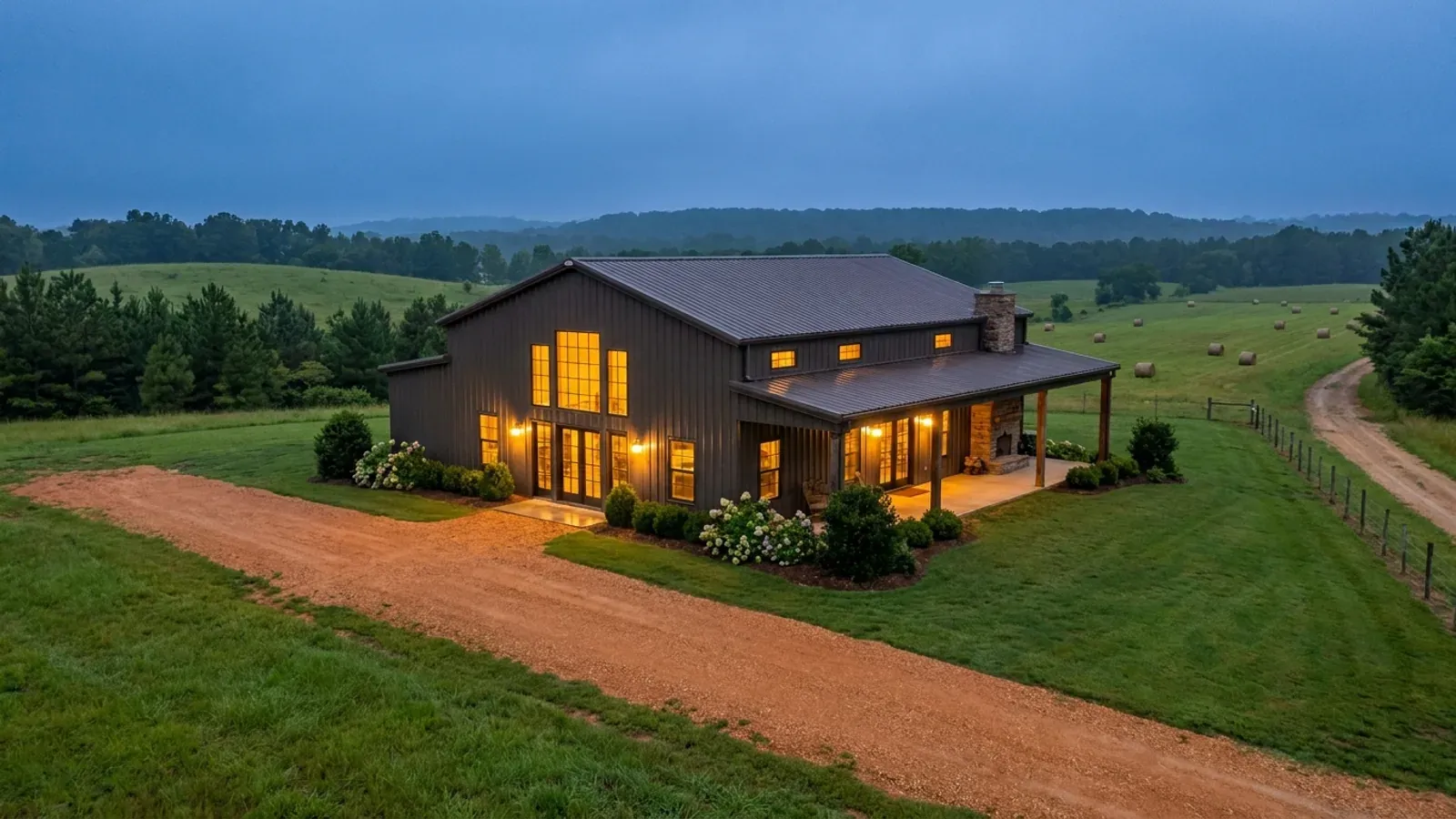
A finished barndominium at dusk with warm interior lighting glowing through its large windows.
Stage three

Frame to finish

Shell erected and dried in, then systems, insulation and interior finish through to CO.

Those are the rules where you are building in Spartanburg County. Tell us what you want to build and we will draw it to them.

Nearby areas we build in

Others we cover nearby. One may be a county and another a municipality inside one — and a South Carolina municipality can sit in two counties at once — so the office that issues the permit, the fees it charges, whether the land is zoned at all, and which design map covers it can all differ from one card to the next.

Building in Spartanburg County: common questions

9 questions we get asked most often about building in Spartanburg County. If yours is not on the list, ask it directly.

What wind speed and seismic design category should my engineer use in Spartanburg County?
Ask the county building official in writing, and be suspicious of any figure quoted without one. South Carolina does not use the residential code's national maps for houses: Regulations 8-1202 and 8-1203 replace the code's wind and seismic sources with the Building Codes Council's own county maps. The Council's page carries 33 county map PDFs plus whole-county text lines for two more, covering 35 of the 46 counties. Spartanburg is one of the eleven it does not cover, alongside Anderson, Cherokee, Greenville, Greenwood, Laurens, McCormick, Oconee, Pickens, Sumter and Union — essentially the entire Upstate. That absence is the local fact and it should be stated rather than papered over: no South Carolina authority publishes an ultimate design wind speed or a seismic design category for this county, and no completed Table R301.2 for Spartanburg County was located either. The Council's page tells the building official to consult a hazard tool where no map exists, and the Council's own 2024 staff comment records that the ATC Hazards by Location site "ceased operation on December 31, 2024," pointing users at the ASCE Hazard Tool instead; from 1 January 2027 the 2024 modifications move the code text itself to that tool. Until then the honest position is that the delineation power sits with the local official under those same regulations, and the numbers belong in plan-review correspondence before anyone orders a frame. The same goes for ground snow load, frost depth and winter design temperature: South Carolina leaves those cells to the jurisdiction, this county publishes none, and the 12-inch minimum footing depth below undisturbed ground in R403.1.4 applies regardless.
What zoning district is my land in?
Probably none, in the sense you mean — and that is the most important thing to understand about building here. Spartanburg County's own zoning page says the county operates under two ordinances that between them cover the whole unincorporated area: the Performance Zoning Ordinance in the Southwest Planning Area, which the county's FAQ describes as the unincorporated land in the vicinity of Duncan, Lyman, Reidville, Greer and Woodruff, and the Unified Land Management Ordinance in the remainder. The page then says it plainly: "Neither ordinance assigns zoning classifications (such as residential, commercial, etc.) at the parcel level as do most traditional (or Euclidean) zoning ordinances." There is still a mapped structure. The PZO establishes a Restrictive Development District, a General Development District and a Partial Restriction District, and in the Partial Restriction District the ULMO's rules apply — which is how the two documents cover the ground between them. But those districts sort development by intensity and performance rather than by use category. The Restrictive Development District, for example, is described as intended primarily for agricultural and residential activity, with non-residential activity admitted subject to more restrictive standards rather than excluded. So there is no district label to look up that says whether a dwelling with a big attached shop is allowed. What decides it is setbacks, road classification, bufferyards, height, and in the Southwest Planning Area the PZO's activity-group tables. Start by asking Planning and Development which ordinance and district your tax map number falls in — the county publishes an interactive zoning map for exactly that — and take the standards question from there.
Can the shop be bigger and taller than the house?
Yes on both counts, and this county is unusually clean about how. On floor area there is simply no ratio rule for a workshop. ULMO Section 3.20(2)(a) says "There is no limit to the number of accessory buildings," and Table 3a gives an Accessory Use a set of setbacks and nothing else — 5 feet at the rear, 5 or 10 feet at the side, the road setback for the street class, and "NONE" for spacing between buildings on the same lot. The only percentage in the residential provisions is Section 3.05, and it governs an accessory dwelling unit — "no greater than 1/3 the floor area of the principal dwelling" — which is a second living space, not a workshop. On height the ordinances do something more interesting than capping it. The Maximum Height column of ULMO Table 3a contains no number at all for a single-family dwelling, only footnote (Y): "Each additional foot above 35' add 1' to each side and rear yard setback." The Performance Zoning Ordinance says the same thing in words at Section 2.3.10, from a base of 35 or 50 feet by activity group, with the increase again bought at one foot of setback per foot of height. Near the Enoree, North Tyger, Middle Tyger and South Tyger Rivers, Section 2.3.11 doubles that to two feet per foot on the river-facing facade. So a tall shop bay is a question of how much room you have to give up at the side and rear lines, not whether it is permitted. And if the shop and the living space share one continuous roof, none of the accessory provisions apply at all: the whole building is the principal dwelling and takes the single-family row of Table 3a.
Can I put the shell up as a storage building and finish the living space later?
No — and Spartanburg County is one of the few counties in South Carolina that has written this down and addressed it to barndominium buyers by name. The Building Codes Department's page headed "Tiny House/Barndominium (Steel/Metal Construction) Customers" states: "Beginning October 1, 2017 Spartanburg County Building Codes Department will no longer allow a storage building to be converted to single family home. (EXCEPTION) Unless Designed by a S.C Registered Architect." The same page requires that "Tiny/Small Homes must be constructed on site meeting the requirements of the current edition of the adopted International Residential Code, or constructed by a licensed S.C. Modular Home Builder and moved to site," and that a wood storage building used as a single-family dwelling "must be designed by a licensed Architect registered with the State of South Carolina. This includes the foundation. Stamped drawings must be submitted and approved." The land-use side reaches the same conclusion from the other direction: inside the Southwest Planning Area, PZO Section 2.1.20(n) provides that a personal-use storage building on a vacant parcel "shall be considered a Principal Activity" and needs a principal-activity permit, because there is no residence yet for it to be accessory to. And the agricultural route is closed too — S.C. Code § 6-9-65 excludes a residence, anything attached to one, and any structure "originally qualifying as a 'farm structure' but later converted to another use," which is exactly what a later finish-out is. The practical answer is that permitting the building as a dwelling from the start, with the shop bay in the drawings, is both cheaper and faster than proving an unpermitted shell after the fact.
How much will the county charge me?
Less than most people expect, because the schedule is a single rate rather than a valuation table. Spartanburg County's residential fee schedule, effective 1 July 2017, prices a residential building permit at $4.75 per thousand of construction cost with a $32.00 minimum. Residential mechanical, electrical, plumbing, swimming pool and fire sprinkler permits use the same structure: $32.00 up to $2,000.99, then $32.00 plus $4.75 per thousand above $2,000. Sheds, garages and other improvements are on the same line, and so are agricultural buildings, which additionally require the completed agricultural disclosure statement. A demolition permit is $105.00, a moving permit is $105.00, and the printable schedule carries a septic tanks line at $150.00 — the onsite wastewater system itself is still a state permit under Regulation 61-56. Reinspections cost $53.00 from the third inspection onward. There is no impact fee on the published residential schedule. Two things are worth planning around. First, renewals: a permit expires six months after issuance or after the last inspection — building, plumbing, mechanical and electrical alike — and each renewal is $53.00, so a slow owner-managed build can accumulate them. Second, the department estimates the fee from the building use, type of construction, square footage and total cost, so an honest cost figure at application avoids a revision later. Septic is a separate state permit under Regulation 61-56 and is not part of any of this.
Is the red clay here a foundation problem?
Mostly the opposite, and it is worth saying clearly because the anxiety usually arrives from somewhere else. A query of the SSURGO soil database returns 329,072 acres of Cecil as a mapped component in the Spartanburg survey area — more than any other survey area in South Carolina — plus 36,578 acres of Pacolet. Both are kaolinitic soils, and kaolinite is a low-activity clay without the interlayer swelling that makes a smectite clay heave. That is firm, well-drained, low-shrink-swell ground: it ordinarily satisfies the residential code's presumptive bearing value for clay and often exceeds it, and it is among the best material in the state for an embedded-post frame. Genuinely expansive soil does exist here, weathered off mafic rock — the same query returns 4,777 acres of Wynott and 1,959 acres of Brewback, rated high and very high for shrink-swell — but against 329,072 acres of Cecil that is a patchwork to be located rather than a countywide condition. What actually varies across an Upstate building pad is depth: saprolite of inconsistent thickness over rock, and weathered-rock refusal at different elevations under different corners. On a wide slab-on-grade building with a long clear span, a boring before the foundation is priced is cheap insurance against finding rock under one corner and soft residuum under another. And to answer the question people really ask: there is no karst here. South Carolina's sinkhole country is a Coastal Plain limestone phenomenon; the Piedmont is crystalline rock and crystalline rock does not dissolve.
How does the septic evaluation work, and when should I do it?
Before you close, not after. Onsite wastewater is permitted by the South Carolina Department of Environmental Services under Regulation 61-56, not by the county, and the Upstate has its own method. Section 104.1(5) requires backhoe pits above the Fall Line separating the Piedmont from the Coastal Plain, and all of Spartanburg County is above that line — so the evaluation is a machine digging pits on site, not a hand auger, and the site has to be prepared before the evaluator arrives. Section 104.1(6) wants the boundary lines and corners cleared and marked, an identification marker at the front centre of the lot, the corners of the proposed building staked, the stub-out, tank and drainfield area marked and the well located. The evaluation can be done by certified Department staff or by a licensed Professional Soil Classifier you hire directly, which is usually the faster lane. Space is the constraint that catches this building type: Section 200.6 keeps no part of the system within five feet of a building or a property line, 75 feet of a private well or 25 feet of a drainage ditch, and Section 200.7(1) requires a usable repair area equal to at least fifty percent of the original system. A barndominium is a wider footprint than the layouts these rules were drawn around, so the drainfield and its replacement area should be sited first and the building pad second. The Permit to Construct is valid five years provided site conditions do not change, and construction before Department approval is prohibited.
I want acreage within reach of a Spartanburg or Greer job. What is the land actually like?
Small tracts, and a lot of competition for them. The 2022 Census of Agriculture counts 1,230 farms in the county working 97,644 acres — 18.9 percent of the county's 517,383 land acres — at an average holding of 79 acres. The distribution matters more than the average: 144 farms are 1 to 9 acres and 678 are 10 to 49, so 822 of the 1,230 operations sit under 50 acres; 275 are between 50 and 179; and only 41 in the entire county exceed 500 acres. Land use inside that splits into 34,327 acres of cropland, 24,149 of pasture and 32,213 of woodland. Between 2017 and 2022 the number of farms fell 14 percent while land in farms actually rose 2 percent and the average holding grew 19 percent, so unlike Greenville next door the acreage base here is not eroding — but the five-to-forty-acre tracts a barndominium buyer wants are exactly what everyone else wants too, and the county absorbed 9,230 net domestic migrants in the year to July 2025, second in the state. Practical read: the land opens up north and east of the city, toward Campobello, Landrum, Chesnee and Pacolet, and south toward Woodruff and Enoree. If nothing in range works, Laurens County borders both Spartanburg and Greenville with 121,421 farm acres at a 162-acre average, Union County has the cheapest acreage within an hour of both Spartanburg and Rock Hill, and Cherokee County has 67,564 acres at 26.9 percent of its land area up the I-85 corridor. The building code is identical in all of them; what changes is the land-use ordinance and the price.
Can I put a second house on the same land, or live on site while I build?
Yes to the first, and only briefly to the second. ULMO Section 2.02-6 provides that two single-family detached dwellings, or any combination of two such dwellings including manufactured homes, may be established on a single lot or parcel, so long as the Table 3 dimensional requirements are met for both as if they sat on separate lots and the arrangement would still work if the property were later subdivided. Each dwelling needs fifty feet of public street frontage; 25-foot flag lots are not allowed for this purpose; and multiple dwelling units are prohibited on lots served by roads built to the private-street standard or anything less. The same section confirms that a single-family dwelling may be located on a non-residential parcel provided the ordinance's other requirements are met. There is a separate, smaller route at Section 3.05 for a detached accessory dwelling unit no larger than one third of the principal dwelling's floor area. Living on site during construction is the tighter constraint: Section 3.03-2 permits a recreational vehicle to be set up "for a period of up to 90 days within a twelve-month period for the purposes of living on site while building a residence," and states that recreational vehicles and travel trailers are not permitted for permanent residential use because they are not built to the HUD standards or the residential code. Ninety days is a shorter window than most owner-builders plan for, so it is worth confirming the arrangement with Planning and Development before the trailer arrives.

Building in Spartanburg County?

Start with the plan. Tell us what you want to build and we will draw it, then confirm which office issues the permit for your parcel, what it will let you put there, and what wind load it has to meet. That conversation costs nothing.