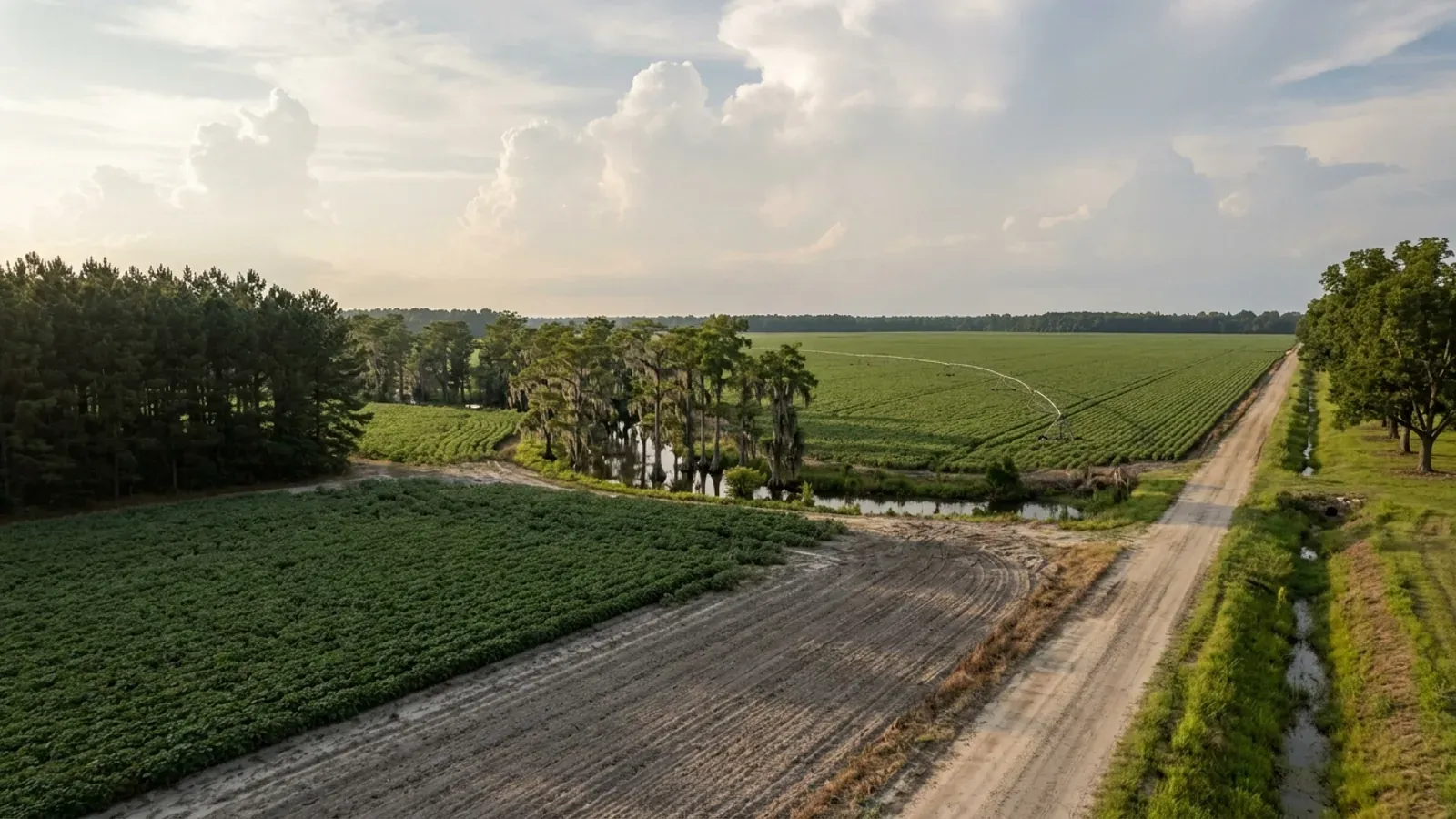
A very large flat South Carolina row-crop field with centre-pivot irrigation tracks, a sharp-edged pine plantation block, a cypress swamp along the creek and a straight dirt road.
Williamsburg County One statewide code, county design maps

Barndominium Builders in Williamsburg County, SC

Williamsburg County is the second-largest farmland base in South Carolina — 208,646 acres in farms, behind only Orangeburg — sitting roughly an hour from Charleston, Florence and the Grand Strand, in a county that has lost 4.4 percent of its people since the 2020 census. That combination is why the land is cheap here and why the acreage is real rather than notional. It is also one of only six South Carolina counties with no zoning ordinance, and the county does not treat that as a secret: the State's own April 2024 procurement document for a new comprehensive plan says outright that Williamsburg is one of the only remaining counties in the state without zoning. What governs your parcel instead is a short and knowable list. The 2003 Land Development Regulations, which regulate the subdivision of land and nothing else — the word zoning does not appear once in the fifty-page ordinance. The building code, enforced by the county Building Codes Department in Kingstree. The 2022 flood damage prevention ordinance, which works from a FEMA study dated 27 October 2022 and requires a development permit before any development activity in a mapped flood area. State septic regulation. And, on most tracts, your own deed. Two things make this county unusual for a barndominium and both are worth reading before you draw anything. The Building Codes Council's Williamsburg sheet is one of at least eight in the state carrying a 140 mph contour. And the county's own published design criteria do not read the same as the Council's map — which is a conversation to have at the counter, in writing, before a steel package is ordered.

Williamsburg County at a glance

County
Williamsburg County
Population
29,662

Building conditions in Williamsburg County

The building code is the same in every South Carolina county: S.C. Code § 6-9-10(A) requires each municipality and county to enforce the Building Codes Council's codes and to enforce only those, and SC Regulation 8-236(C) bars a local jurisdiction from writing one of its own. The design numbers are not local either, but they are not one number for the state — Regulations 8-1202 and 8-1203 send wind and seismic to the Council's own map for this county, and those maps are drawn as contours, so the figure is read at your address rather than off a county name. What is genuinely local is who issues the permit and inspects the work, what that office charges, the permit procedure it adopted by ordinance, whether your parcel is zoned at all, and the rest of Table R301.2 — frost depth, termite probability and flood — which the jurisdiction fills in for itself.

Build conditions for Williamsburg County , South Carolina : design wind speed The Building Codes Council's Williamsburg County sheet, Williamsburg 15(Mays).pdf, carries two blue wind contours labelled at both ends - a 140 MPH line running the length of the county from the north-eastern corner near the Great Pee Dee south-west to the Santee River on the southern boundary, and a shorter 130 MPH line entering at the Florence County line in the north-west near Beulah and Singleton Church and running west out of the county - together with seismic design category labels C, D0 and D1 lettered on both sides of two roughly east-west red boundaries, C to the north, D0 between them and D1 to the south. BUILD CONDITIONS WILLIAMSBURG COUN…Williamsburg CountyONE STATEWIDE CODEDESIGN WIND SPEEDThe Building Codes…Regs 8-1202 and 8-1203 replace IRC R301.2.1 and R301.2.2.1 with the South Carolina Building CodesCouncil's own county maps, and Williamsburg is one of the thirty-five counties that has one. The…ZONING · UNDEFINEDThere is no county zoning ordinance. Williamsburg is one of sixSouth Carolina counties without zoning, and the State says so…RESIDENTIAL BUILDING PERMIT$460 for the first $100,000 of valua…That is the third of four bands on the county's published BuildingPermit Fees sheet. The other bands: $1,000 to $50,000, a $50…WHO ISSUES THE PERMITWilliamsburg County Building Codes D…201 West Main Street, Suite 121, Kingstree SC 29556; 843-355-9321ext. 5300. The same office issues building permits, reviews plans,…
Build conditions for Williamsburg County, drawn from the sourced facts on this page. Every figure above is cited in the quick-facts panel below, with its source and vintage.
No zoning ordinance — and the State said so in writing before we did
Williamsburg County has no zoning. The county's only adopted land-use ordinance is its Land Development Regulations, and that document is explicit about what it is: the enacting clause reads "AN ORDINANCE GOVERNING THE SUBDIVISION OF LAND WITHIN UNINCORPORATED AREAS OF WILLIAMSBURG COUNTY, SOUTH CAROLINA, AND PROVIDING FOR DESIGN STANDARDS, REQUIRED IMPROVEMENTS AND ADMINISTRATION, ENFORCEMENT AND AMENDMENT THEREOF." Section 102 states the purpose as "the orderly development of Williamsburg County through the control and regulation of the subdivision of land," and Section 104 gives it jurisdiction over "all land subdivisions within the unincorporated area." It was approved by County Council on 21 January 2003; the copy the county posts on its own Code Enforcement Ordinances page is headed "(revised March 2007)," and a further amending ordinance, No. 2013-007, is posted alongside it. The whole fifty-page document was downloaded and searched: the word "zoning" occurs zero times in it. There is no district map, no permitted-use table, no rezoning procedure, no special exception and no board of zoning appeals, because no county document creates any of those things. This matters enough to corroborate from outside the county, and it can be. The South Carolina Office of Resilience's April 2024 Request for Qualifications for a Williamsburg County Comprehensive Plan — State Project No. D30-N043-MJ, funded from a HUD Community Development Block Grant-Mitigation grant — describes the county in its own words: "Williamsburg County is one of the only remaining counties in the state that does not currently have zoning, and in need of updates to its land development regulations and is seeking a comprehensive plan to pursue these updates." So read the direction of travel too: the county is actively planning, and what is true today is not guaranteed to be true in five years. Ask the Building Codes Department what has been adopted before you commit.

Williamsburg County Land Development Regulations, approved by County Council 21 January 2003 (posted copy headed "revised March 2007"), enacting clause and §§ 102 and 104, https://www.williamsburgcounty.sc.gov/DocumentCenter/View/1587/Ordinance-for-Land-Development-Regulations-PDF (application/pdf, 393,177 bytes, 50 pages, downloaded 6 September 2026 and read in both layout and reading-order extraction modes; zero occurrences of "zoning"); Ordinance No. 2013-007 Amending Land Development Regulations, https://www.williamsburgcounty.sc.gov/DocumentCenter/View/1803/Ordinance-No-2013-007-Amending-Land-Development-Regulations ; the county's own list of what it has adopted at Williamsburg County Code Enforcement, Ordinances, https://www.williamsburgcounty.sc.gov/548/Ordinances ; South Carolina Office of Resilience, "Request for Qualifications for Williamsburg County Comprehensive Plan," State Project # D30-N043-MJ, 1 April 2024, https://scor.sc.gov/sites/scor/files/Documents/Mitigation/RFQ%20_Williamsburg%20County%20Comprehensive%20Plan_Final_01APR24.pdf

The Council's Williamsburg sheet carries a 130 and a 140 mph contour, and three seismic categories
South Carolina takes wind speed and seismic design category away from the locality: Regulation 8-1202 replaces IRC Section R301.2.1 and Regulation 8-1203 replaces R301.2.2.1 with "the previously published maps by the South Carolina Building Codes Council." Williamsburg is one of the thirty-five counties for which such a map exists, and the sheet is worth describing properly rather than reducing to a number. The base is the SCDOT and Federal Highway Administration General Highway System map of Williamsburg County dated August 2005; the Council's overlay adds a boxed note reading "NOTE! Wind speed, shown in miles per hour, applies at all points along the length of its corresponding (blue) line. Interpolation between wind speed lines is determined by the AHJ as permitted by Figure R301.2(4)(A) of the 2015 International Residential Code." It carries two blue wind contours, each labelled at both ends. The 140 MPH line runs the length of the county from the north-eastern corner near the Great Pee Dee down to the Santee River on the southern boundary, roughly north-east to south-west, leaving the eastern part of the county on its seaward side. The 130 MPH line is much shorter: it enters at the Florence County line in the county's north-west, near Beulah and Singleton Church, and runs west out of the county. Williamsburg is one of at least eight county sheets in the state carrying a 140 mph line — the others are Charleston, Berkeley, Beaufort, Colleton, Dorchester, Horry and Marion. The seismic overlay is drawn the same way, as two red boundaries running roughly east to west with the categories lettered on both sides at both ends: C on the northern side of the upper line, D0 between the two, and D1 south of the lower one. So a Williamsburg parcel can read C, D0 or D1 depending on where it sits, and the number that applies to your tract comes from reading the sheet at your tract — with the Council's own note leaving interpolation between lines to the authority having jurisdiction. One thing not to infer from the 140 figure: IRC R301.2.1.1's 140 mph limb is qualified by "in a special wind region," no South Carolina county is established as a special wind region here, and both South Carolina jurisdictions publishing a completed Table R301.2 record "No" in that cell. A 140 mph reading does not by itself put a house outside prescriptive design.

SC Building Codes Council, "Wind/Seismic Maps", https://llr.sc.gov/bcc/maps.aspx ; the Williamsburg County sheet itself at https://llr.sc.gov/bcc/PDFfiles/WSMaps/Williamsburg%2015(Mays).pdf (application/pdf, 17,346,584 bytes, downloaded 6 September 2026; the note box and every "130 MPH", "140 MPH", "C", "D0" and "D1" label were read from the sheet's own text layer, and the two blue wind contours and two red seismic boundaries were reconstructed from the sheet's vector geometry and plotted against the county outline and the sheet's compass rose and 79°15'0" meridian tick to fix orientation); Regs 8-1202 and 8-1203 and the R301.2.1.1 special-wind-region qualification quoted from SC Building Codes Council, 2021 Code Modifications, https://llr.sc.gov/bcc/PDFfiles/2021-Code-Modifications.pdf

The county publishes design criteria of its own, and they do not read the same as the Council's map
This is the single most important thing to settle before anyone orders a frame for a Williamsburg County build, and it is a genuine conflict rather than a technicality. The county's own Building Codes and Plans Preparation page states: "Design criteria for plan submittal must meet a minimum of 102 to 110 miles per hour (mph) winds; 'D' Seismic for Commercial and 'D-2' Seismic for Residential." Set that against the Council's Williamsburg sheet, which carries 130 and 140 mph wind contours and letters the seismic categories C, D0 and D1. Two observations, and then the practical advice. On wind, the figures are reconcilable: 102 and 110 mph are almost exactly the allowable-stress-design equivalents of 130 and 140 mph ultimate under the standard IRC conversion in which the nominal speed is the ultimate speed multiplied by the square root of 0.6 — 130 gives 100.7 and 140 gives 108.5 — so the county page appears to be quoting the same two contours in the older nominal convention. On seismic they do not reconcile: the county page asks residential plans to be designed to D-2, and no part of the Council's Williamsburg map is lettered D2 at all. D-2 is the more onerous position, and the county is the authority having jurisdiction. The department also enforces its criteria concretely — its Residential Plan Overview requires that plans "include seismic requirements for the given area as well as wind load," that the foundation detail page be "designed for the seismic and wind load for the area that your property resides in," and that plans show hold-down strapping type and placement, uplift anchoring of the floor system and roof, gable-end bracing, and floor-to-floor uplift connections on two-storey work. A memo dated 11 July 2024 from the county Building Inspector adds that the county is now enforcing IRC Section M1307, so that in Seismic Design Category D water heaters and thermal storage units must be anchored or strapped against horizontal displacement. None of this is an argument to be had at the inspection. Take the Council sheet and the county page to plan review together, agree in writing which wind speed and which seismic design category the drawings are to carry, and have the engineer state the source on the drawings before the building is bought.

Williamsburg County Code Enforcement, "Building Codes & Plans Preparation", https://www.williamsburgcounty.sc.gov/195/Building-Codes-Plans-Preparation (served HTML retrieved 6 September 2026, 109,914 bytes; the design-criteria sentence is quoted from the page as served); Williamsburg County, "Residential Plan Overview", https://www.williamsburgcounty.sc.gov/203/Residential-Plan-Overview ; Williamsburg County Building Inspection Department memo, 11 July 2024, "Compliance with International Residential Code — Section M1307", https://www.williamsburgcounty.sc.gov/DocumentCenter/View/2034/Compliance-with-International-Residential-Code-Memo ; the Council map for comparison at https://llr.sc.gov/bcc/PDFfiles/WSMaps/Williamsburg%2015(Mays).pdf and Regs 8-1202 and 8-1203 at https://llr.sc.gov/bcc/PDFfiles/2021-Code-Modifications.pdf

208,646 acres in farms — the second-largest farmland base in South Carolina
Only Orangeburg County operates more farmland than Williamsburg County does. The 2022 Census of Agriculture counts 530 farms in Williamsburg working 208,646 acres at an average of 394 acres, which is 34.9 percent of the county's 597,866 land acres — ninth-highest share in the state, but second-highest in absolute acreage behind Orangeburg's 230,111 and ahead of Anderson, Sumter and Darlington. The five-year direction is the quietly interesting part. Between 2017 and 2022 the number of farms fell 4 percent and the average size rose 4 percent, while land in farms did not move at all: zero percent change. The acreage base is not leaving agriculture here; it is simply being worked by slightly fewer and slightly larger operations. Inside that base the land use splits into 106,476 acres of cropland, 90,350 of woodland, 8,996 of other uses and 2,824 of pastureland, which sum exactly to the 208,646-acre total. That woodland figure is the one to notice if you are buying: 43 percent of the county's farmland is trees, so a great deal of what is for sale as "farm" here is timbered ground that will need clearing, and the clearing cost belongs in the budget before the slab does. The size distribution is unusually favourable to someone wanting a workable tract rather than a homesite: 39 farms of 1 to 9 acres, 122 of 10 to 49, 155 of 50 to 179, 110 of 180 to 499, 43 of 500 to 999 and 61 of 1,000 or more. And the county is emphatically a crop county — crops are 93 percent of the value of what is sold, against 7 percent for livestock and poultry, with soybeans on 42,831 acres, cotton on 19,778 and corn for grain on 16,175. It ranks fourth in the state in tobacco and fifth in cotton. All of this is happening in a county that is losing people: 29,662 residents estimated for 2025 against 31,026 at the 2020 census, a fall of 1,364 or 4.4 percent. Falling population and a flat farmland base is precisely the arithmetic that keeps land cheap.

USDA National Agricultural Statistics Service, 2022 Census of Agriculture County Profile — Williamsburg County, South Carolina, https://www.nass.usda.gov/Publications/AgCensus/2022/Online_Resources/County_Profiles/South_Carolina/cp45089.pdf (application/pdf, 879,943 bytes, downloaded 6 September 2026 and read in both reading-order and layout extraction modes; the three percentage-change figures are quoted from the reading-order render, where label, value and percent print on one line, and the four land-use figures were checked to sum exactly to the total); the statewide farmland comparison from research/statewide/geography-and-population.md, built on the same census joined to the 2025 Census Gazetteer county file, https://www2.census.gov/geo/docs/maps-data/data/gazetteer/2025_Gazetteer/2025_gaz_counties_45.txt ; population from U.S. Census Bureau Vintage 2025 county population estimates, https://www2.census.gov/programs-surveys/popest/datasets/2020-2025/counties/totals/co-est2025-alldata.csv

The published permit fee schedule, band by band
Williamsburg County posts a one-page Building Permit Fees sheet, and it is short enough to read in full. On the building permit itself there are four valuation bands. From $1,000 to $50,000: a $50 minimum, $15 for the first $1,000 plus $5 per additional $1,000 up to $50,000. From $50,000 to $100,000: $260 for the first $50,000 and $4 per additional $1,000 up to $100,000. From $100,000 to $500,000: $460 for the first $100,000 and $3 for each additional $1,000 up to $500,000. And $500,000 and up: $1,660 for the first $500,000 and $2 for each additional $1,000. Plan review is listed as one-half of the permit fee. A re-inspection fee of $50 is listed. A moving fee is $100 and a demolition fee is $100 flat. Manufactured homes are separate — $50 to move, $150 for a singlewide and $200 for a doublewide. The plat fee is $25 per lot residential and $50 commercial. The sheet also carries a short block of per-square-foot figures attached to particular structure types — decks $15 per square foot, porches $25, accessory structures $30 and private garages $43.33 — which read as the valuation rates the department applies to those structures when working out the permit fee rather than as fees in themselves; on a large shop bay that distinction is worth several thousand dollars, so ask the permit technician to walk through the calculation on your own drawings before you budget it. Septic is not in any of this: it is a separate state permit under S.C. Regulation 61-56. The county also charges a water availability fee under Ordinance No. 2015-007 and runs a business registration under Ordinance No. 2007-001.

Williamsburg County Building Codes Department, "Building Permit Fee Schedule" (PDF), https://www.williamsburgcounty.sc.gov/DocumentCenter/View/134/Building-Permit-Fee-Schedule-PDF (application/pdf, 183,260 bytes, downloaded 6 September 2026 and read in both layout and reading-order extraction modes, which agree); linked from Williamsburg County, "Inspections, Permits & Applications", https://www.williamsburgcounty.sc.gov/198/Inspections-Permits-Applications ; Ordinance No. 2015-007 Water Availability Fee, https://www.williamsburgcounty.sc.gov/DocumentCenter/View/1804/Ordinance-No-2015-007-Water-Availability-Fee ; S.C. Regulation 61-56, https://des.sc.gov/sites/des/files/Library/Regulations/R.61-56.pdf

This county does publish a farm structure affidavit — and a barndominium can never use it
Williamsburg County is one of the South Carolina counties that publishes a Farm Structure Building Permit Affidavit as a downloadable form, listed on its own Inspections, Permits and Applications page beside the fee schedule. That makes the myth more tempting here than in a county with no such form, so it is worth being precise about what the affidavit is and what it is not. The county's form quotes the statute it rests on: S.C. Code § 6-9-65(C), which requires that "before constructing a farm structure, the person owning the property on which the structure is to be constructed files an affidavit with the county or municipal official responsible for enforcing the building code stating that the structure is being constructed as a farm structure. The affidavit must include a statement of purpose or intended use of the proposed structure or addition." The form asks for a statement of purpose, the tax map identifier and a farm or agricultural number, and the signer acknowledges in terms that "the construction of the structure will NOT be inspected in any way by the Williamsburg County Building Department other than the electrical point of delivery if required." Now the part that settles it. Subsection (A) of the same statute defines a farm structure as one built on a farm "other than a residence or a structure attached to it." A barndominium is a residence, so it is outside the exemption from the first day, and the shop half of a shouse is outside it too because it is attached to a residence. There is no square-footage test and no percentage-of-use test to argue with, and the definition expressly excludes a structure that originally qualified "but later converted to another use" — which is exactly what a later finish-out would be. Signing that affidavit for a building you intend to live in is a false statement of purpose on a county form, and it also buys you a building with no inspections behind it, which is the last thing a lender or an insurer wants to see. Permit the building as a dwelling from the start, with the shop bay in the drawings.

Williamsburg County Building Codes Department, "Farm Structure Building Permit Affidavit", https://www.williamsburgcounty.sc.gov/DocumentCenter/View/2033/Farm-Structure-Building-Permit-Affidavit (application/pdf, 43,027 bytes, downloaded 6 September 2026; a single scanned page, read at native resolution); listed at Williamsburg County, "Inspections, Permits & Applications", https://www.williamsburgcounty.sc.gov/198/Inspections-Permits-Applications ; S.C. Code § 6-9-65, https://www.scstatehouse.gov/code/t06c009.php

Also worth knowing before you build in Williamsburg County

What the Land Development Regulations actually require, if you are dividing land
The Land Development Regulations bite only when land is subdivided, but when they do they set real numbers, and those numbers are the closest thing Williamsburg County has to a minimum lot size. Section 403.2 provides that where public water or sewer is not reasonably accessible, lots "shall meet the minimum requirements of all public health regulations, but in no case shall be less than one (1) acre in size for lots utilizing a well and septic tank, nor less than twenty-five thousand (25,000) square feet for lots with public water and a septic tank," with lots on both public water and sewer no less than 60 feet wide and 6,000 square feet. Section 403.1 requires every lot to front for a minimum of fifty feet on a street, or thirty feet on a cul-de-sac or loop street. Section 204.4 creates a Minor Subdivision route that is genuinely useful on family land: up to six lots, each at least one acre, "to enable rural land owners to subdivide property for transfer to family members," with private streets built and maintained by the subdivider to a minimum twenty-foot roadway and no dedication of right-of-way required — but a seventh lot triggers the full roadway standards and a dedicated right-of-way. Section 405 lets the Planning Commission refuse to approve a subdivision at all where the site "is not suitable for platting and development purposes of the kind proposed," and provides that land prone to frequent floods or topographically unsuitable "shall not be platted for residential occupancy." Section 408 requires a registered engineer's report for any part of a subdivision inside the 100-year floodplain shown on the county's Flood Insurance Rate Map. Section 409 makes a subdivision of a parent tract under five acres show the surveyed boundaries of the parent tract as well as the new lots. What the ordinance never does is set a setback, a building height, or any rule sizing an accessory building against a dwelling — and if your tract already exists as a lot of record and you are not dividing it, none of Article IV applies to you at all.

Williamsburg County Land Development Regulations, §§ 204.4, 403.1, 403.2, 405, 408 and 409, https://www.williamsburgcounty.sc.gov/DocumentCenter/View/1587/Ordinance-for-Land-Development-Regulations-PDF (read in full 6 September 2026)

In a mapped flood area the development permit comes before anything else
The one county land-use rule that really does bite on a Williamsburg parcel is the floodplain, and the county rewrote it recently. Ordinance No. 2022-07 amends Ordinance No. 2012-009 and establishes the county's flood damage prevention ordinance. Article I.D applies it "to all areas of special flood hazard within the jurisdiction of Williamsburg County as identified by the Federal Emergency Management Agency (FEMA) in its Flood Insurance Study, dated October 27, 2022, with accompanying maps and other supporting data," adopted by reference. Article I.E is short and absolute: "A Development Permit shall be required in conformance with the provisions of this ordinance prior to the commencement of any development activities." Article I.G adds that where the ordinance and another rule conflict or overlap, "whichever imposes the more stringent restrictions, shall prevail," and expressly says the ordinance is not intended to repeal or impair existing easements, covenants or deed restrictions. This is not a marginal issue in this county. The State's own description of Williamsburg is a county "bordered to the east by the Great Pee Dee River, the south by the Santee River, and … bisected by the Black River and Black Mingo Creek," located about twenty-five miles from the coast and "often subject to impacts from tropical storms and hurricanes." The cheapest acreage in a county like that is very often bottomland, and a wide slab-on-grade building is exactly the shape that is awkward and expensive to elevate after the fact. The county's own permit guidance also notes that a Flood Elevation Certificate is needed for A and AE zones. Check the flood map before you make an offer, not after.

Williamsburg County Ordinance No. 2022-07, Flood Damage Prevention, Article I.A, I.D, I.E and I.G, https://www.williamsburgcounty.sc.gov/DocumentCenter/View/1796/Ordinance-No-2022-07-Flood-Damage-Prevention (application/pdf, 1,934,966 bytes, 33 pages, downloaded 6 September 2026; a scanned document, pages read as images at native resolution); the elevation certificate note at Williamsburg County, "Inspections, Permits & Applications", https://www.williamsburgcounty.sc.gov/198/Inspections-Permits-Applications ; the county's river geography quoted from South Carolina Office of Resilience, Request for Qualifications for Williamsburg County Comprehensive Plan, 1 April 2024, https://scor.sc.gov/sites/scor/files/Documents/Mitigation/RFQ%20_Williamsburg%20County%20Comprehensive%20Plan_Final_01APR24.pdf

Williamsburg is NOT in the coastal zone, however coastal it feels
It is twenty-five miles from the ocean, it drains to the Santee and the Great Pee Dee, and its Council wind map carries the same 140 mph contour as Charleston's. None of that puts Williamsburg County in South Carolina's coastal zone, and the distinction is worth a paragraph because getting it wrong costs a permit cycle. The coastal zone is a closed statutory list of eight counties, and the South Carolina Department of Environmental Services states the number itself repeatedly — the Bureau of Coastal Management protects the state's coastal resources "in the eight coastal counties of South Carolina," and Coastal Zone Consistency review runs "within South Carolina's eight (8) coastal counties." Williamsburg is not among them. So there is no OCRM Critical Area line on a Williamsburg tract, no critical area permit, and no coastal zone consistency certification on a house build here — the neighbouring counties of Georgetown, Berkeley and Charleston are inside that boundary and Williamsburg is not. What does apply on the water side is ordinary: the flood ordinance, federal wetlands jurisdiction where a tract holds wetlands, and the state stormwater rules once land disturbance reaches an acre. Do not let anyone sell you a coastal permit you do not need, and do not assume the reverse either — check the flood map and check for wetlands on the specific parcel.

SC Department of Environmental Services, Bureau of Coastal Management, https://des.sc.gov/programs/bureau-coastal-management ; SC Coastal Zone Management Program, https://des.sc.gov/south-carolina-coastal-zone-management-program ; Coastal Zone Consistency Certification, https://des.sc.gov/programs/bureau-coastal-management/coastal-zone-consistency-certification ; the eight-county list as compiled in research/statewide/land-water-and-septic.md

Outer Coastal Plain ground: the water table is the foundation decision
Williamsburg County sits in the Inner and Outer Coastal Plain, and the thing that decides a foundation here is not bearing capacity but water. The dominant soils across this belt are the wet flatwoods series — Lynchburg, Rains, Coxville, Rembert, Wahee and their relatives — and across the Outer Coastal Plain counties the seasonal water table sits roughly six to eighteen inches below grade from November through April. On that kind of ground the height of the building pad is the foundation decision, not an afterthought: fill volume, compaction and the drainage away from the pad are where the money goes, and an embedded-post foundation that spends half the year in saturated soil may simply be the wrong system for the site. Septic is permitted by the South Carolina Department of Environmental Services under Regulation 61-56, not by the county, and it is the septic evaluation rather than any county rule that will decide how small a workable tract can be. Below the Fall Line the evaluation is done with hand borings rather than backhoe pits, and § 200.5 disqualifies a site where a restrictive horizon or the seasonal high water table sits too close to the trench bottom — which on a Coastal Plain parcel is the common failure, and it is invisible from the surface in August. Section 200.6 keeps no part of the system within five feet of a building or a property line, 75 feet of a private well, 100 feet of a public well or 25 feet of a drainage ditch, and § 200.7(1) requires a usable repair area equal to at least half the original system. On a wide barndominium footprint that arithmetic, not a setback line, is usually what fixes where the pad goes. Get the soil evaluation done before you close, and if you can, walk the tract in a wet month.

S.C. Regulation 61-56, Onsite Wastewater Systems, §§ 200.5, 200.6 and 200.7(1), https://des.sc.gov/sites/des/files/Library/Regulations/R.61-56.pdf ; SC Department of Environmental Services, Professional Soil Classifiers, https://des.sc.gov/permits-regulations/septic-tanks/professional-soil-classifiers ; the Outer Coastal Plain soil-series and water-table profile from research/statewide/soils-and-geology.md, built on USDA-NRCS SSURGO acreage by survey area

Where you permit, who inspects, and what the county wants on the drawings
Permits for unincorporated Williamsburg County come from the Williamsburg County Building Codes Department at 201 West Main Street, Suite 121, Kingstree, on 843-355-9321 extension 5300. The department was established in 1999 and its jurisdiction is the unincorporated county; the Town of Kingstree runs its own building and fire codes function inside the town limits. The county enforces the State's codes and says so plainly — the latest South Carolina adopted versions of the International Building, Energy Efficiency, Fire, Gas, Mechanical, Plumbing and Residential Codes, the National Electrical Code and the Property Maintenance Code — which is what S.C. Code § 6-9-10(A) requires of every county, and Ordinance No. 2022-08 is the county's amended building and fire codes ordinance. Building plans must be designed by a South Carolina licensed design professional for residential work beyond the scope of the adopted codes and for all commercial occupancies. The submittal is two copies each of site plans and building plans, with the site plan showing the location of the proposed construction to all property lines, dimensioned from the exterior wall to each line. The county wants a great deal of structural detail on a residential set: foundation depth and width, rebar, bond beams, hold-down strapping type, brand, length and placement, pier sizing, stem wall reinforcement and embedment, crawl space ventilation, anchoring of the floor system for uplift and lateral movement with specific sizes and brands, framing member spans and spacing, a window schedule, all four elevations, gable end wall bracing, wall sheathing and siding, and roof anchoring for wind uplift. Inspections run in a published sequence — building, electrical, plumbing, mechanical, gas and insulation, then insulation, then fire sprinkler and alarm where applicable. One rule catches owner-builders here: a homeowner pulling their own permit may use family members, not friends, to help; anyone under contract must be licensed for the full dollar amount of the contract, and a specialty contractor licence covers work only up to $5,000.

Williamsburg County Code Enforcement, "Building Codes & Plans Preparation", https://www.williamsburgcounty.sc.gov/195/Building-Codes-Plans-Preparation ; "Residential Plan Overview", https://www.williamsburgcounty.sc.gov/203/Residential-Plan-Overview ; "Inspections, Permits & Applications", https://www.williamsburgcounty.sc.gov/198/Inspections-Permits-Applications (all read 6 September 2026); Ordinance No. 2022-08, Amended Building and Fire Codes, https://www.williamsburgcounty.sc.gov/DocumentCenter/View/1797/Ordinance-No-2022-08-Amended-Building-and-Fire-Codes ; the town's own function at Town of Kingstree, Building & Fire Codes, https://kingstree.org/building-fire-codes/ ; S.C. Code § 6-9-10, https://www.scstatehouse.gov/code/t06c009.php

The manufactured home rules are the one place the county already regulates a building on a lot
Article VI of the Land Development Regulations is the exception to everything else on this page: it is a set of county controls that apply to a structure on an individual parcel rather than only to a subdivision, and it is worth knowing because it shows what the county's enforcement machinery already does. Section 600 says its criteria are "site development criteria for site within Williamsburg County for manufactured homes," in addition to the rest of the regulations. Section 601 makes it unlawful to install or store a manufactured home on any parcel in the county without a permit from the Building Inspection/Code Enforcement Department, unlawful to move one from site to site without a certification statement, setup permit, decal or moving permit, and it bars any power company from connecting power without an electric power release from the same department. A pre-1976 unit from outside the county may not be brought in at all, although one already on the Williamsburg County tax rolls may be relocated within it. No installation permit issues without approval of a potable water system and a sewage effluent system by the state health authority. Section 602 requires underpinning around the entire exterior and permanent steps and landings to at least one entrance before power release. Section 603 gives ninety days to replace a non-conforming unit on an individual lot, extendable once by thirty days for hardship. None of this reaches a site-built or steel-framed barndominium — but the power-release gate is the same lever the department holds on any build, and it is the reason an unpermitted shell does not get energised in this county.

Williamsburg County Land Development Regulations, Article VI, §§ 600, 601, 602 and 603, https://www.williamsburgcounty.sc.gov/DocumentCenter/View/1587/Ordinance-for-Land-Development-Regulations-PDF (read in full 6 September 2026); Williamsburg County, "Manufactured Home Requirements", https://www.williamsburgcounty.sc.gov/DocumentCenter/View/1558/Manufactured-Home--Requirements
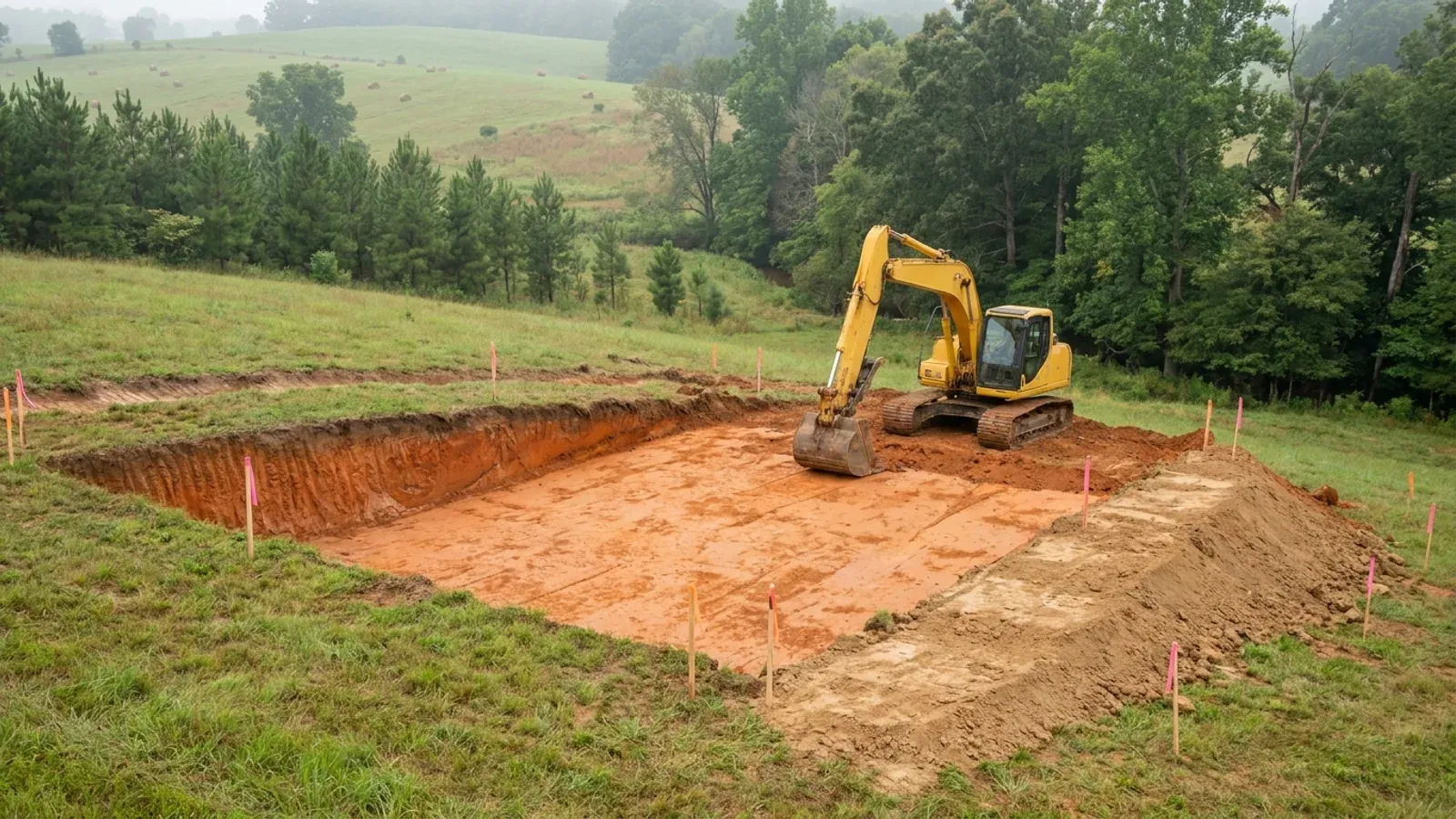
An excavator grading a compacted building pad on a cleared lot, with orange clay in the cut face, survey stakes and a drainage swale.
Below the slab

The expensive surprises are in the ground, not the building

What moves a South Carolina budget is usually below grade, and more often than not it is the drainfield rather than the foundation. R.61-56 § 200.1 settles whether a parcel can take an onsite system from soil morphology — texture, structure, depth to a restrictive horizon and depth to the zone of saturation — and § 200.2 then rules out two conditions outright: soils exhibiting massive or platy structure, and soils with substantial amounts of expansible layer clay minerals or smectites. That second clause is the one that bites on the mafic Piedmont, where the shrink-swell series sit in quantity under York, Fairfield, Chester, Laurens, Union, Newberry, Greenwood, McCormick, Lancaster, Saluda, Abbeville and Edgefield. A foundation problem has a price and an answer; an unbuildable septic parcel has neither, which is why we look at it first. Bedroom count is the number to settle early, because § 61-56.501 drives design flow from bedrooms, design flow drives trench length, and trench length plus a repair area decides how much good soil the parcel has to have — shop square footage adds nothing to it. Above the Fall Line the evaluation is done in backhoe pits rather than borings alone, so the answer comes from a dug hole and not a form. The site work, the foundation and the drainfield therefore get resolved together rather than one at a time. We price the dirt before we price the building.

What a build looks like

Three stages every Williamsburg County project passes through, from a raw parcel to a finished home. Site work first, because that is where the budget is decided.
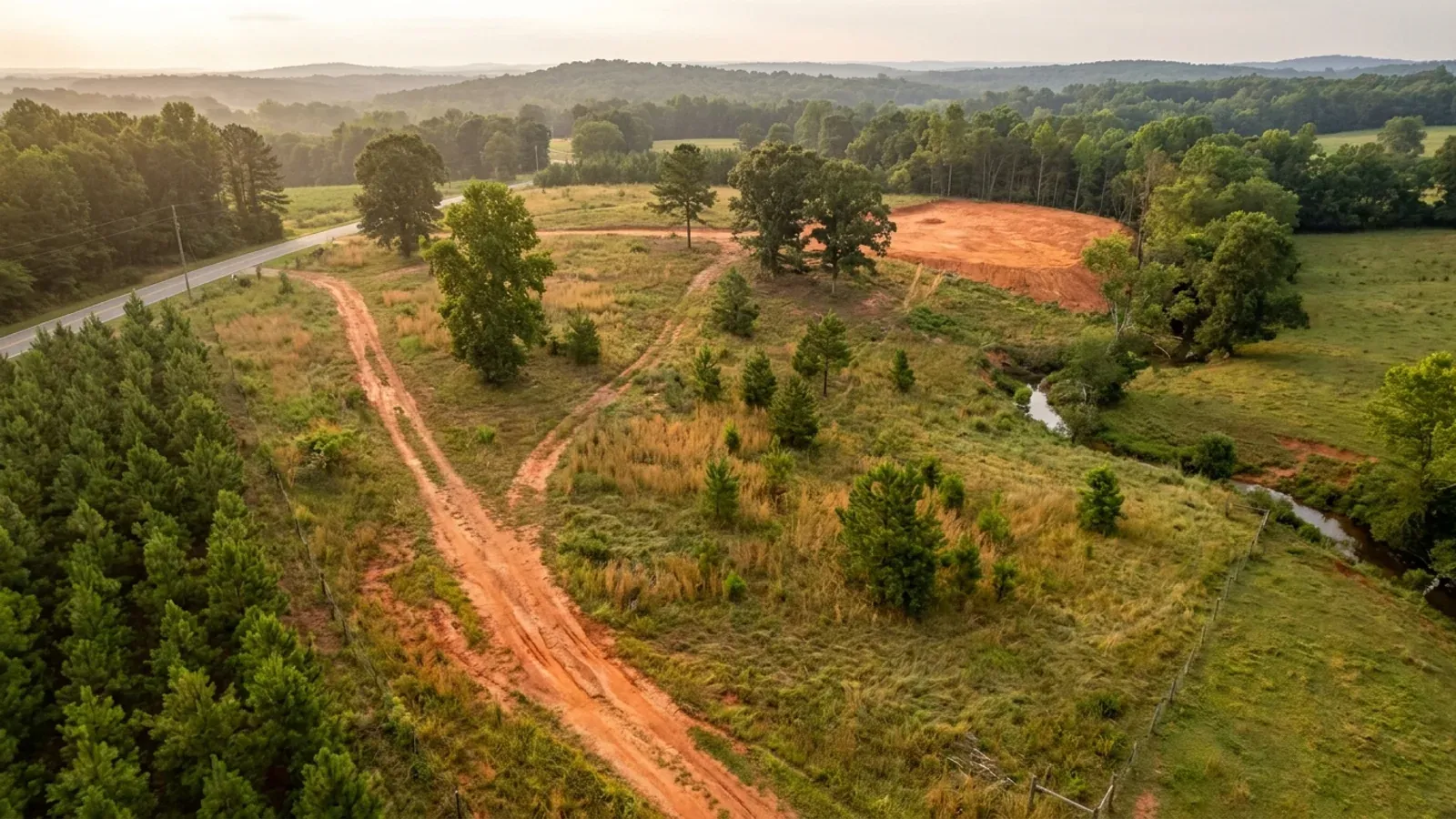
Aerial view of an undeveloped rural lot with cleared rough grass, planted pine along one boundary, and a red dirt access track cut through orange clay.
Stage one

The parcel

Zoning, setbacks, flood zone and utility access get checked before anything is drawn.

An excavator grading a compacted building pad on a cleared lot, with orange clay in the cut face, survey stakes and a drainage swale.
Stage two

Pad and permit

Clearing, grading and a compacted pad, while the submittal works through whichever office issues the permit where you are building.
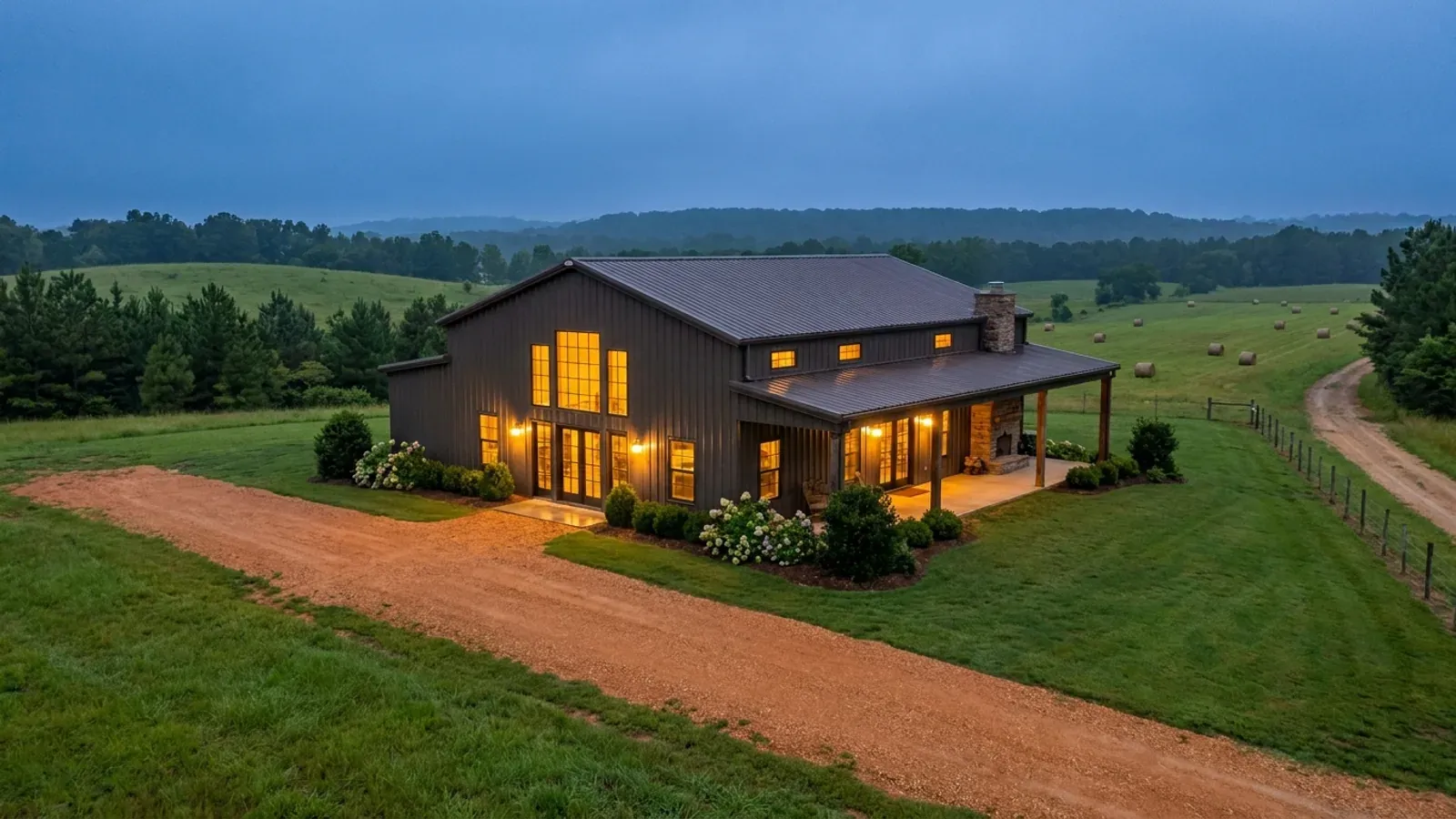
A finished barndominium at dusk with warm interior lighting glowing through its large windows.
Stage three

Frame to finish

Shell erected and dried in, then systems, insulation and interior finish through to CO.

Those are the rules where you are building in Williamsburg County. Tell us what you want to build and we will draw it to them.

Nearby areas we build in

Others we cover nearby. One may be a county and another a municipality inside one — and a South Carolina municipality can sit in two counties at once — so the office that issues the permit, the fees it charges, whether the land is zoned at all, and which design map covers it can all differ from one card to the next.

Building in Williamsburg County: common questions

8 questions we get asked most often about building in Williamsburg County. If yours is not on the list, ask it directly.

Williamsburg County really has no zoning? What stops my neighbour — or stops me?
It really does, and you do not have to take our word for it. The State's own April 2024 procurement document for a new Williamsburg County comprehensive plan says the county "is one of the only remaining counties in the state that does not currently have zoning, and in need of updates to its land development regulations." The county's only land-use ordinance is its Land Development Regulations, approved in January 2003, and that document's own enacting clause describes it as an ordinance governing the subdivision of land within the unincorporated areas — the word "zoning" appears nowhere in its fifty pages. So there is no district on your parcel, no permitted-use table, no accessory-structure ratio, no height cap, no rezoning, no special exception and no board of zoning appeals; and the same is true of the parcel next door. What still applies is real enough. The building code, which every South Carolina county must enforce under S.C. Code § 6-9-10(A) and which the county Building Codes Department in Kingstree enforces here. The flood damage prevention ordinance, Ordinance No. 2022-07, which requires a development permit before any development activity in a mapped special flood hazard area. The Land Development Regulations themselves, if you are dividing land. The manufactured home article, if that is what you are placing. And the state septic regulation. Two practical consequences follow. First, on most tracts the recorded covenants and deed restrictions are the only land-use rules that apply, so read the title work carefully — in an unzoned county they carry all the weight. Second, this is not permanent: the county is actively procuring a comprehensive plan with State funding, precisely in order to update its land development regulations. Ask the Building Codes Department what has been adopted before you commit.
So how far from the property line does my building have to sit?
No county-adopted document answers that question for an existing lot of record in unincorporated Williamsburg County, and it is better to say that plainly than to dress it up. There is no county setback ordinance, no height limit, and no minimum lot size that applies to a tract you already own — the one-acre figure in § 403.2 of the Land Development Regulations applies to newly created lots on a well and septic tank, and the 25,000 square foot figure to newly created lots on public water with a septic tank. What will actually position your building is a short list. The septic system, because S.C. Reg 61-56 § 200.6 keeps no part of it within five feet of a building or a property line, 75 feet of a private well or 25 feet of a drainage ditch, and § 200.7(1) requires a usable repair area equal to at least half the original system; on a wide barndominium footprint that arithmetic, not a setback line, is what decides where the pad goes. The flood map, if any part of the tract is in a special flood hazard area under the FEMA study dated 27 October 2022. Your access. And your deed — covenants, building lines shown on a recorded plat, and utility or access easements are enforceable against you whether or not the county has an ordinance. The county's own submittal rule still makes you draw it: the site plan must show the location of the proposed construction to all property lines, dimensioned from the exterior wall to each line, in two copies.
Can the shop be bigger and taller than the house?
Yes. In a zoned county this is usually decided by a district table capping a detached accessory building at some fraction of the dwelling's floor area and at a fixed height. There is no such table in Williamsburg County, because there is no zoning ordinance, and the Land Development Regulations set no height limit and no accessory-structure floor-area cap either. What does bind you is the building code as this county enforces it, and here the design criteria are the live question rather than the dimensions — the Council's Williamsburg sheet carries 130 and 140 mph wind contours and seismic categories C, D0 and D1, while the county's own page asks for 102 to 110 mph and D-2 seismic on residential plans. A long clear span over a shop bay is exactly where those numbers show up in steel tonnage and connection detailing, so agree them in writing before the frame is priced. Beyond that the constraints are physical rather than regulatory: the septic setbacks and required repair area, which on a wide building are usually the binding limit; the flood map, if the tract touches one of the county's river bottoms; your own covenants; and the water table, because on Outer Coastal Plain ground the height of the pad is a real cost. One planning note that saves argument later: if the shop and the living space share one continuous roof there is no accessory building in the picture at all — the whole thing is simply the dwelling, permitted as a dwelling.
What design wind speed and seismic category should my engineer use in Williamsburg County?
This one needs care, because two South Carolina bodies publish different-looking answers for this county and you need both in the room. Start with the authoritative one. South Carolina does not use the residential code's national maps for houses: Regulation 8-1202 replaces IRC R301.2.1 and Regulation 8-1203 replaces R301.2.2.1 with "the previously published maps by the South Carolina Building Codes Council." Williamsburg has such a map, and it is a contour sheet rather than a single value. It carries a 140 MPH line running the length of the county from the north-eastern corner near the Great Pee Dee south-west to the Santee River, and a shorter 130 MPH line clipping the north-western corner at the Florence County line. Seismic is lettered C, D0 and D1 across two roughly east-west boundaries, with the higher categories to the south. The sheet's own note says the wind speed applies at all points along its line and that interpolation between lines is for the authority having jurisdiction. Williamsburg is one of at least eight county sheets in the state carrying a 140 mph line. Now the county's own answer. Its Building Codes and Plans Preparation page states that design criteria for plan submittal must meet a minimum of 102 to 110 mph winds, with D seismic for commercial and D-2 seismic for residential. On wind those two figures are the allowable-stress-design equivalents of 130 and 140 mph ultimate under the standard conversion — nominal equals ultimate times the square root of 0.6, so 130 gives 100.7 and 140 gives 108.5 — which is to say the county appears to be quoting the same two contours in the older convention. On seismic they genuinely differ: nothing on the Council's Williamsburg map is lettered D2, and D-2 is the more onerous position. The county is the authority having jurisdiction and the one who signs your permit. So do this: take the Council sheet and the county page to plan review together, agree in writing which wind speed and which seismic design category the drawings will carry, and have the engineer state the source and the values on the drawings. The county already enforces the downstream consequences — a Building Inspector's memo of 11 July 2024 records that it is now enforcing IRC M1307, so in Seismic Design Category D water heaters and thermal storage units must be anchored or strapped against horizontal displacement. And do not let anyone tell you a 140 mph reading puts the house outside prescriptive design: that limb of R301.2.1.1 is qualified by "in a special wind region," and both South Carolina jurisdictions publishing a completed Table R301.2 record "No" in that cell.
Can I build the shell as a farm building and finish the living space later? The county has a form for it.
It does have a form, and that is exactly why this needs a straight answer: no. Williamsburg County publishes a Farm Structure Building Permit Affidavit, listed on its Inspections, Permits and Applications page. The form quotes S.C. Code § 6-9-65(C), which requires the owner to file an affidavit before constructing a farm structure, stating that the structure is being constructed as a farm structure and including a statement of purpose or intended use. But subsection (A) of the same statute defines a farm structure as one built on a farm "other than a residence or a structure attached to it." A barndominium is a residence, so it is outside the exemption from the first day, and the shop half of a shouse is outside it too because it is attached to a residence. There is no square-footage test and no percentage-of-use test to work with, and the definition expressly excludes a structure that originally qualified "but later converted to another use" — which is precisely what a later finish-out is. There are two further reasons not to try it here. Signing the county's affidavit for a building you intend to live in is a false statement of purpose on a county form. And the affidavit's own text tells you what you would be buying: the signer acknowledges that the structure "will NOT be inspected in any way by the Williamsburg County Building Department other than the electrical point of delivery if required" — an uninspected building, which is a problem for a lender, an insurer and eventually a buyer. There is also a practical gate: the county's manufactured home provisions show the same lever it holds on any build, barring a power connection without an electric power release from the department. Permit the building as a dwelling from the start, with the shop bay in the drawings.
What will the county charge me?
The county posts a one-page Building Permit Fees sheet and it is short enough to check yourself. The permit runs on total valuation in four bands. From $1,000 to $50,000: a $50 minimum, $15 for the first $1,000 plus $5 per additional $1,000. From $50,000 to $100,000: $260 for the first $50,000 plus $4 per additional $1,000. From $100,000 to $500,000: $460 for the first $100,000 plus $3 for each additional $1,000. And $500,000 and up: $1,660 for the first $500,000 plus $2 for each additional $1,000. Plan review is listed as one-half of the permit fee, which is the line people forget. Re-inspections are $50. A moving fee is $100 and a demolition fee is $100 flat. Manufactured homes are priced separately — $50 to move, $150 singlewide, $200 doublewide — and the plat fee is $25 per residential lot. The sheet also carries a short block of per-square-foot figures against particular structure types: decks $15, porches $25, accessory structures $30 and private garages $43.33. Those read as valuation rates the department applies when working out the permit fee rather than as fees in themselves, and on a large shop bay the difference between those two readings is thousands of dollars — so ask the permit technician to walk the calculation through on your own drawings before you budget it. No impact fee appears anywhere on the schedule. A water availability fee exists separately under county Ordinance No. 2015-007, and septic is a separate state permit under Regulation 61-56 that is not part of any of this.
The land is cheap here. What am I actually buying?
You are buying into the second-largest farmland base in South Carolina in a county that is losing people, which is the whole reason the price is what it is. The 2022 Census of Agriculture counts 530 farms on 208,646 acres at an average of 394 acres — 34.9 percent of the county's land area, and second in the state only to Orangeburg's 230,111 acres. Between 2017 and 2022 the number of farms fell 4 percent and the average size rose 4 percent while land in farms did not move at all, so the acreage base is stable and simply held in slightly fewer hands. Meanwhile the population fell from 31,026 at the 2020 census to an estimated 29,662 in 2025, down 4.4 percent. Two things to know before you go looking. First, 90,350 of those 208,646 farm acres are woodland — 43 percent — so a great deal of what is advertised here as farm is timbered ground, and the clearing cost belongs in the budget alongside the slab. The rest is 106,476 acres of cropland, 8,996 of other uses and 2,824 of pasture, and those four figures sum exactly to the total. Second, the size distribution genuinely suits a barndominium buyer: 122 operations of 10 to 49 acres and 155 of 50 to 179, so 316 of the county's 530 farms are under 180 acres. Location is the other half of the case. The State describes Williamsburg as about twenty-five miles from the coast, bordered east by the Great Pee Dee and south by the Santee, bisected by the Black River and Black Mingo Creek. Kingstree sits within reach of Charleston, Florence and the Grand Strand without being priced by any of them. What the rivers give in price they take back in flood exposure and in water table, so the order of operations on a Williamsburg tract is: check the flood map, get the septic soil evaluation before you close rather than after, and price the pad height honestly.
Is Williamsburg County in the coastal zone? Do I need an OCRM permit?
No, and it is worth being definite about because everything about the county invites the opposite guess. It is twenty-five miles from the ocean, it drains to the Santee and the Great Pee Dee, and its Building Codes Council wind sheet carries the same 140 mph contour that Charleston's does. None of that puts it in South Carolina's coastal zone. The coastal zone is a closed statutory list of eight counties, and the South Carolina Department of Environmental Services states the number itself: the Bureau of Coastal Management protects the state's coastal resources "in the eight coastal counties of South Carolina," and coastal zone consistency review runs "within South Carolina's eight (8) coastal counties." Williamsburg is not one of them, although three of its neighbours — Georgetown, Berkeley and Charleston — are. So there is no OCRM Critical Area line on a Williamsburg tract, no critical area permit, and no coastal zone consistency certification on a house build here. What does apply is ordinary and still worth checking: the county flood ordinance and the FEMA study dated 27 October 2022, federal wetlands jurisdiction where a tract holds wetlands, and the state construction stormwater rules once land disturbance reaches an acre. Do not buy a coastal permit you do not need — and do not skip the flood map on the strength of it.

Building in Williamsburg County?

Start with the plan. Tell us what you want to build and we will draw it, then confirm which office issues the permit for your parcel, what it will let you put there, and what wind load it has to meet. That conversation costs nothing.